
In today’s fast-evolving markets, innovation is no longer confined to isolated labs or engineering departments. The most successful companies recognize that breakthrough products don’t emerge solely from technical brilliance—they result from deep alignment between research and development (R&D) and marketing. When these two functions operate in silos, organizations risk developing solutions that are technically impressive but commercially irrelevant. Integrating R&D and marketing transforms innovation from a gamble into a strategic, market-driven process.
The Innovation Gap: When Great Ideas Miss the Market
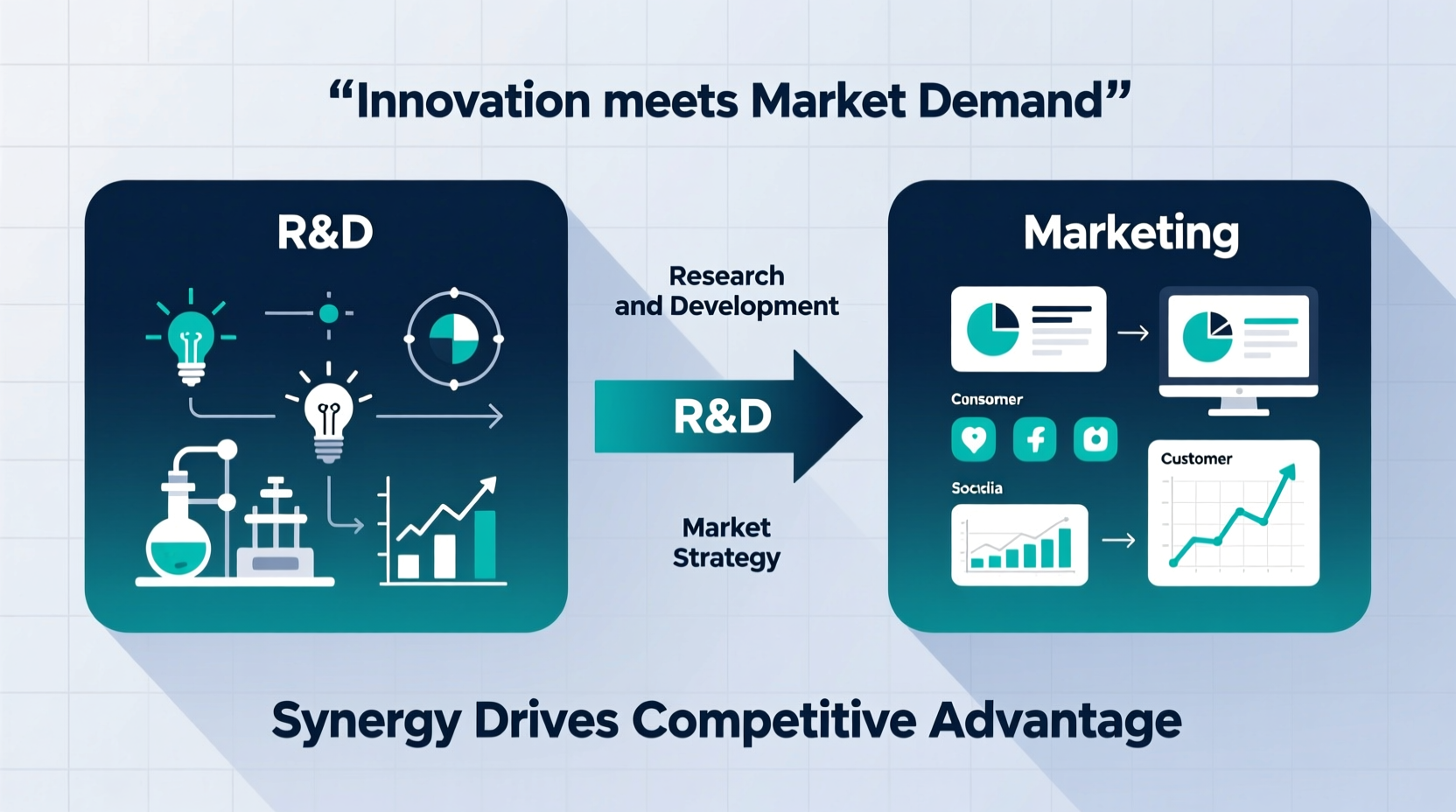
Many promising technologies fail not because they lack functionality, but because they fail to meet real customer needs. This disconnect often stems from a structural divide: R&D teams focus on feasibility and performance, while marketing teams emphasize demand and positioning—without sufficient dialogue between them.
Consider a medical device startup that developed a cutting-edge wearable sensor capable of tracking five vital signs simultaneously. Technically, it was a triumph. However, when launched, adoption stalled. Clinicians found it too complex for routine use, and patients disliked its bulkiness. Marketing had been brought in only after the product was finalized, leaving no room to adjust design based on user feedback. The innovation was sound—but misaligned with market expectations.
“Technology doesn’t sell itself. Even the most advanced solution needs to be desirable, understandable, and accessible.” — Dr. Lena Torres, Director of Product Strategy, MedInnovate Labs
Synergy in Action: How Integration Drives Better Outcomes
When R&D and marketing collaborate from the outset, innovation becomes both technically viable and commercially viable. Marketing provides early insights into customer pain points, preferences, and unmet needs. In return, R&D offers realistic assessments of what’s possible within technical and cost constraints. This two-way exchange fosters smarter decision-making at every stage of product development.
Integration enables:
- Faster time-to-market: With shared goals and aligned timelines, teams avoid rework and last-minute pivots.
- Higher customer relevance: Products are designed with real-world usage in mind, increasing adoption rates.
- Better resource allocation: Companies prioritize projects with genuine market potential, reducing wasted investment.
- Stronger brand positioning: Marketing can craft compelling narratives around features that matter to users—not just specs.
Structural Models for Effective Integration
There is no one-size-fits-all approach to merging R&D and marketing, but several organizational models have proven effective:
| Model | Description | Best For |
|---|---|---|
| Cross-Functional Teams | R&D engineers and marketers co-lead product development from concept to launch. | Mid-sized tech firms, startups, and agile enterprises. |
| Joint Innovation Councils | Regular meetings between department heads to align roadmaps and review pipeline projects. | Larger corporations with decentralized units. |
| Dual Reporting Structures | Product managers report to both R&D and marketing leadership, ensuring balanced accountability. | Companies with strong matrix management cultures. |
| Embedded Marketers in R&D | Marketing professionals assigned full-time to R&D teams to provide continuous market intelligence. | Innovation-heavy industries like biotech and consumer electronics. |
Step-by-Step Guide to Building R&D-Marketing Alignment
Integration doesn’t happen overnight. It requires deliberate planning and cultural shifts. Follow this timeline to build sustainable collaboration:
- Assess Current Gaps (Weeks 1–2): Conduct interviews with R&D and marketing leads to identify communication barriers and misaligned incentives.
- Define Shared Goals (Week 3): Establish joint KPIs such as “customer validation rate” or “time from idea to prototype feedback,” rather than isolated metrics like “patents filed” or “campaign reach.”
- Create Feedback Loops (Weeks 4–6): Implement regular sync-ups where marketing shares customer insights (e.g., survey data, support logs), and R&D presents technical progress and constraints.
- Pilot a Co-Lead Project (Months 2–4): Select a mid-priority innovation project and assign co-leaders—one from R&D, one from marketing—to manage jointly.
- Scale Success (Month 5+): Evaluate results, document best practices, and roll out the model across other product lines.
Real Example: How a Consumer Electronics Firm Turned Failure into Breakthrough
A global electronics manufacturer once launched a smart home thermostat with advanced AI learning capabilities. Despite superior technology, sales underperformed. Post-launch analysis revealed that customers didn’t understand how to set it up or trust its automation decisions.
For the next version, the company restructured its development process. Marketing joined the R&D team from day one, conducting ethnographic studies in homes to observe user behavior. They discovered that people preferred gradual automation over full autonomy and valued clear explanations of system decisions.
Armed with these insights, R&D simplified the interface and added a “Why did it change?” feature that explained temperature adjustments in plain language. Marketing crafted messaging around transparency and control. The second-generation product saw a 68% increase in adoption and won an industry design award.
Checklist: Signs Your R&D and Marketing Are Aligned
Use this checklist to evaluate your organization’s integration maturity:
- ✅ R&D considers customer feedback during the ideation phase, not just after prototyping.
- ✅ Marketing participates in technical roadmap reviews.
- ✅ Product launches include features specifically highlighted because they solve known customer problems.
- ✅ Joint budget planning exists for innovation initiatives.
- ✅ There is a documented process for sharing market intelligence with R&D teams monthly.
- ✅ Leadership rewards cross-departmental collaboration in performance evaluations.
Frequently Asked Questions
Can small companies benefit from integrating R&D and marketing?
Absolutely. In fact, smaller organizations often find integration easier due to fewer bureaucratic layers. Even a founder-led startup can formalize brief weekly check-ins between technical and marketing leads to ensure alignment.
What if R&D and marketing speak different languages?
This is common—but solvable. Introduce a shared vocabulary through workshops. For example, teach engineers basic customer journey mapping and marketers the fundamentals of technical feasibility assessment. A neutral facilitator, like a product manager, can bridge communication gaps.
How do we measure the success of integration?
Track both operational and commercial outcomes: reduction in development cycle time, increase in customer satisfaction scores for new products, percentage of launched products meeting first-year revenue targets, and internal survey results on interdepartmental satisfaction.
Conclusion: From Silos to Synergy
The separation between R&D and marketing is a relic of industrial-era thinking. In the age of customer-centric innovation, the most valuable ideas emerge at the intersection of technical possibility and human need. Companies that treat R&D and marketing as complementary forces—not separate functions—gain a decisive edge: they innovate faster, launch stronger, and connect more deeply with their audiences.
Integration isn’t just about better products. It’s about building an organization where insight flows freely, where engineers understand customers, and where marketers respect technical limits. That culture doesn’t happen by accident. It starts with a decision to break down walls and build bridges.




 浙公网安备
33010002000092号
浙公网安备
33010002000092号 浙B2-20120091-4
Comments
No comments yet. Why don't you start the discussion?