
The joke \"Why is 69 afraid of 70?\" has circulated for decades across playgrounds, comedy stages, and internet forums. On the surface, it sounds like a childish riddle, but beneath its simplicity lies clever wordplay rooted in linguistic timing, mathematical proximity, and cultural associations. The punchline—\"Because 70 ate 9!\"—relies on a homophonic twist: “ate” sounding identical to “eight.” This pun transforms a numerical sequence into a humorous narrative where numbers behave like characters in a story. While short, the joke encapsulates broader principles of humor, language, and even psychology.
The Mechanics of the Pun: How 'Ate' Becomes 'Eight'
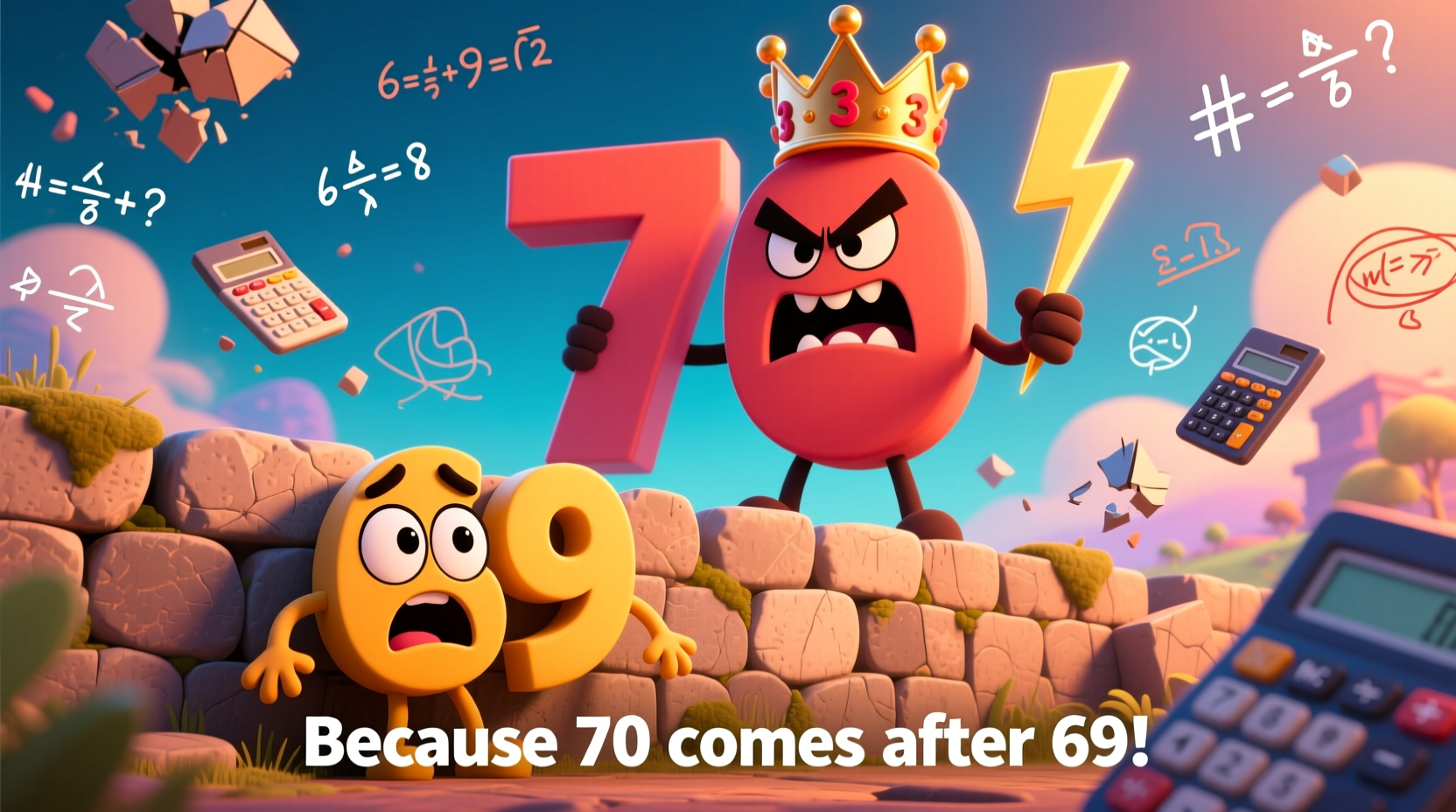
At the heart of this joke is a phonetic pun. When spoken aloud, “70 ate 9” sounds nearly identical to “70 eight 9,” suggesting that the number 70 consumed the number 9. This creates an absurd image: a number committing a culinary act against another. But since 69 contains the digit 9, the implication is that 70 might come after 69 next—making 69 “afraid” of being eaten too.
This type of humor falls under the category of homophonic puns, where words with similar sounds but different meanings generate surprise or amusement. In this case:
- “Ate” (past tense of eat) sounds like “eight”, the number.
- The sequence 70... ate... 9 mimics 70... eight... 9, which would be part of a counting pattern.
- The fear attributed to 69 anthropomorphizes numbers, giving them emotions and motivations.
The humor emerges from the collision of logic and absurdity. Mathematically, numbers don’t eat each other. Yet by using sound-alike words and personification, the joke tricks the listener into momentarily accepting a fictional reality.
Why This Joke Works: The Psychology of Surprise and Relief
Psychologists often describe humor as arising from incongruity—when expectations are subverted in a safe way. In this joke, the setup (“Why is 69 afraid of 70?”) suggests a serious or logical explanation might follow. Perhaps something about age, numerology, or social dynamics? Instead, the answer shifts into nonsense territory with a playful twist.
“Humor thrives on misdirection. The brain enjoys solving puzzles—even tiny ones like puns—because it triggers a mini ‘aha’ moment.” — Dr. Lydia Chen, Cognitive Psychologist
This “aha” moment is key. Listeners process the sentence twice: first literally, then phonetically. Once they catch the pun, the initial confusion gives way to amusement. This cognitive shift releases tension, which explains why people often smile or chuckle even if they’ve heard the joke before.
Additionally, the joke benefits from brevity and rhythm. It follows a classic three-part structure:
- Setup: “Why is 69 afraid of 70?”
- Pause: Creates anticipation.
- Punchline: “Because 70 ate 9!”
This economy of language makes it memorable and easy to repeat—two qualities that contribute to viral spread, especially among children and casual conversationalists.
Cultural Context: From Schoolyards to Social Media
The joke gained popularity in the late 20th century, frequently shared among schoolchildren who enjoy both numbers and taboo-adjacent topics. The number 69 carries sexual connotations in modern slang, adding a layer of cheeky innuendo. While the joke itself isn’t explicitly sexual, its use of 69 primes listeners for something risqué, making the innocent punchline even more surprising.
This dual-layered reception—one group hearing a clean math pun, another detecting subtle adult humor—has helped the joke endure. It’s been referenced in TV shows like The Simpsons and Brooklyn Nine-Nine, often used to highlight a character’s nerdy or immature sense of humor.
In the digital age, the joke has evolved. Memes pair the riddle with images of cartoon numbers running from a fork-wielding 70. Online communities dissect it ironically, treating it like a philosophical paradox. Some educators even use it to teach homophones or number patterns in elementary classrooms—proof that even silly jokes can serve functional purposes.
Real Example: A Classroom Experiment
In a third-grade math class in Portland, Oregon, teacher Marcus Reed introduced the joke during a lesson on number sequences. After posing the riddle, students initially guessed answers like “because 70 is bigger” or “because it comes after.” When he revealed the punchline, laughter followed—but so did engagement. Students began creating their own number puns: “Why was 5 afraid of 6? Because 6, 7, 8!” (a play on “6 ate 7”).
Reed noted, “It turned abstract concepts into something tangible and fun. Kids remembered the order of operations better because they were thinking about how numbers could interact.”
Do’s and Don’ts of Telling This Joke
Despite its widespread appeal, the joke can fall flat—or offend—if delivered poorly. The following table outlines best practices:
| Do | Don't |
|---|---|
| Deliver the punchline verbally—sound matters more than text. | Tell it in formal settings like job interviews or academic presentations. |
| Use it to lighten the mood in casual, relaxed environments. | Assume everyone will get the pun; some non-native English speakers may miss the homophone. |
| Leverage the pause between “70” and “ate 9” for comedic timing. | Overuse it. Like any joke, repetition reduces impact. |
| Pair it with visual aids when teaching language or math concepts. | Expect deep intellectual resonance—it's meant to be silly. |
Expanding the Concept: Creating Your Own Number Puns
Once you understand the mechanics, crafting similar jokes becomes a creative exercise. The formula is simple:
- Choose two numbers close in value.
- Find a homophone or near-homophone related to one of them.
- Build a narrative around action or emotion.
For example:
- Why was 10 mad at 9? Because 10 was two hot (too hot).
- What did 0 say to 8? Nice belt! (Visual pun on the shape.)
- Why did 5 break up with 6? Because 6 was always acting odd. (Mathematical + wordplay.)
Frequently Asked Questions
Is the joke inappropriate because of the number 69?
Context determines appropriateness. The number 69 does have sexual connotations in certain cultures, but the joke itself doesn’t reference that meaning. In educational or family-friendly settings, many focus solely on the phonetic pun. However, use discretion when telling it in professional or sensitive environments.
Can non-native English speakers appreciate this joke?
Yes, but with effort. Understanding requires familiarity with the pronunciation of “ate” and “eight.” Teachers sometimes use the joke as a listening comprehension tool, helping learners distinguish between similar-sounding words in context.
Are there versions of this joke in other languages?
Rarely. The joke depends on English-specific homophones. Languages with less phonetic overlap between numbers and verbs (like German or Mandarin) struggle to replicate the same effect. However, other cultures have their own number-based wordplay—just not this exact structure.
Final Thoughts: Why We Laugh at Absurdity
The enduring popularity of “Why is 69 afraid of 70?” reveals something fundamental about human cognition: we enjoy reinterpreting the familiar in unexpected ways. Numbers, typically rigid and logical, become characters with fears and appetites. Language, precise by nature, bends just enough to create delight.
More than just a throwaway gag, this joke exemplifies how minimalism in humor can yield maximum impact. It requires no props, no setup beyond a single sentence, yet it sparks recognition, laughter, and often, imitation.




 浙公网安备
33010002000092号
浙公网安备
33010002000092号 浙B2-20120091-4
Comments
No comments yet. Why don't you start the discussion?