
Capacitors are among the most fundamental components in electronics, yet many people overlook their importance until a circuit fails or behaves unexpectedly. Found in everything from smartphones to power grids, capacitors perform critical roles that keep electrical systems stable, efficient, and functional. Understanding why a capacitor is used requires more than just knowing its definition—it demands insight into its behavior, applications, and real-world impact.
A capacitor stores electrical energy in an electric field between two conductive plates separated by an insulator, known as a dielectric. While this sounds simple, the implications of that basic function ripple through nearly every aspect of modern electronics. From smoothing voltage fluctuations to timing circuits and filtering signals, capacitors enable precision and reliability where none would otherwise exist.
How Capacitors Work: The Core Principle
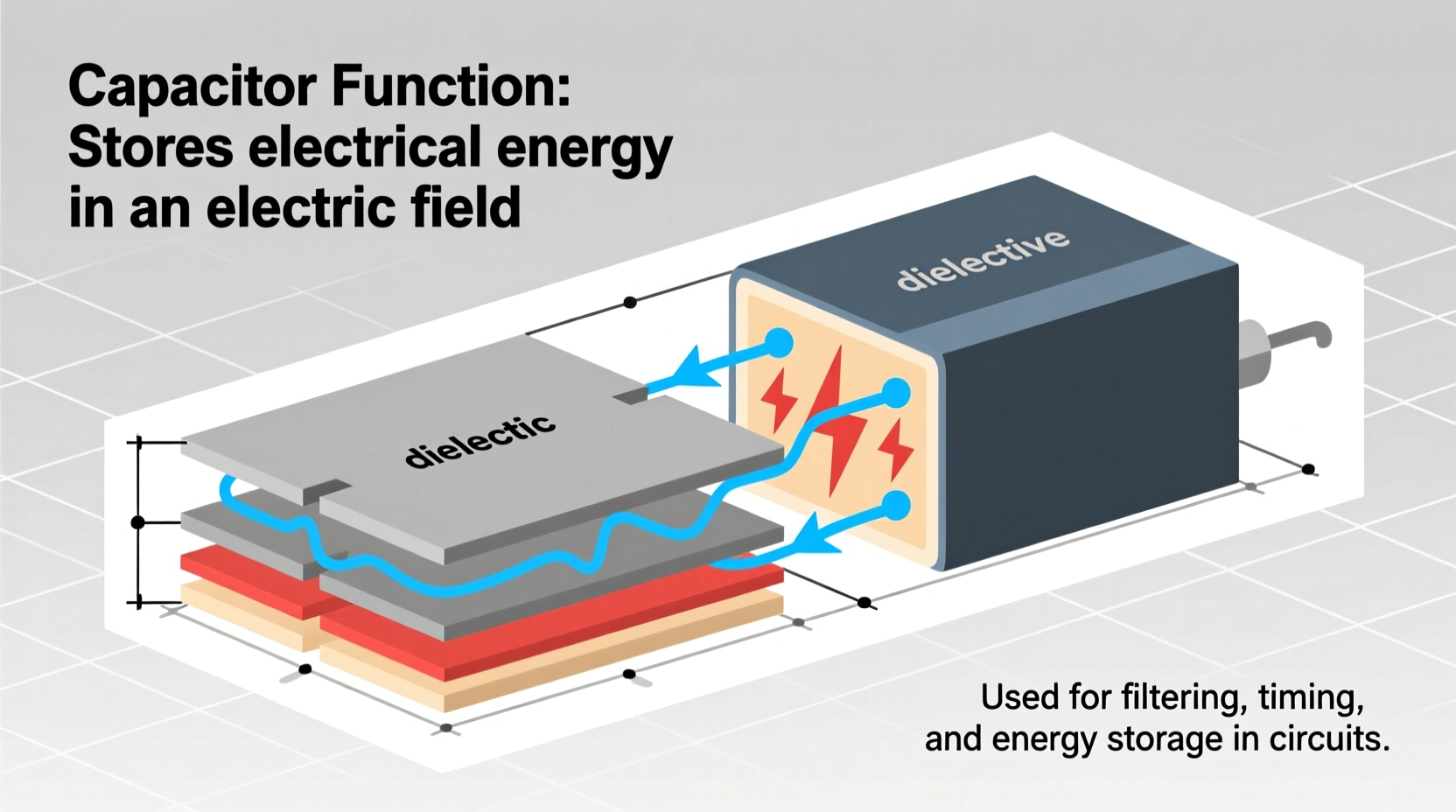
At its heart, a capacitor works by accumulating charge when voltage is applied across its terminals. As current flows into the capacitor, electrons gather on one plate while being drawn away from the other, creating an electric field across the dielectric. This stored energy can then be released back into the circuit when needed.
The amount of charge a capacitor can store is measured in farads (F), though most practical capacitors range from picofarads (pF) to microfarads (µF). The capacitance value depends on three factors:
- The surface area of the plates – larger area means higher capacitance.
- The distance between the plates – closer plates increase capacitance.
- The type of dielectric material – materials with higher permittivity enhance storage capacity.
When a capacitor charges, it initially allows current to flow freely. Over time, as the voltage across its plates approaches the supply voltage, current slows and eventually stops—this is called reaching steady state. When the voltage drops, the capacitor discharges, supplying current back into the circuit.
Key Functions of Capacitors in Circuits
The versatility of capacitors comes from their ability to respond dynamically to changes in voltage. Their primary functions include:
1. Energy Storage and Power Backup
In devices like camera flashes or backup power systems, capacitors provide quick bursts of energy. Unlike batteries, which release energy slowly, capacitors deliver near-instantaneous discharge, making them ideal for high-power pulses.
2. Filtering and Smoothing Voltage
In power supplies, capacitors smooth out ripples in DC voltage caused by rectified AC input. By charging during voltage peaks and discharging during dips, they maintain a consistent output level, protecting sensitive components.
3. Signal Coupling and Decoupling
Capacitors allow AC signals to pass while blocking DC components—a process known as coupling. In audio amplifiers, this ensures only the sound signal moves between stages. Conversely, decoupling capacitors shunt unwanted noise to ground, isolating parts of a circuit from interference.
4. Timing and Oscillation Control
Paired with resistors or inductors, capacitors create time delays essential in oscillators, timers, and clock circuits. The RC (resistor-capacitor) time constant determines how quickly a capacitor charges or discharges, forming the basis of precise timing mechanisms.
5. Motor Start and Run Assistance
In single-phase AC motors, start capacitors provide the phase shift needed to generate initial torque. Run capacitors improve efficiency during operation by correcting power factor and stabilizing current flow.
“Capacitors are silent guardians of circuit integrity—they don’t generate power, but without them, most electronic systems would fail unpredictably.” — Dr. Alan Reyes, Electrical Systems Engineer
Types of Capacitors and Their Applications
Not all capacitors are created equal. Different materials and constructions suit specific purposes based on stability, size, cost, and performance.
| Type | Dielectric Material | Typical Use Cases | Pros & Cons |
|---|---|---|---|
| Ceramic | Ceramic | Decoupling, RF circuits, general-purpose filtering | Pros: Small, cheap, stable Cons: Lower capacitance, voltage-dependent values |
| Electrolytic | Aluminum/Tantalum Oxide | Power supply filtering, energy storage | Pros: High capacitance per volume Cons: Polarized, limited lifespan, leakage |
| Film | Polyester, Polypropylene | Audio circuits, motor run, snubbers | Pros: Low distortion, reliable Cons: Larger size, moderate cost |
| Supercapacitor | Electrochemical double-layer | Short-term energy backup, regenerative braking | Pros: Extremely high capacitance Cons: Low voltage rating, high self-discharge |
Real-World Example: Capacitor Failure in a Power Supply
A technician was troubleshooting a desktop computer that randomly shut down under load. Initial checks showed no overheating or BIOS errors. Upon opening the power supply unit (PSU), visual inspection revealed swollen electrolytic capacitors on the output side.
These capacitors had degraded over time due to heat exposure, losing their ability to smooth the DC output. As a result, voltage ripple increased significantly when the system demanded more power, causing instability and shutdowns. Replacing the faulty capacitors restored clean power delivery and resolved the issue.
This case illustrates how a seemingly minor component can bring down an entire system when it fails—emphasizing the importance of capacitor health in long-term device reliability.
Step-by-Step Guide to Choosing the Right Capacitor
Selecting the correct capacitor involves more than matching capacitance values. Follow these steps to ensure optimal performance:
- Determine the function: Is it for filtering, timing, coupling, or energy storage?
- Calculate required capacitance: Use formulas (e.g., RC = 1ms for timing) or refer to datasheets.
- Select voltage rating: Choose at least 1.5x the maximum expected voltage for safety margin.
- Consider temperature and environment: High temperatures reduce lifespan, especially for electrolytics.
- Check physical constraints: Board space may limit size or type (e.g., surface mount vs. through-hole).
- Evaluate lifetime and reliability: For mission-critical systems, prioritize longer-rated or solid-state options.
Frequently Asked Questions
Can capacitors work with both AC and DC?
Yes, but differently. In DC circuits, capacitors charge and block further current once full. In AC circuits, they continuously charge and discharge, effectively allowing alternating current to \"pass through\" while resisting changes in voltage.
Why do some capacitors have polarity?
Electrolytic and tantalum capacitors are polarized because their internal chemistry relies on correct voltage direction. Installing them backward can cause overheating, leakage, or even explosion. Always observe the negative stripe or lead marking.
Do capacitors wear out over time?
Yes, especially electrolytic types. The electrolyte inside evaporates over time, reducing capacitance and increasing internal resistance. Heat accelerates this aging process. Film and ceramic capacitors typically last much longer under normal conditions.
Conclusion: Embracing the Silent Workhorse
Understanding why a capacitor is used goes beyond textbook definitions—it's about recognizing its role as a stabilizer, protector, and enabler in electronic design. Whether you're debugging a flickering LED, designing a radio receiver, or maintaining industrial equipment, capacitors quietly shape how systems behave under real conditions.
Their simplicity belies their significance. A well-chosen capacitor can mean the difference between a circuit that hums reliably for years and one that fails mysteriously within months. By mastering their functions, types, and limitations, engineers, hobbyists, and technicians alike gain deeper control over the electronic world around them.




 浙公网安备
33010002000092号
浙公网安备
33010002000092号 浙B2-20120091-4
Comments
No comments yet. Why don't you start the discussion?