
The hummingbird is one of nature’s most captivating creatures—tiny, vibrant, and impossibly agile. But perhaps the most distinctive thing about it isn’t just how it flies, but the sound it makes while doing so. The name “hummingbird” doesn’t come from its color, size, or diet. It comes from the constant, soft hum that follows it wherever it goes. This article explores the origins and science behind the name, revealing how sound, speed, and evolution all play a role in what makes a hummingbird truly a hummingbird.
The Sound Behind the Name
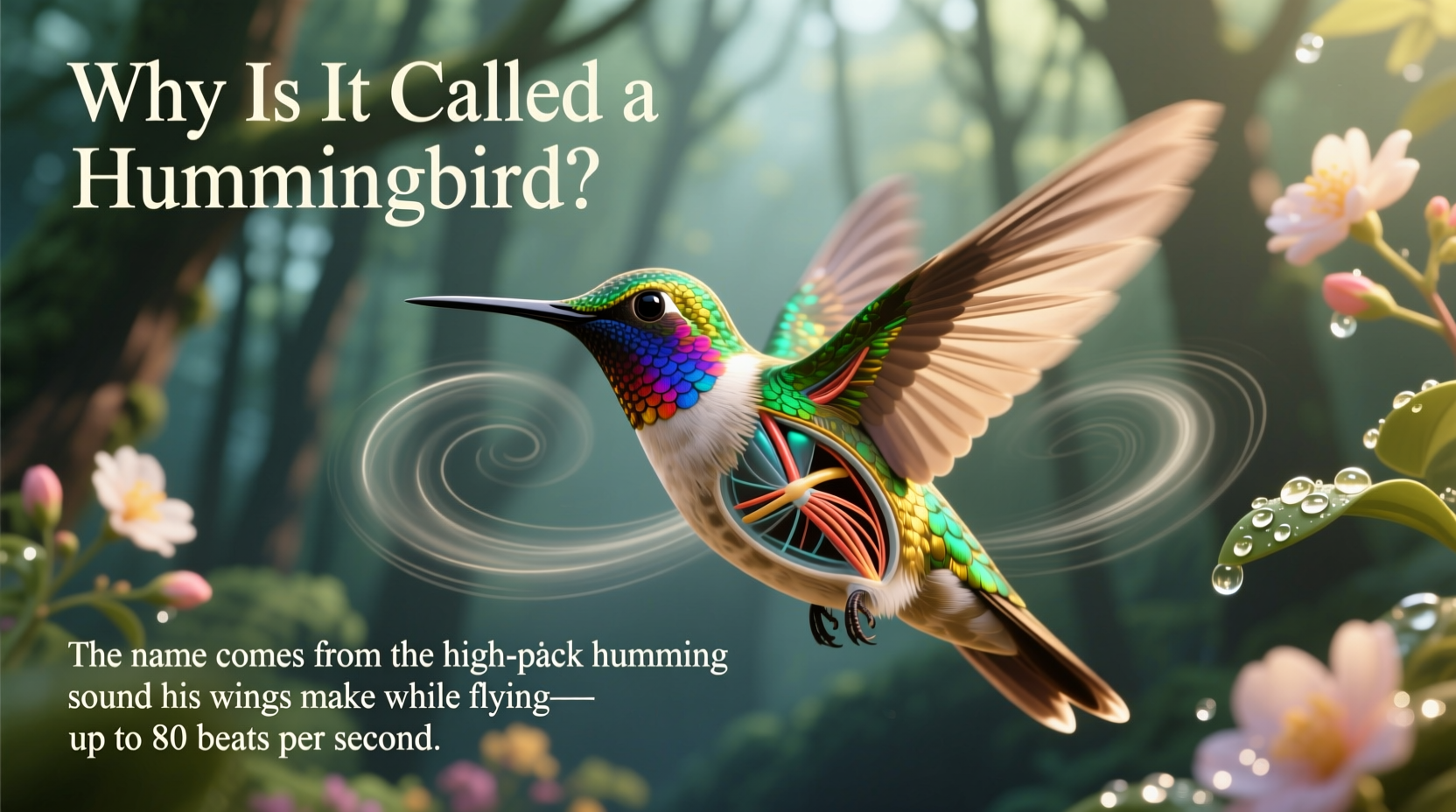
The word “hummingbird” is an onomatopoeic term—it mimics the sound the bird produces. As it hovers in midair, darting from flower to flower, its wings beat so rapidly that they generate a distinct buzzing or humming noise. This sound is not made by the bird vocalizing, but rather by the aerodynamic forces created as its wings slice through the air at incredible speeds.
Most hummingbirds flap their wings between 50 and 80 times per second during normal flight. During courtship displays or high-speed chases, some species can exceed 200 beats per second. At these frequencies, the wing motion becomes a blur to the human eye—and the resulting airflow produces a continuous hum, much like a tiny engine. This persistent sound is what early observers latched onto when naming the bird.
“Birds are named for many reasons—color, habitat, behavior—but in the case of the hummingbird, it’s all about the sound. It’s rare to find a creature whose name so perfectly captures its acoustic signature.” — Dr. Lena Torres, Ornithologist, Cornell Lab of Ornithology
How Wing Structure Creates the Hum
The hummingbird’s hum isn’t accidental—it’s a byproduct of highly specialized wing anatomy and flight mechanics. Unlike most birds, which primarily flap their wings up and down, hummingbirds rotate their wings in a figure-eight pattern. This allows them to generate lift on both the upstroke and the downstroke, enabling sustained hovering.
This unique motion creates complex pressure waves in the air. As the wings move forward and backward at high velocity, they displace air rapidly, producing oscillations in atmospheric pressure that our ears interpret as sound. Researchers at Stanford University used high-speed cameras and audio sensors to analyze this phenomenon and found that the dominant frequency of the hum falls between 40 and 80 Hz—within the lower range of human hearing, similar to the tone of a bass guitar.
The sound intensity also varies by species. Larger hummingbirds with broader wings tend to produce deeper, louder hums, while smaller species emit higher-pitched buzzes. For example:
| Species | Wingbeat Frequency (Hz) | Hum Pitch |
|---|---|---|
| Rufous Hummingbird | 70–80 | Moderate-high buzz |
| Bee Hummingbird | 200+ | High-pitched whine |
| Anna’s Hummingbird | 55–65 | Soft, rhythmic hum |
Historical Naming and Cultural Perception
The term “hummingbird” entered English usage in the 17th century, though indigenous peoples across the Americas had long observed and named these birds in their own languages. In Nahuatl, spoken by the Aztecs, the hummingbird was called *Huitzilin*, meaning “precious little thing,” and was associated with warriors and the sun god Huitzilopochtli.
European naturalists, upon encountering these birds in the New World, were struck by their rapid movement and constant noise. Early accounts describe them as “flying jewels” and “feathered bees.” The name “hummingbird” first appeared in written records around 1678, replacing earlier terms like “buzzard-bird” or “sunbird,” which were misleading or already used for other species.
The name stuck because it was both accurate and evocative. Unlike scientific names—which often honor people or describe physical traits—common names rely on public recognition. And few birds are as instantly recognizable by sound as the hummingbird.
Not All Hummingbirds Hum the Same
While all hummingbirds produce some form of humming sound, the volume and tone vary significantly. Some species have evolved quieter flight patterns, especially those that rely on stealth to defend territories or avoid predators. Others amplify their hum intentionally—as part of mating displays.
For instance, male Anna’s Hummingbirds perform dramatic dive displays during courtship. As they plummet from over 100 feet in the air, they spread their tail feathers at the last moment, creating a loud squeal caused by air rushing through the feathers. This sound, combined with the wing hum, forms a two-part auditory signal designed to impress females.
In contrast, the Sword-billed Hummingbird, known for its exceptionally long beak, has a softer hum due to slower wingbeats relative to its body size. This illustrates that while the name “hummingbird” applies broadly, the acoustic experience differs across species.
Mini Case Study: The Backyard Observer
Sarah Mitchell, a nature enthusiast from Colorado, installed a sugar-water feeder in her garden hoping to attract local wildlife. Within days, she noticed a faint buzzing near the flowers. At first, she assumed it was a large bee. But when she looked closer, she saw a tiny bird hovering midair, sipping nectar without landing.
“I didn’t even realize it was a bird at first,” she said. “The sound was so insect-like. But then I saw the iridescent throat flash in the sun, and I knew it had to be a hummingbird. Now, I can tell which species visit just by the pitch of their hum.”
Sarah’s experience highlights how the sound is often the first clue to a hummingbird’s presence—especially in dense foliage where visibility is limited.
Why the Name Matters Beyond Sound
The name “hummingbird” does more than describe a noise—it encapsulates the bird’s entire ecological niche. The ability to hover, feed on nectar, and sustain high-energy flight is directly linked to the same physiology that produces the hum. So, when we refer to a bird as a “hummingbird,” we’re indirectly acknowledging its metabolic intensity, aerial precision, and evolutionary uniqueness.
In fact, the hummingbird’s metabolism is among the highest of any animal. To fuel their flight, they consume up to twice their body weight in nectar each day and must eat every 10–15 minutes during daylight hours. Their hearts can beat over 1,200 times per minute. The hum, therefore, is not just a side effect—it’s an audible sign of extraordinary biological effort.
Checklist: How to Identify a Hummingbird by Sound
- Listen for a continuous, rhythmic buzzing near flowering plants
- Distinguish it from insects: hummingbird hums are steadier and often accompanied by sudden directional changes
- Note the pitch—higher frequencies suggest smaller species
- Pay attention to variations: a sharp chirp or squeal may indicate a dive display
- Use stillness: stand quietly in a garden; the hum will often lead you to the bird
Frequently Asked Questions
Do hummingbirds make sounds with their voices?
Yes, but minimally. Hummingbirds do produce chirps and calls, usually during territorial disputes or mating. However, the primary humming sound comes from their wings, not their vocal cords.
Can you hear a hummingbird at night?
Rarely. Hummingbirds are diurnal and typically roost at night. During sleep, their metabolism slows dramatically, and they enter a state called torpor. No flight means no hum.
Are there silent hummingbirds?
No species is completely silent, but some are quieter than others. Birds in dense forests may have evolved less noisy flight to avoid detection. Still, all produce some level of wing-generated sound due to their flight mechanics.
Conclusion: More Than Just a Name
The name “hummingbird” is a perfect marriage of language and nature—a simple word that captures a complex blend of sound, motion, and biology. It reminds us that names aren’t arbitrary; they often hold clues to behavior, adaptation, and sensory experience. The next time you hear that familiar buzz in the garden, take a moment to appreciate not just the bird, but the story behind its name.




 浙公网安备
33010002000092号
浙公网安备
33010002000092号 浙B2-20120091-4
Comments
No comments yet. Why don't you start the discussion?