
At first glance, the rule that multiplying a positive number by a negative number yields a negative result may seem arbitrary or even counterintuitive. Yet this principle is not just a convention—it's a logical consequence of how numbers behave under multiplication and addition. Understanding why this rule holds true deepens your grasp of arithmetic and prepares you for more advanced mathematics. This article explores the reasoning behind this fundamental concept through multiple perspectives: patterns, real-world analogies, number line reasoning, algebraic consistency, and mathematical definitions.
The Pattern Approach: Observing Numerical Sequences
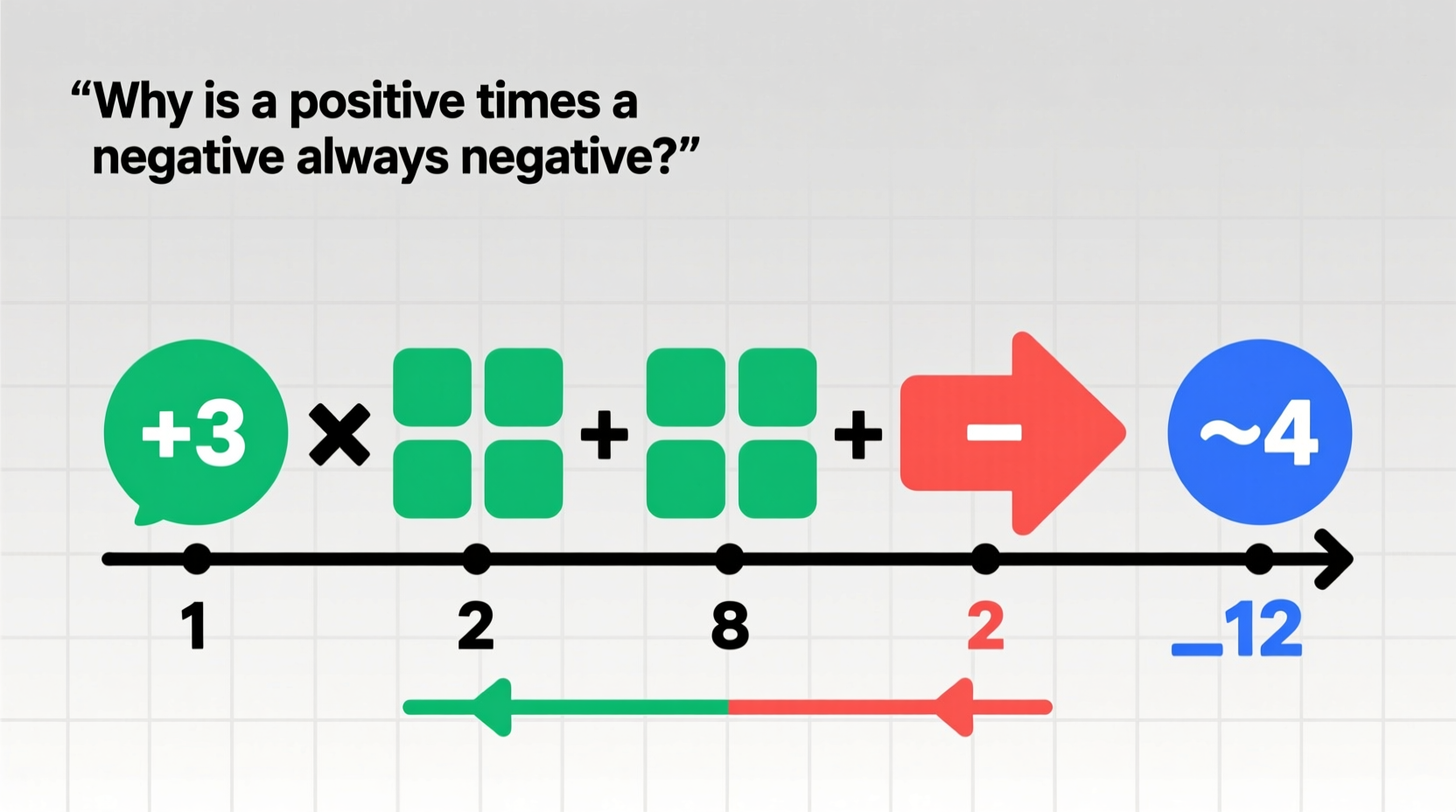
One of the most accessible ways to understand why a positive times a negative is negative is by examining patterns in multiplication. Consider what happens when you multiply a fixed positive number—say, 4—by a sequence of decreasing integers:
| Multiplication | Result |
|---|---|
| 4 × 3 | 12 |
| 4 × 2 | 8 |
| 4 × 1 | 4 |
| 4 × 0 | 0 |
| 4 × (−1) | ? |
Notice that each time the second factor decreases by 1, the product decreases by 4. Continuing this pattern logically leads to:
- 4 × (−1) = −4
- 4 × (−2) = −8
- 4 × (−3) = −12
This consistent decrease preserves the integrity of arithmetic. If we were to break this pattern and assign a positive value to 4 × (−1), the entire system would become inconsistent. The pattern approach shows that defining positive times negative as negative maintains coherence across all integer multiplications.
Real-World Analogies: Debt and Direction
Mathematics often reflects real-life situations. One practical model involves money and debt. Imagine you earn $10 per hour. Working 3 hours gives you:
10 × 3 = $30
Now consider the opposite: instead of earning, you are losing money—perhaps paying off a debt at $10 per hour. How much do you owe after 3 hours?
(−10) × 3 = −$30
But what if you \"remove\" 3 hours of debt? That’s equivalent to gaining $30. In other words, removing a negative is positive:
(−10) × (−3) = $30
Conversely, if you gain 3 hours of debt (i.e., incur more obligation), you end up worse off:
10 × (−3) = −$30
This illustrates that a positive quantity (hours worked) multiplied by a negative rate (debt accumulation) results in a negative outcome (loss). Real-world contexts like finance, temperature changes, or elevation shifts reinforce that negative outcomes from positive actions in negative contexts make intuitive sense.
Number Line Reasoning: Direction and Scaling
The number line provides a geometric interpretation of multiplication. Positive numbers extend to the right; negatives go left. Multiplication can be seen as scaling and possibly reversing direction.
For example, multiplying by 2 stretches a number to twice its distance from zero in the same direction. But multiplying by −2 does two things:
- Scales the number by 2 (doubles its magnitude).
- Reverses its direction (flips it across zero).
So, starting with 5 (to the right of zero):
- 5 × 2 = 10 → still on the right, further out.
- 5 × (−2) = −10 → now on the left, reversed and scaled.
This reversal explains why the product is negative: the positive input is flipped to the opposite side of zero. The act of multiplying by a negative number introduces a directional change—an essential feature built into the structure of signed arithmetic.
Algebraic Consistency: Preserving the Distributive Property
Perhaps the most compelling reason comes from algebra. The distributive property—that is, a(b + c) = ab + ac—is foundational in mathematics. Suppose we reject the idea that positive × negative = negative. Let’s see what happens.
Take the expression: 5 × (3 + (−3))
We know that 3 + (−3) = 0, so the entire expression equals 5 × 0 = 0.
Now distribute: 5×3 + 5×(−3) = 15 + ?
To maintain equality, 15 + ? must equal 0. Therefore, 5 × (−3) must be −15.
If we had defined 5 × (−3) as positive 15, the sum would be 30—not 0—and the distributive law would fail. Since this law is crucial across all areas of math—from basic arithmetic to calculus—we accept that positive × negative = negative to preserve consistency.
“The rules of sign multiplication aren’t arbitrary—they’re the only way to keep arithmetic logically coherent.” — Dr. Alan Reyes, Mathematics Educator
Formal Definition via Additive Inverses
In formal mathematics, negative numbers are defined as additive inverses. For any number a, there exists a number −a such that a + (−a) = 0.
Multiplication involving negatives is then defined to be consistent with these inverses and the properties of operations. Specifically, we define:
a × (−b) = −(a × b)
This means multiplying a positive a by a negative b produces the additive inverse of a × b. Since a × b is positive, its inverse must be negative. This definition ensures compatibility with subtraction, equations, and higher algebra.
Step-by-Step Derivation Using Properties
Let’s prove that 4 × (−5) = −20 using only fundamental properties:
- Start with: −5 + 5 = 0 (definition of additive inverse)
- Multiply both sides by 4: 4 × (−5 + 5) = 4 × 0
- Apply distributive property: 4×(−5) + 4×5 = 0
- Simplify: 4×(−5) + 20 = 0
- Therefore: 4×(−5) = −20
This derivation doesn’t rely on intuition—it follows directly from accepted axioms. The conclusion is unavoidable within standard arithmetic.
Common Misconceptions and Why They Arise
Some learners struggle because they interpret multiplication as repeated addition and ask: “How can you add something a negative number of times?” While multiplication of positives can be modeled as repeated addition, this model breaks down with negatives. Instead, we must expand our understanding: multiplication is better viewed as scaling with direction.
Another confusion arises from mixing up operations. For instance, people sometimes think that “two negatives make a positive” applies universally—but this is only true for multiplication and division, not addition. (−3) + (−5) = −8, not +8. Context matters.
Frequently Asked Questions
Why isn't a positive times a negative positive?
Because doing so would break core mathematical properties like the distributive law. If 5 × (−3) equaled +15, then 5×(3 + (−3)) would not equal 0, which contradicts basic arithmetic.
Does this rule apply to all number types?
Yes. Whether dealing with integers, decimals, or fractions, the rule holds: positive × negative = negative. It extends to real and complex numbers as well, preserving consistency across mathematical systems.
What about zero? Is zero positive or negative?
Zero is neither positive nor negative. Any number multiplied by zero is zero, regardless of sign. So 7 × 0 = 0 and (−7) × 0 = 0.
Conclusion: Embracing Mathematical Logic
The rule that a positive times a negative is negative is not an arbitrary decree but a necessary outcome of maintaining logical consistency in mathematics. From observable patterns and real-world analogies to rigorous algebraic proofs, every perspective converges on the same truth. This principle supports everything from balancing budgets to solving equations in physics and engineering.
Understanding *why* this rule works transforms it from a memorized fact into a meaningful insight. It strengthens your foundation for future learning and sharpens your analytical thinking. Mathematics rewards curiosity—keep asking “why,” and the logic will reveal itself.




 浙公网安备
33010002000092号
浙公网安备
33010002000092号 浙B2-20120091-4
Comments
No comments yet. Why don't you start the discussion?