
In Lewis Carroll’s 1865 classic “Alice’s Adventures in Wonderland,” one of the most enduring puzzles emerges not from a sage philosopher or ancient text, but from the lips of the Mad Hatter: “Why is a raven like a writing desk?” The question appears during a chaotic tea party, where logic dissolves into whimsy. Unlike traditional riddles with clear answers, this one was originally posed without solution—making it not just a linguistic puzzle, but a profound commentary on meaning, language, and the absurd.
Over time, the riddle has captured the imaginations of readers, scholars, and wordplay enthusiasts alike. It stands as a symbol of nonsense literature, yet continues to invite serious inquiry. What makes this riddle so compelling? Is there an answer hidden beneath the madness? And what can we learn about creativity, interpretation, and the limits of reason by exploring it?
The Origin of the Riddle
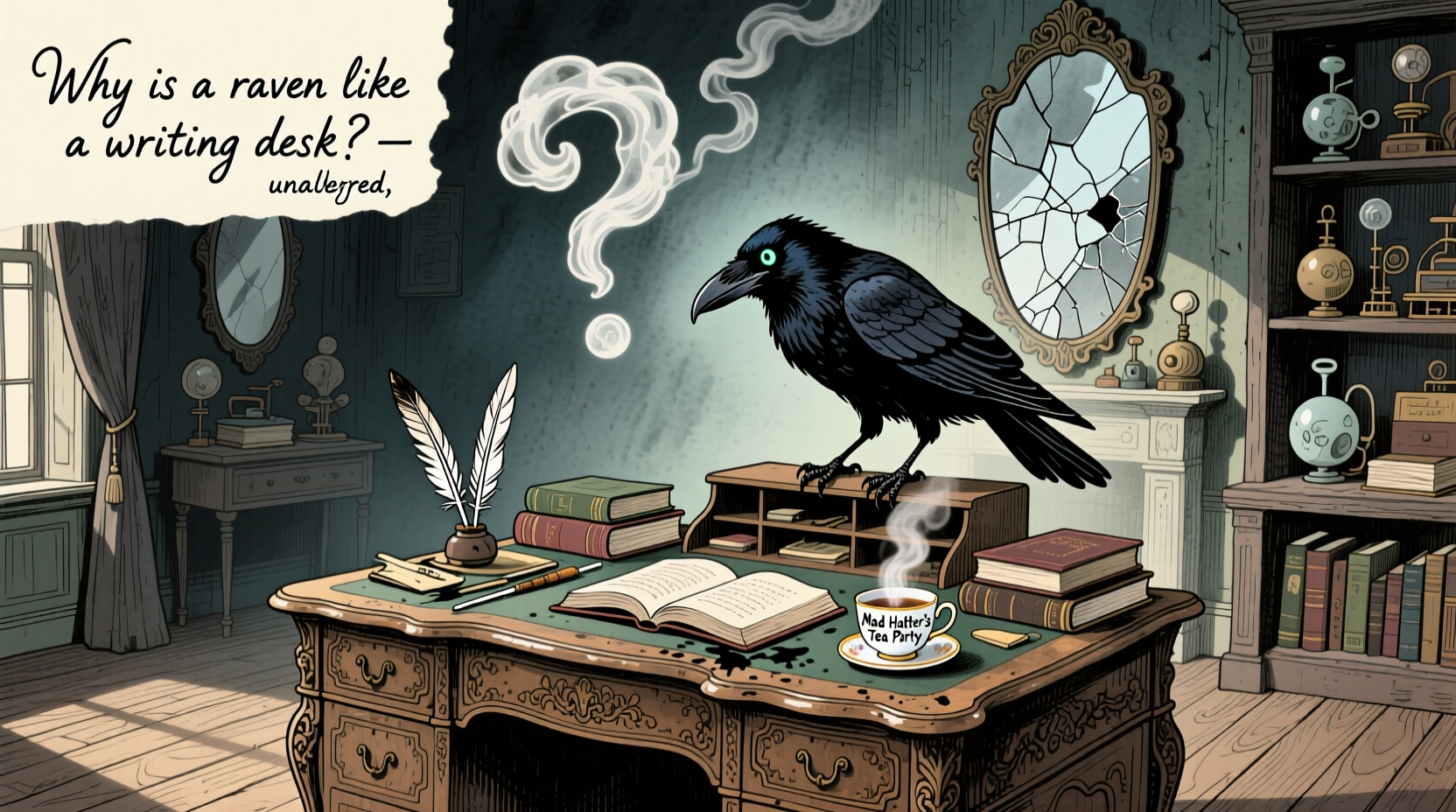
Lewis Carroll introduced the riddle in Chapter VII, “A Mad Tea-Party,” when the Hatter abruptly asks Alice, “Why is a raven like a writing desk?” When she admits she doesn’t know, he replies, “I haven’t the slightest idea.” This moment shocked early readers—riddles were expected to have answers. Yet Carroll admitted in the preface to the 1896 edition that he had no solution in mind when he wrote it.
The absence of an intended answer was deliberate. In a letter to a young fan, he wrote: “Because it can produce a few notes, though they are very flat; and it is never put with the wrong end in front!” He added, “This seemed to me to be a good answer… but others have since invented better ones.” This playful reversal—offering a tongue-in-cheek answer after years of silence—only deepened the riddle’s mystique.
“Nonsense can make sense if you stop expecting logic to lead the way.” — Dr. Rebecca Langlands, Literary Scholar
Linguistic Parallels and Wordplay
One of the reasons the riddle endures is its rich potential for puns and phonetic play. Many proposed solutions hinge on clever manipulation of sound, spelling, or double meanings:
- “Because there is a ‘b’ in both and an ‘n’ in neither.” – A cheeky tautology that plays with letter presence and absence.
- “Poe wrote on both.” – Edgar Allan Poe famously wrote “The Raven,” and presumably used a writing desk. This is among the most popular fan-submitted answers.
- “Because they both come with inky quills.” – Ravens have dark feathers, and old desks held inkwells and quill pens.
- “They both carry notes.” – A musical pun: ravens caw (produce “notes”), and desks hold written notes.
The brilliance lies in the fact that none of these answers are definitive—they’re all plausible within their own frameworks. This reflects Carroll’s background as a mathematician and logician who enjoyed subverting expectations through structured absurdity.
Cultural Impact and Philosophical Implications
Beyond wordplay, the riddle resonates because it challenges assumptions about meaning itself. In a world increasingly obsessed with productivity and correct answers, the Mad Hatter’s riddle reminds us that questions can have value even without solutions.
Philosophers have drawn parallels between the riddle and existential absurdism. Like Camus’ Sisyphus, the riddle forces us to confront meaninglessness—not as a flaw, but as an invitation to create our own meaning. The act of searching for connections between a bird and a piece of furniture becomes a metaphor for human curiosity.
| Proposed Answer | Type of Logic | Plausibility |
|---|---|---|
| Poe wrote on both | Cultural reference | High (popular) |
| Both have “b” and no “n” | Linguistic trick | Moderate (clever but arbitrary) |
| They both produce notes | Pun-based | High (musical/dual meaning) |
| No logical connection | Nihilistic | Philosophically strong |
| Carroll’s own: flat notes, wrong end | Humorous | Low (intentionally silly) |
A Mini Case Study: The Riddle in Education
In a high school English class in Bristol, UK, a teacher used the riddle to introduce a unit on postmodern literature. Instead of seeking one correct interpretation, students were asked to write short essays defending their own answers using evidence, logic, and creativity.
One student argued that both a raven and a writing desk represent tools of communication—one through flight and cawing in nature, the other through written language. Another claimed the riddle mirrors the structure of dreams, where unrelated objects coexist without explanation.
The exercise didn’t yield a single truth, but it sparked deeper engagement with symbolism, metaphor, and narrative ambiguity. As the teacher noted, “It taught them that literature isn’t always about answers—it’s about asking better questions.”
Step-by-Step Guide to Interpreting Nonsense
Engaging with riddles like the Mad Hatter’s requires a shift in mindset. Follow this process to extract insight from apparent absurdity:
- Suspend judgment. Resist the urge to dismiss something as meaningless too quickly.
- Identify patterns. Look for phonetic similarities, thematic overlaps, or historical context.
- Consider multiple frames. Analyze the riddle through lenses like humor, linguistics, philosophy, or psychology.
- Generate your own answer. Even if it’s playful, creating a response fosters deeper understanding.
- Reflect on the process. Ask: What did this exploration reveal about my thinking?
Famous Fan Solutions and Their Origins
Over the decades, writers, scientists, and comedians have offered their own takes:
- Sam Loyd (puzzle expert): “Because the notes for which they are noted are not noted for being musical notes.” – A masterclass in recursive wordplay.
- Stephen Fry: Once quipped, “Because they both start with ‘r-e’ and end with ‘t-d’”—highlighting the futility of forced symmetry.
- Carlton Mellick III (surrealist author): “Because one tweets and the other re-tweets.” – A modern twist blending old and new communication.
Each answer reflects the solver’s worldview. Mathematicians favor symmetry, poets lean toward metaphor, and comedians embrace irony. The lack of closure allows infinite reinterpretation—a hallmark of great art.
Checklist: How to Appreciate Literary Nonsense
To fully engage with works like Carroll’s, use this checklist:
- ☑ Read slowly and aloud—sound matters in nonsense writing.
- ☑ Note recurring motifs (time, identity, rules).
- ☑ Avoid over-rationalizing; allow ambiguity to sit.
- ☑ Research the author’s background (Carroll was a logician).
- ☑ Discuss interpretations with others—meaning emerges in dialogue.
- ☑ Write your own nonsensical verse or riddle.
FAQ
Did Lewis Carroll ever give a real answer?
Not initially. Years later, he offered a humorous non-answer involving “flat notes” and positioning. Most scholars believe he intended the riddle to be unsolvable, making the search more important than the solution.
Is the riddle supposed to be funny or profound?
It’s both. On the surface, it’s a joke rooted in absurdity. Beneath, it questions how we assign meaning and whether logic is the only path to understanding.
Can this riddle be used in teaching critical thinking?
Absolutely. It encourages lateral thinking, challenges binary reasoning, and promotes creative problem-solving—skills essential in both humanities and STEM fields.
Conclusion: Embracing the Unanswerable
The enduring power of “Why is a raven like a writing desk?” lies not in any single solution, but in its ability to provoke thought, laughter, and wonder. In a culture that often demands immediate answers, the riddle stands as a quiet rebellion—a reminder that some questions are meant to be lived, not solved.
Whether you see it as a linguistic game, a philosophical koan, or a piece of Victorian whimsy, engaging with the riddle expands your capacity for imagination. It teaches us that meaning isn’t always found—it’s made.




 浙公网安备
33010002000092号
浙公网安备
33010002000092号 浙B2-20120091-4
Comments
No comments yet. Why don't you start the discussion?