
In the whimsical world of Lewis Carroll’s *Alice’s Adventures in Wonderland*, logic bends, language dances, and riddles are posed without answers. One of the most enduring puzzles from the book—“Why is a raven like a writing desk?”—has baffled readers for over 150 years. Unlike traditional riddles meant to be solved, this one was originally offered with no solution at all. Yet its enigmatic charm has inspired generations of thinkers, writers, and wordplay enthusiasts to propose their own clever resolutions. This article dives deep into the origins, cultural impact, and evolving interpretations of this famous literary conundrum.
The Origin: A Riddle Without an Answer
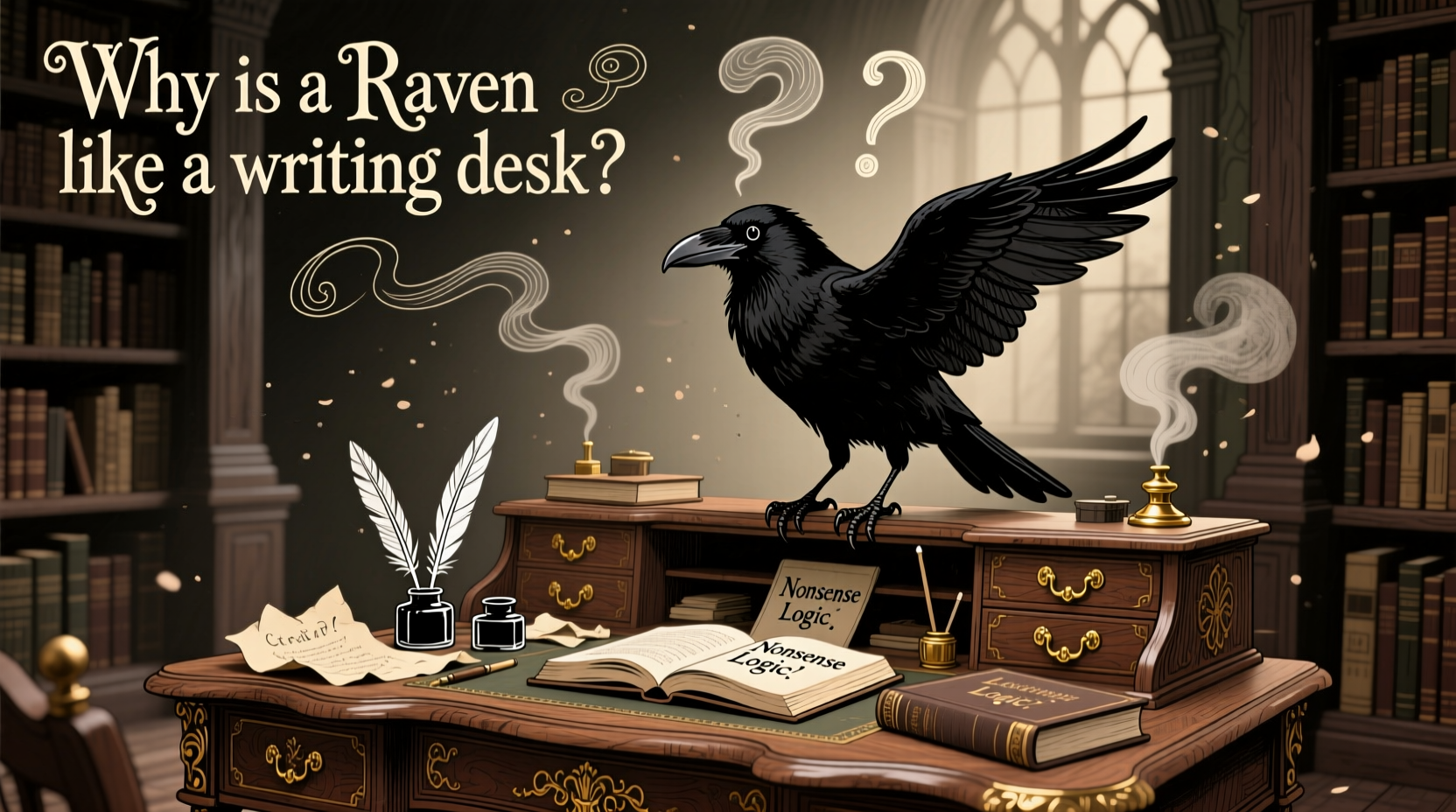
First appearing in Chapter 7 of *Alice’s Adventures in Wonderland* (1865), the riddle is posed by the Mad Hatter during the chaotic tea party scene. Alice, ever curious, attempts to solve it—only to be told that neither the Hatter nor anyone else knows the answer. Carroll himself admitted in the preface to the 1896 edition that he had no solution in mind when he wrote it. The riddle was pure nonsense, a playful jab at the conventions of logic and expectation.
“Have you guessed the riddle yet?” the Hatter said, turning to Alice again. “I haven’t the slightest idea,” said Alice. “Nor have I,” said the Hatter. — Lewis Carroll, *Alice’s Adventures in Wonderland*
This exchange underscores the absurdity central to Wonderland. The riddle isn’t meant to be solved—it’s designed to resist meaning, challenging readers to question why they expect coherence in the first place. Yet human curiosity refuses to let such mysteries lie. Over time, fans and scholars alike began offering their own solutions, transforming the unsolvable into a canvas for wit and linguistic creativity.
Famous Proposed Solutions
Despite Carroll’s original intent, numerous imaginative answers have been suggested over the decades. Some are humorous, others surprisingly poetic, and a few even reflect deeper philosophical ideas.
- Sam Loyd’s Answer: “Because Poe wrote on both.” A play on Edgar Allan Poe’s famous poem “The Raven” and the fact that people write on desks.
- Carroll’s Later Attempt: In a later preface, Carroll proposed: “Because it can produce a few notes, though they are very flat; and it is never put with the wrong end in front.” While clever, many consider this a retroactive justification rather than a true solution.
- Modern Wordplay: “They both have inky quills.” A nod to ravens’ feathers used as quill pens and ink-stained writing desks.
- Philosophical Take: “Neither one can carry a tune.” Highlighting the absurdity of comparing unrelated things through shared flaws.
Linguistic and Literary Significance
The riddle operates on multiple levels: grammatically, it mimics a standard analogy (“A is like B because…”), inviting logical reasoning. But semantically, it defies connection—ravens and desks belong to entirely different categories. This tension between form and content is precisely what makes the riddle so powerful.
Linguists point out that the riddle exploits **category confusion**, a common feature in humor and surrealism. By juxtaposing a living creature with an inanimate object, it forces the brain to search for patterns where none exist—a cognitive itch that’s hard to ignore.
Literary critic Martin Gardner observed:
“The beauty of the riddle lies in its refusal to conform. It mocks the very act of interpretation, reminding us that not everything needs to make sense.” — Martin Gardner, *The Annotated Alice*
In this light, the riddle becomes more than a joke—it’s a commentary on the limits of language and reason. Wonderland doesn’t reject logic; it reveals how fragile our reliance on it truly is.
Cultural Impact and Modern Usage
Over time, “Why is a raven like a writing desk?” has transcended its literary roots to become a cultural shorthand for absurdity, paradox, and intellectual playfulness. It appears in academic discussions, puzzle competitions, and even tech industry interviews as a metaphor for thinking outside the box.
In classrooms, teachers use the riddle to spark debates about meaning, metaphor, and creativity. Writers cite it as inspiration for experimental forms. Psychologists have explored how people respond to unsolvable problems—often revealing more about their cognitive styles than the problem itself.
Mini Case Study: The Riddle in Education
A high school English teacher in Portland introduced the riddle during a unit on postmodern literature. Instead of seeking one correct answer, students were asked to create their own justifications using metaphor, puns, or philosophical arguments. One student wrote: “Because both are haunted by the past—one by memories, the other by unfinished letters.” Another argued: “They’re both furniture in the mind’s house.”
The exercise didn’t just engage students—it demonstrated how ambiguity can foster deeper critical thinking. By removing the pressure to be “right,” learners felt freer to explore language creatively.
Do’s and Don’ts When Interpreting Nonsense Literature
| Do | Don’t |
|---|---|
| Consider the historical and authorial context | Assume every element must have a fixed meaning |
| Embrace ambiguity as part of the artistic intent | Dismiss nonsense as meaningless or lazy writing |
| Analyze patterns of language and repetition | Ignore the emotional or tonal effect of the text |
| Use imagination to generate interpretive possibilities | Insist on a single “correct” interpretation |
Step-by-Step Guide to Creating Your Own Literary Riddle
If the Mad Hatter’s riddle inspires you, try crafting your own. Follow these steps to design a memorable, thought-provoking puzzle:
- Choose two unrelated objects or concepts (e.g., a clock and a mountain).
- Identify superficial similarities—sound, function, appearance, or cultural associations.
- Frame it as a comparison: “Why is a clock like a mountain?”
- Test potential answers using puns, metaphors, or paradoxes.
- Decide whether to offer a solution—or leave it delightfully unresolved.
FAQ
Did Lewis Carroll ever give a real answer?
Initially, no—he stated the riddle had no solution. Later, he proposed a playful answer involving “notes” and orientation, but acknowledged it was created after publication and not part of the original intent.
Is the riddle supposed to be funny?
Yes, but not in a straightforward way. Its humor comes from subverting expectations. Readers anticipate a punchline or clever twist, but are met with silence—or absurdity—highlighting the comedy of failed logic.
Why does this riddle still matter today?
It continues to resonate because it captures a universal experience: the human desire to find meaning, even where none exists. In an age of information overload, the riddle reminds us that some questions are valuable not for their answers, but for the thinking they provoke.
Conclusion: Embracing the Unanswerable
“Why is a raven like a writing desk?” remains one of literature’s most enchanting puzzles—not because it confounds us, but because it liberates us. It invites readers to step outside rigid frameworks of logic and enjoy the play of language for its own sake. Whether you favor Sam Loyd’s pun, Carroll’s belated quip, or your own inventive twist, the true value of the riddle lies in the conversation it sparks.
In a world that often demands definitive answers, perhaps we need more questions like this one—questions that don’t close doors, but open them. Let the riddle linger in your mind, not as a problem to solve, but as a reminder that wonder thrives in the space between sense and nonsense.




 浙公网安备
33010002000092号
浙公网安备
33010002000092号 浙B2-20120091-4
Comments
No comments yet. Why don't you start the discussion?