
AES Corporation (NYSE: AES), a global power company with operations across renewables, thermal generation, and transmission, has seen its stock under pressure in recent months. Investors are asking: why is AES stock down? While no single factor fully explains the decline, a combination of macroeconomic headwinds, sector-specific challenges, earnings volatility, and shifting investor sentiment has contributed to weaker performance. This article breaks down the key drivers behind AES’s recent stock movement, analyzes financial trends, and offers context for what investors should watch going forward.
Market Overview: AES Stock Performance in 2023–2024
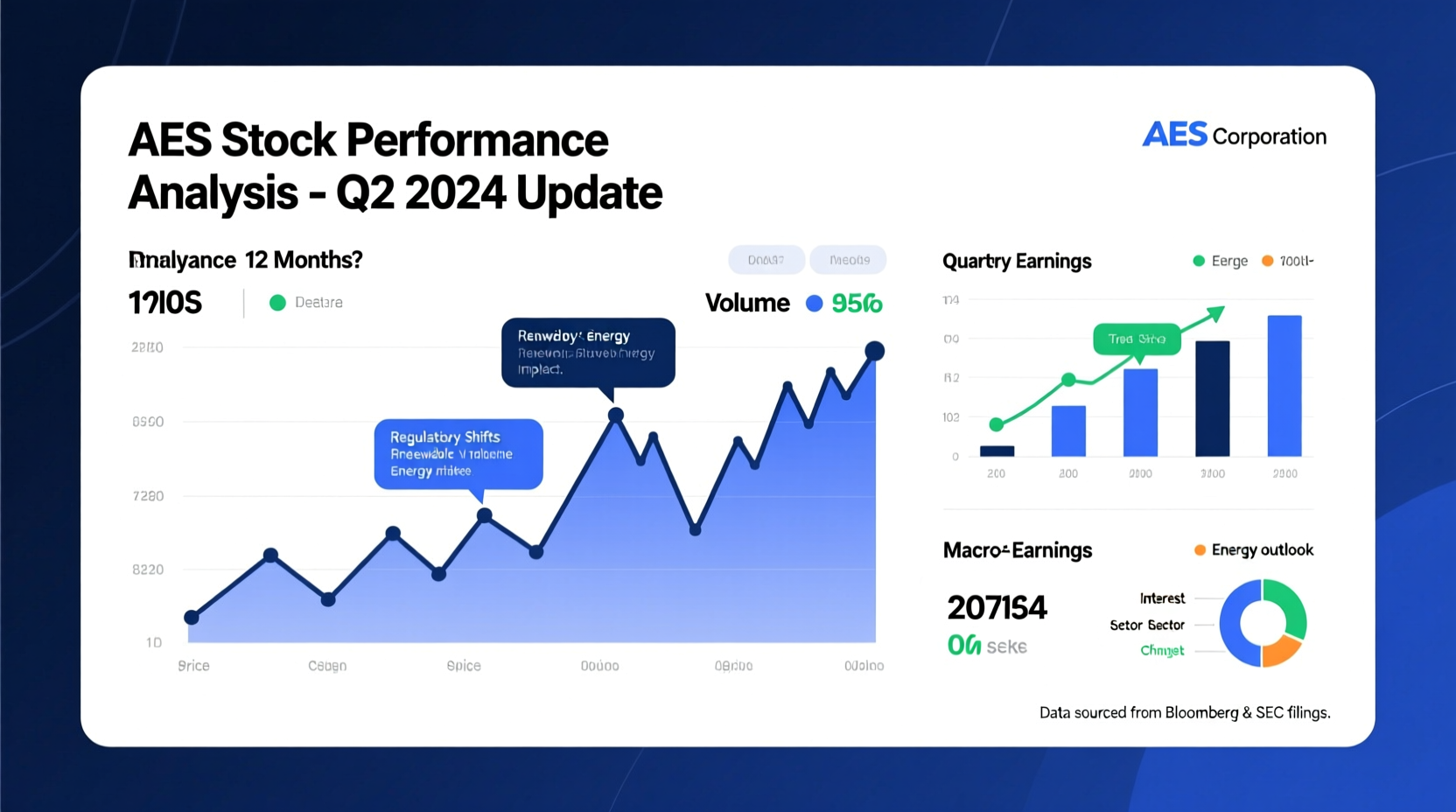
Over the past year, AES stock has experienced notable volatility. From mid-2023 through early 2024, shares declined by approximately 18%, underperforming both the broader S&P 500 and the utilities sector average. The drop wasn't linear—there were rebounds tied to earnings beats or renewable project announcements—but the overall trend has been downward. As of Q1 2024, AES trades at around $26 per share, down from a 52-week high near $32.
This underperformance comes despite the company’s strategic pivot toward clean energy and strong long-term growth targets in solar, wind, and battery storage. So what’s behind the disconnect between fundamentals and stock price?
Key Factors Behind the Decline in AES Stock
1. Rising Interest Rates and High Debt Load
Like many utility and infrastructure firms, AES carries a significant amount of debt to finance large-scale energy projects. As of its latest 10-Q filing, AES reported total debt of over $24 billion. While this supports growth, it also makes the company sensitive to interest rate fluctuations.
The Federal Reserve’s aggressive rate hikes in 2022 and 2023 increased borrowing costs across the board. Higher rates reduce the present value of future cash flows—a critical metric for capital-intensive firms like AES. Additionally, investors have rotated out of rate-sensitive sectors such as utilities, favoring technology and other growth areas with stronger near-term earnings visibility.
“High-growth utilities like AES face a double whammy when rates rise: higher financing costs and reduced multiples on future earnings.” — Michael Tran, Energy Strategist at RBC Capital Markets
2. Slower-than-Expected Earnings Growth
AES reported mixed results in its 2023 fiscal year. Revenue increased modestly to $9.7 billion, but adjusted EPS came in at $1.38, below analyst expectations of $1.45. Management cited delays in commissioning new renewable assets and lower-than-expected capacity factors in some Latin American markets due to weather variability.
Investors reacted negatively to the guidance update, where AES revised its 2024 EPS forecast to $1.40–$1.50, still conservative compared to pre-pandemic growth rates. While the company maintains a long-term target of 8–10% annual earnings growth, the near-term execution risks have dampened enthusiasm.
3. Geopolitical and Regulatory Risks in Key Markets
AES operates in over 15 countries, with major exposure in Chile, Colombia, Brazil, and the United States. While diversification can be a strength, it also exposes the company to regional instability.
- In Colombia, proposed tax reforms targeting energy exporters created uncertainty.
- In Chile, evolving regulatory frameworks around renewable subsidies have delayed project approvals.
- Inflation and currency volatility in Argentina and Brazil have impacted local profitability, even though these represent smaller portions of revenue.
These geopolitical concerns don’t threaten AES’s solvency, but they do introduce execution risk that investors penalize during times of market caution.
4. Competitive Pressure in the Renewable Sector
AES has bet heavily on renewables through its subsidiary AES Clean Energy. It aims to reach 10 GW of renewable capacity by 2025. However, competition in solar and battery storage has intensified, with margins compressing due to oversupply of panels and rising labor costs.
Meanwhile, larger players like NextEra Energy and Iberdrola continue to scale faster, benefiting from stronger balance sheets and better access to low-cost capital. AES, while innovative, lacks the same economies of scale, making it harder to win large PPA (Power Purchase Agreement) contracts without accepting thinner margins.
Financial Snapshot: AES vs. Sector Peers
| Metric | AES Corp | NextEra Energy | Duke Energy |
|---|---|---|---|
| Forward P/E Ratio | 14.2x | 22.5x | 16.8x |
| Dividend Yield | 3.1% | 2.8% | 4.0% |
| Debt-to-Equity (Leverage) | 2.6x | 1.8x | 2.1x |
| Renewables % of Portfolio | ~45% | ~75% | ~20% |
| 5-Year EPS Growth (CAGR) | 4.2% | 8.9% | 3.5% |
The table shows that while AES offers a competitive dividend and is more advanced in renewables than traditional utilities, its higher leverage and lower growth profile explain the valuation discount relative to leaders like NextEra.
Real-World Example: The Andes Solar Delay
In late 2023, AES announced a six-month delay in the commissioning of its 350 MW Andes Solar project in Chile. Originally expected to come online in Q4 2023, the project faced permitting bottlenecks and supply chain disruptions for inverters. Although the asset is now operational, the delay cost the company an estimated $45 million in lost EBITDA for the year.
Analysts at Morgan Stanley noted that while one project delay isn’t catastrophic, it raised concerns about AES’s ability to meet aggressive build-out timelines. “Execution risk is becoming a bigger theme for AES,” said lead analyst Sarah Park. “They’re not just building plants—they’re scaling complex tech across unstable jurisdictions.”
What Investors Should Watch Going Forward
The path to recovery for AES stock hinges on several catalysts. Here’s a checklist of key indicators to monitor:
- Earnings Execution: Can AES deliver in-line or above-consensus EPS in 2024?
- Project Commissioning: Are new solar and battery storage assets coming online on schedule?
- Interest Rate Outlook: Will the Fed begin cutting rates in late 2024, easing pressure on high-debt firms?
- Debt Reduction: Is AES actively refinancing or reducing leverage through asset sales or equity raises?
- Policy Tailwinds: Will Inflation Reduction Act incentives accelerate U.S.-based clean energy deployment?
Actionable Investor Checklist
- Review AES’s quarterly reports for updates on project timelines and CapEx spending.
- Track consensus EPS estimates on Bloomberg or Reuters to gauge sentiment shifts.
- Monitor Treasury yields—especially the 10-year note—as a proxy for rate sensitivity.
- Assess management commentary on capital allocation and dividend sustainability.
- Compare AES’s valuation multiples against peers after each earnings cycle.
Frequently Asked Questions
Is AES stock undervalued right now?
Many analysts believe AES is trading below intrinsic value based on its long-term clean energy pipeline. With a forward P/E of 14.2x and a 3.1% dividend yield, it appears attractively priced relative to growth potential—if execution improves. However, the high debt level remains a concern, so \"undervalued\" doesn't mean \"low risk.\"
Does AES pay a dividend?
Yes, AES pays a quarterly dividend. As of Q1 2024, the dividend is $0.20 per share, resulting in a trailing yield of about 3.1%. The company has maintained the payout through market cycles, but investors should watch free cash flow coverage, especially if interest expenses rise.
What percentage of AES’s business is renewable energy?
Approximately 45% of AES’s current portfolio is in renewables, including wind, solar, and battery storage. The company aims to increase this to over 60% by 2030 as part of its decarbonization strategy. Its ownership of Fluence, a leading grid storage firm, strengthens its position in the fast-growing energy storage market.
Conclusion: Navigating the Downward Trend
The decline in AES stock reflects real challenges—high leverage, execution delays, and macroeconomic pressures—but not necessarily a failing business. The company remains well-positioned in the global transition to clean energy, with a robust pipeline and technological edge in battery storage. However, restoring investor confidence will require consistent delivery on promises, tighter project management, and favorable shifts in the interest rate environment.
For long-term investors who believe in the energy transition, AES may present a contrarian opportunity. But patience and vigilance are essential. Understanding the interplay between financial health, global operations, and market sentiment is key to making informed decisions.




 浙公网安备
33010002000092号
浙公网安备
33010002000092号 浙B2-20120091-4
Comments
No comments yet. Why don't you start the discussion?