
Despite being one of the oldest forms of mass communication, AM radio remains a staple for news, talk shows, and emergency broadcasts. Yet, anyone who has tuned into an AM station knows its sound quality pales in comparison to FM or digital audio. Crackles, static, muffled voices, and limited frequency response make listening less than ideal—especially for music. The root causes aren’t due to outdated equipment alone but stem from fundamental technical and physical limitations inherent to AM broadcasting.
To understand why AM radio sounds the way it does, we need to examine how it transmits signals, the constraints placed on its bandwidth, and the environmental factors that degrade reception. This article breaks down the core reasons behind AM’s poor audio fidelity and offers practical context for listeners, broadcasters, and tech enthusiasts alike.
How AM Radio Works: A Technical Overview
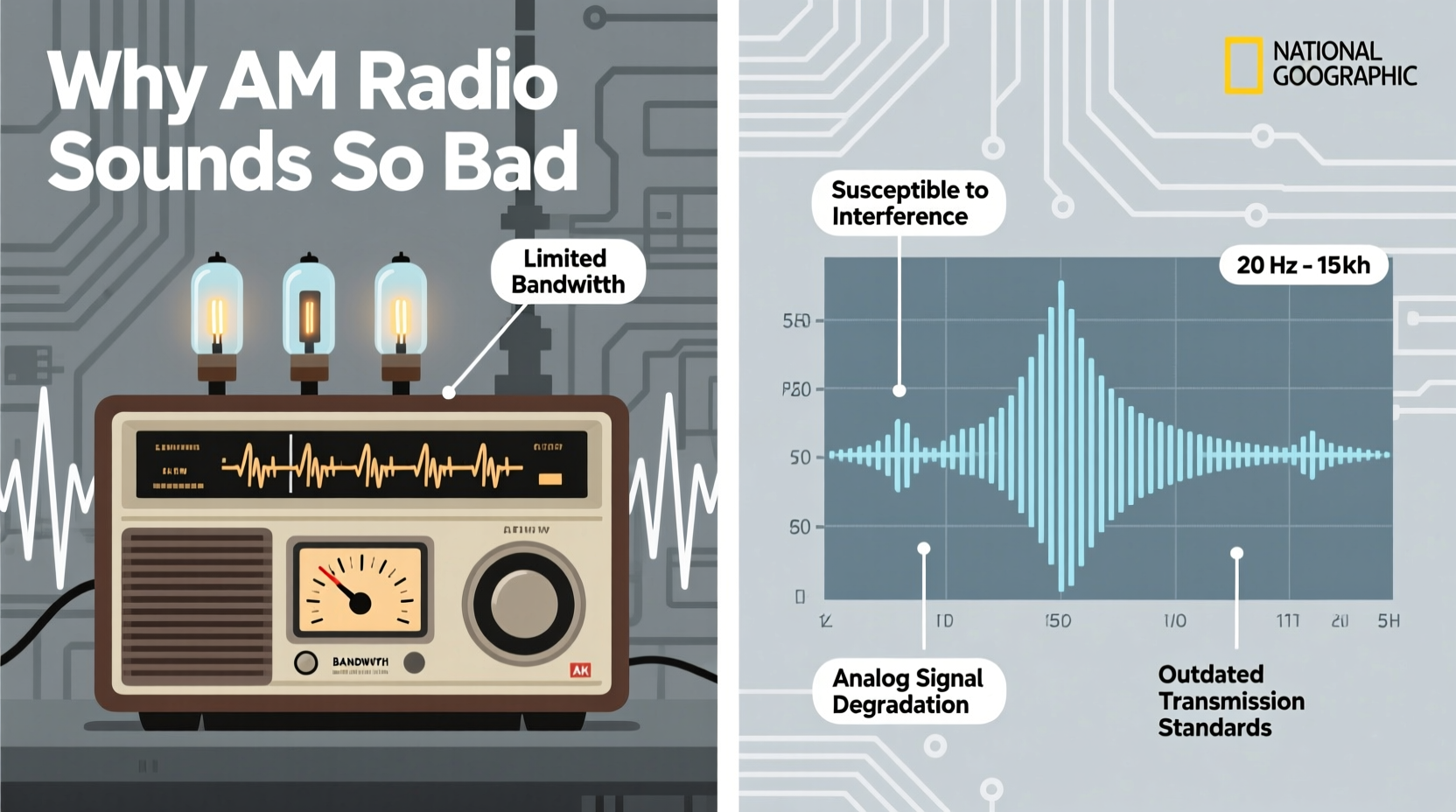
AM stands for Amplitude Modulation, a method of encoding audio information onto a radio frequency carrier wave by varying its amplitude (strength) while keeping the frequency constant. When you speak into a microphone at an AM station, your voice is converted into an electrical signal. This signal then modulates the amplitude of a high-frequency carrier wave, which is transmitted through the air via large antennas.
At the receiving end, your radio demodulates the signal—extracting the original audio from the amplitude variations—and plays it through the speaker. While conceptually simple, this process is highly susceptible to interference because any change in signal strength (from weather, buildings, or electrical devices) can be misinterpreted as part of the audio.
Unlike FM (Frequency Modulation), which varies the frequency of the carrier wave and is more resistant to noise, AM’s reliance on amplitude makes it vulnerable to disruptions. Even minor fluctuations in signal intensity caused by atmospheric conditions or nearby electronics can introduce pops, hisses, and fading.
Bandwidth Limitations and Audio Fidelity
One of the most significant contributors to poor AM sound quality is its narrow bandwidth allocation. In the United States, each AM station is limited to a 10 kHz channel width (9 kHz in some countries). This restricts the range of audio frequencies that can be transmitted—typically between 100 Hz and 5 kHz.
For comparison, human hearing spans roughly 20 Hz to 20,000 Hz, and high-fidelity audio systems aim to reproduce as much of that range as possible. Music with rich bass and crisp highs loses much of its character when stripped of frequencies above 5 kHz. Vocals may remain intelligible, but instruments like cymbals, violins, or electric guitars lose their brilliance and presence.
This bandwidth restriction also affects stereo broadcasting. While stereo AM exists (via systems like C-QUAM), it requires even more precise tuning and is rarely used due to compatibility and fidelity issues. Most AM stations broadcast in mono, further limiting spatial depth and realism.
| Audio Medium | Frequency Range | Channel Bandwidth | Stereo Support |
|---|---|---|---|
| AM Radio | 100 Hz – 5 kHz | 10 kHz | Limited / Rare |
| FM Radio | 30 Hz – 15 kHz | 200 kHz | Yes (Standard) |
| CD Quality Audio | 20 Hz – 20 kHz | N/A (Digital) | Yes |
Interference and Environmental Challenges
AM radio waves travel farther than FM, especially at night, thanks to their ability to bounce off the ionosphere—a phenomenon known as \"skywave propagation.\" While this allows AM stations to cover vast geographic areas, it also introduces co-channel interference, where distant stations on the same frequency interfere with local ones after dark.
Additionally, AM signals are easily disrupted by man-made sources such as power lines, motors, LED lighting, and digital devices. These generate electromagnetic noise that overlaps with AM frequencies, manifesting as buzzing or static. Urban environments, packed with electronic infrastructure, often suffer from particularly poor AM reception.
Natural phenomena also play a role. Thunderstorms, solar flares, and even changes in temperature can affect signal propagation. During geomagnetic storms, AM listeners might hear distant stations suddenly appear—or their favorite station vanish under a wave of static.
“AM radio’s vulnerability to interference isn’t a flaw—it’s a trade-off for long-range coverage. You gain reach, but sacrifice consistency and clarity.” — Dr. Alan Reeves, Broadcast Engineering Consultant
Modern Solutions and Listener Workarounds
While the underlying technology of AM radio hasn’t changed dramatically, several modern approaches aim to improve the listening experience:
- Digital Hybrid Systems: HD Radio allows AM stations to broadcast a digital signal alongside the analog one, offering clearer sound and reduced noise—though adoption remains limited.
- Streaming Integration: Many AM stations now simulcast online, bypassing terrestrial limitations entirely and delivering FM-like quality over the internet.
- Improved Receivers: Radios with DSP (Digital Signal Processing) chips can filter noise, enhance weak signals, and stabilize reception far better than older analog models.
For listeners stuck with traditional AM radios, small adjustments can yield noticeable improvements.
Checklist: Improving Your AM Listening Experience
- Use a radio with a built-in ferrite rod antenna or connect an external loop antenna.
- Position the radio near a window, away from computers, chargers, or fluorescent lights.
- Rotate the radio slowly—AM antennas are directional and perform best when aligned properly.
- Try listening at different times; nighttime may bring distant stations but also more interference.
- Consider switching to the station’s online stream for higher fidelity.
Real-World Example: The Talk Radio Dilemma
Consider a popular national talk radio host whose show airs both on AM and via podcast. Listeners tuning in live on AM often complain about background hum, inconsistent volume, and difficulty understanding rapid speech segments. However, the same episode downloaded as a podcast features clean, balanced audio with full vocal clarity.
The difference isn’t in content quality—it’s delivery. The AM version is compressed, bandwidth-limited, and exposed to real-time interference. The podcast, recorded digitally and streamed losslessly, preserves the full dynamic range. This case illustrates how AM’s technical constraints directly impact listener perception, even when the source material is identical.
Frequently Asked Questions
Why doesn’t AM radio sound better if stations upgrade their equipment?
Even with modern transmitters and studio gear, AM is bound by FCC-regulated bandwidth limits and modulation standards. Upgraded equipment improves signal stability but cannot expand the audio frequency range beyond 5 kHz or eliminate atmospheric interference.
Can AM radio ever sound as good as FM?
Not with current analog AM technology. The physics of amplitude modulation and narrow channel spacing inherently limit fidelity. Digital alternatives like HD Radio or internet streaming come closer but require different receivers or data connections.
Is AM radio dying because of poor sound quality?
While declining music programming reflects its audio limitations, AM remains vital for spoken-word content, local news, emergency alerts, and niche audiences. Its long-range reliability ensures continued relevance, especially in rural or disaster-prone areas.
Conclusion: Respecting AM’s Role Despite Its Limits
AM radio’s poor sound quality isn’t the result of neglect or outdated thinking—it’s a consequence of engineering trade-offs made over a century ago. Its ability to cover vast distances with relatively simple technology comes at the cost of audio fidelity and noise resistance. Understanding these limitations helps listeners appreciate what AM does well: deliver reliable, far-reaching communication, especially when other systems fail.
As broadcasting evolves, hybrid models combining AM with digital platforms offer a path forward. But for now, recognizing the “why” behind the static empowers us to adapt—whether by optimizing our radios, switching to streams, or simply adjusting expectations.




 浙公网安备
33010002000092号
浙公网安备
33010002000092号 浙B2-20120091-4
Comments
No comments yet. Why don't you start the discussion?