
For millions of viewers worldwide, Attack on Titan was more than an anime—it was a cultural phenomenon. Its final season concluded with intense emotional weight, philosophical depth, and narrative complexity that left many fans stunned. But among those who followed only the anime adaptation, confusion became just as common as admiration. The final arcs—especially the \"War for Paradis\" and Eren’s transformation into the antagonist—felt abrupt, morally ambiguous, and at times, narratively disorienting.
The truth is, while the anime faithfully adapted Hajime Isayama’s manga, it made unavoidable compromises in pacing, exposition, and character motivation due to runtime constraints. As a result, anime-only viewers missed crucial internal monologues, historical context, and thematic nuances that were present in the original source material. This gap between what was shown and what was implied is the core reason behind the widespread confusion.
The Sudden Shift in Eren’s Character
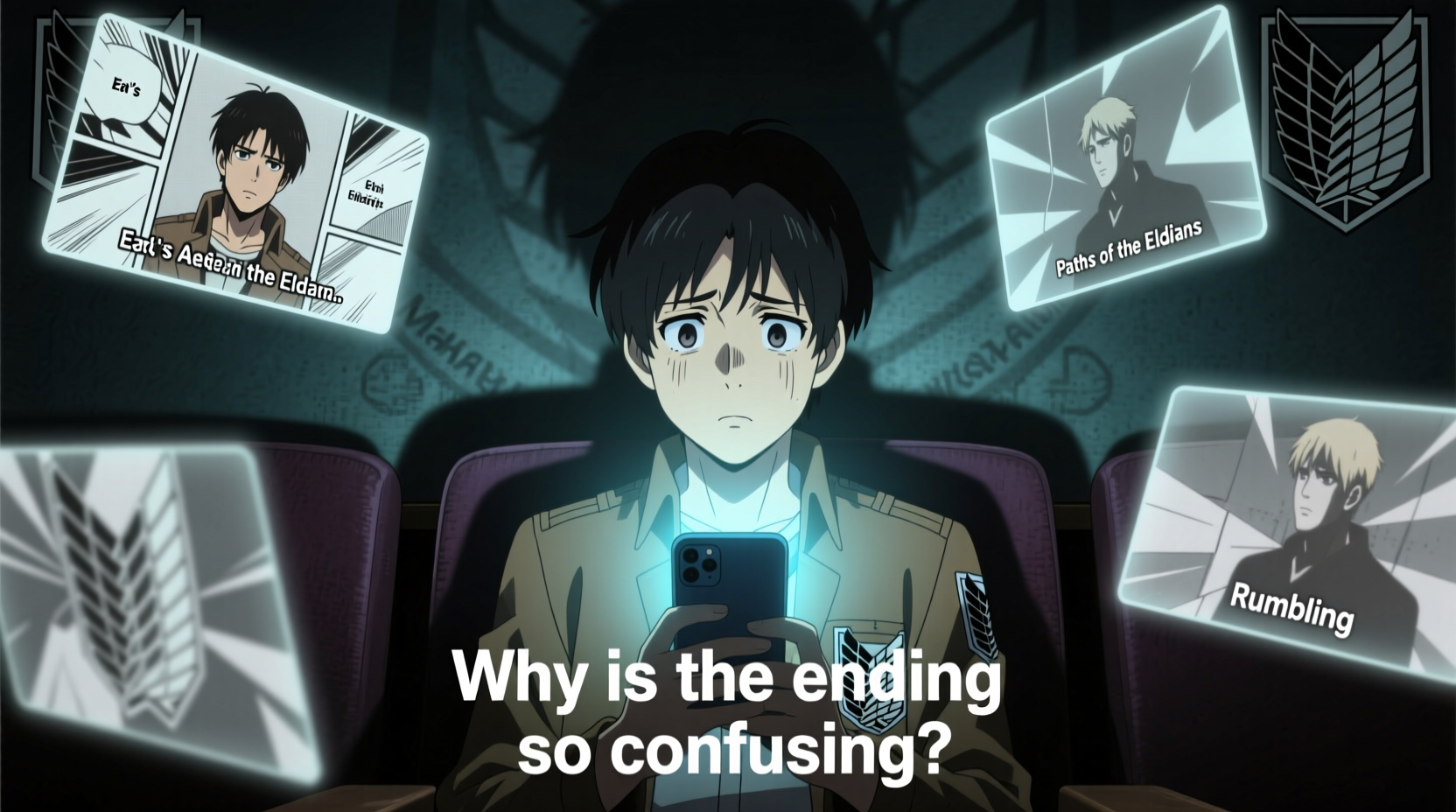
One of the most jarring elements for anime-only audiences was Eren Yeager’s dramatic turn from protagonist to genocidal warmonger. In earlier seasons, Eren was portrayed as a symbol of resistance against oppression—a boy driven by vengeance but ultimately fighting for freedom. By the final season, he becomes the very force of destruction he once opposed, orchestrating the Rumbling to wipe out 80% of humanity beyond the walls.
To many viewers, this shift felt unearned. There was little buildup in the anime to suggest such a radical ideological evolution. While Eren had always been hot-headed and vengeful, his descent into full-scale annihilation lacked the psychological depth that readers of the manga received through extended inner dialogue and flashbacks.
“Freedom… I thought it meant breaking free from cages. But I’ve become the one building them.” — Eren Yeager, Chapter 131
In the manga, Eren spends years isolated in the Paths, conversing with past and future versions of himself, grappling with inevitability, trauma, and the burden of foresight. These moments are either shortened or omitted entirely in the anime, leaving viewers without access to his internal conflict. What appears in the anime as cold-blooded extremism reads in the manga as a tragic, self-aware spiral toward a fate he cannot escape—even if he wanted to.
Timeline Jumps and Compressed Storytelling
The final season of the anime spans over four years of in-universe time, covering multiple geopolitical shifts, character developments, and strategic maneuvers. To fit this into roughly 24 episodes, the production team had to compress timelines, merge events, and remove transitional scenes.
For example, the transition from Marley’s invasion force preparing to attack Paradis to the global alliance forming against Eren happens rapidly. Characters like Armin, Historia, and Jean undergo significant personal growth off-screen, making their decisions in the final arc seem sudden or inconsistent.
Consider the case of Armin’s negotiation with the world leaders. In the anime, this moment feels almost miraculous—an impassioned speech that halts a global military coalition. But the manga reveals months of secret diplomacy, intelligence gathering, and moral debates within Paradis’ government that laid the groundwork for this outcome. Without that context, Armin’s success seems less like strategy and more like narrative convenience.
Key Timeline Gaps in the Anime
| Event | Manga Coverage | Anime Treatment |
|---|---|---|
| Eren’s isolation in Paths | Multiple chapters of introspection | Brief montages and cryptic lines |
| Paradis defense preparations | Detailed political debates | Rushed montage |
| Global alliance formation | Gradual buildup across nations | Sudden appearance in finale |
| Mikasa’s emotional journey | Extended focus on identity & love | Implied through visuals |
Lore and the Nature of the Titans
By the end of the series, Attack on Titan transcends its initial premise of survival horror and evolves into a meditation on cycles of hatred, historical repetition, and the limitations of freedom. However, much of this philosophical payload is delivered through dense exposition in the manga—conversations in the Coordinate, revelations about Ymir Fritz, and the true function of the Founding Titan.
Anime-only viewers may have struggled with concepts like:
- The Paths—a metaphysical dimension connecting all Subjects of Ymir
- Ymir Fritz’s 2,000-year-long servitude as a subconscious construct
- The meaning of “I love him” in the context of generational trauma
- The significance of Zeke’s euthanasia plan versus Eren’s desire for controlled destruction
These ideas are not inherently confusing, but they require time and reflection to unpack. The anime often presents them in rapid succession during climactic battles, prioritizing visual spectacle over philosophical clarity. As a result, viewers are left trying to process existential themes while also following complex action sequences.
Mini Case Study: The Final Conversation Between Eren and Armin
In the final battle, Eren and Armin meet in the Paths—a surreal, white void where time and memory converge. Their conversation is central to understanding Eren’s motives. He explains that he saw the future: no matter what choices he made, war would continue. His solution? Force the world to unite against a single, overwhelming threat—himself.
In the manga, this scene spans several pages, with Eren expressing regret, fear, and a twisted form of love for his friends. He admits he didn’t want to die, but knew it was the only way to break the cycle. In the anime, the same scene is condensed into under five minutes, with minimal dialogue expansion. The emotional gravity is still present, but the intellectual framework behind Eren’s decision is significantly weakened.
This is a prime example of how compression affects comprehension. Anime viewers witness the emotion but miss the rationale. They see a friend betray another, not realizing it was a premeditated sacrifice built on decades of inherited trauma.
Missing Context: The Island Nation of Paradis
Another source of confusion lies in the geopolitical framing. For most of the series, Paradis is portrayed as a victim—a nation oppressed by Marley and the outside world. But in the final arc, Paradis becomes the aggressor, with Eren threatening global extinction.
What many anime-only viewers didn’t fully grasp is that Paradis had already begun militarizing and expanding its influence long before Eren initiated the Rumbling. Under the leadership of figures like Magath and Dot Pixis (before his death), the island developed advanced weaponry, including airships and artillery capable of reaching continents away. The Warriors’ return from Marley wasn’t just a rescue mission—it was an intelligence-gathering operation with imperial ambitions.
This nuance is explored in supplementary manga chapters and side novels, but only hinted at in the anime. Without it, Paradis’ transformation from victim to threat feels sudden, rather than the culmination of a long-standing power struggle.
Expert Insight: On Narrative Complexity in Adaptations
“Adapting a deeply internal story like Attack on Titan into animation requires difficult choices. You can’t voice every thought, but removing them risks alienating the audience from character motives.” — Dr. Lena Torres, Media Studies Professor, Kyoto University of the Arts
Dr. Torres, who has published extensively on anime adaptations of serialized manga, emphasizes that internal monologue is often the first casualty in translation from page to screen. “Isayama’s writing relies heavily on introspective narration. When that’s cut, characters appear more impulsive than reflective. Eren doesn’t seem tragic—he seems irrational.”
This insight underscores a broader challenge in adapting literary-heavy manga into anime: the balance between visual storytelling and narrative depth. While WIT Studio and MAPPA delivered stunning animation and choreography, the cost was a reduction in psychological exposition.
Step-by-Step Guide: How to Fully Understand the Ending
If you finished the anime feeling confused, you’re not alone. Here’s a structured approach to fill in the gaps and gain a deeper appreciation of the conclusion:
- Read the Final Manga Arc (Chapters 120–139): Focus on Eren’s conversations in the Paths, Ymir’s backstory, and the epilogue.
- Review Key Flashbacks: Pay attention to young Ymir’s abuse, Frieda Reiss’s conversation with Grisha, and Zeke’s childhood.
- Watch the Final Season Again (with context): Re-watch Part 3 and the finale after reading the manga. Notice subtle foreshadowing and visual cues.
- Explore Creator Interviews: Hajime Isayama has discussed his intentions in multiple post-finale interviews, clarifying themes of freedom and inevitability.
- Engage with Analytical Content: Read essays or watch breakdowns from trusted sources that compare manga and anime scenes.
Frequently Asked Questions
Did Eren really want to destroy the world?
No—not in the way it initially appears. Eren’s goal wasn’t mindless destruction, but to force the world into a confrontation that would exhaust the cycle of hatred. He believed that by becoming the ultimate enemy, he could unite humanity against a common threat, after which peace might follow. It was a desperate, flawed plan rooted in trauma, not pure malice.
Why did Mikasa kill Eren?
Mikasa killed Eren because he asked her to. In their final moment, she chose love over possession. Throughout the series, her identity was tied to protecting Eren, even when he pushed her away. By ending his life, she honored his autonomy and broke free from the role of protector, asserting her own will.
What happened to the Titans after the Rumbling stopped?
With Ymir’s liberation, the power of the Titans vanished. Anyone transformed reverted to human form, and no new transformations occurred. The era of the Titans ended not through war, but through forgiveness—Ymir, after centuries of silence, finally chose to let go.
Checklist: Understanding Attack on Titan’s Ending
- ☑ Read manga chapters 120–139
- ☑ Reflect on Eren’s trauma and inherited destiny
- ☑ Understand the symbolism of Ymir Fritz’s choice
- ☑ Recognize that both Eren and Armin were right in their philosophies
- ☑ Accept that the ending is intentionally bittersweet, not neatly resolved
Conclusion: Embracing the Ambiguity
The confusion surrounding Attack on Titan’s ending isn’t a flaw—it’s a testament to its ambition. Few stories dare to challenge their audience with moral gray areas, cyclical violence, and protagonists who become villains. The anime, constrained by format, couldn’t deliver every layer of the manga’s narrative, but it succeeded in sparking global conversation.
If you walked away from the final episode with questions, that’s okay. Confusion can be a doorway to deeper understanding. The real legacy of Attack on Titan isn’t in clear answers, but in the uncomfortable truths it forces us to confront: about freedom, about hate, and about the stories we tell to justify our actions.




 浙公网安备
33010002000092号
浙公网安备
33010002000092号 浙B2-20120091-4
Comments
No comments yet. Why don't you start the discussion?