
Benjamin Franklin stands as one of the most influential figures in American history—not because he held the highest office, but because his impact spanned science, diplomacy, publishing, and civic life. A true polymath, Franklin helped shape the foundations of a new nation while advancing knowledge that transcended borders. His fame rests not on a single achievement, but on a lifetime of innovation, service, and intellectual curiosity.
Revolutionary Statesman and Founding Father
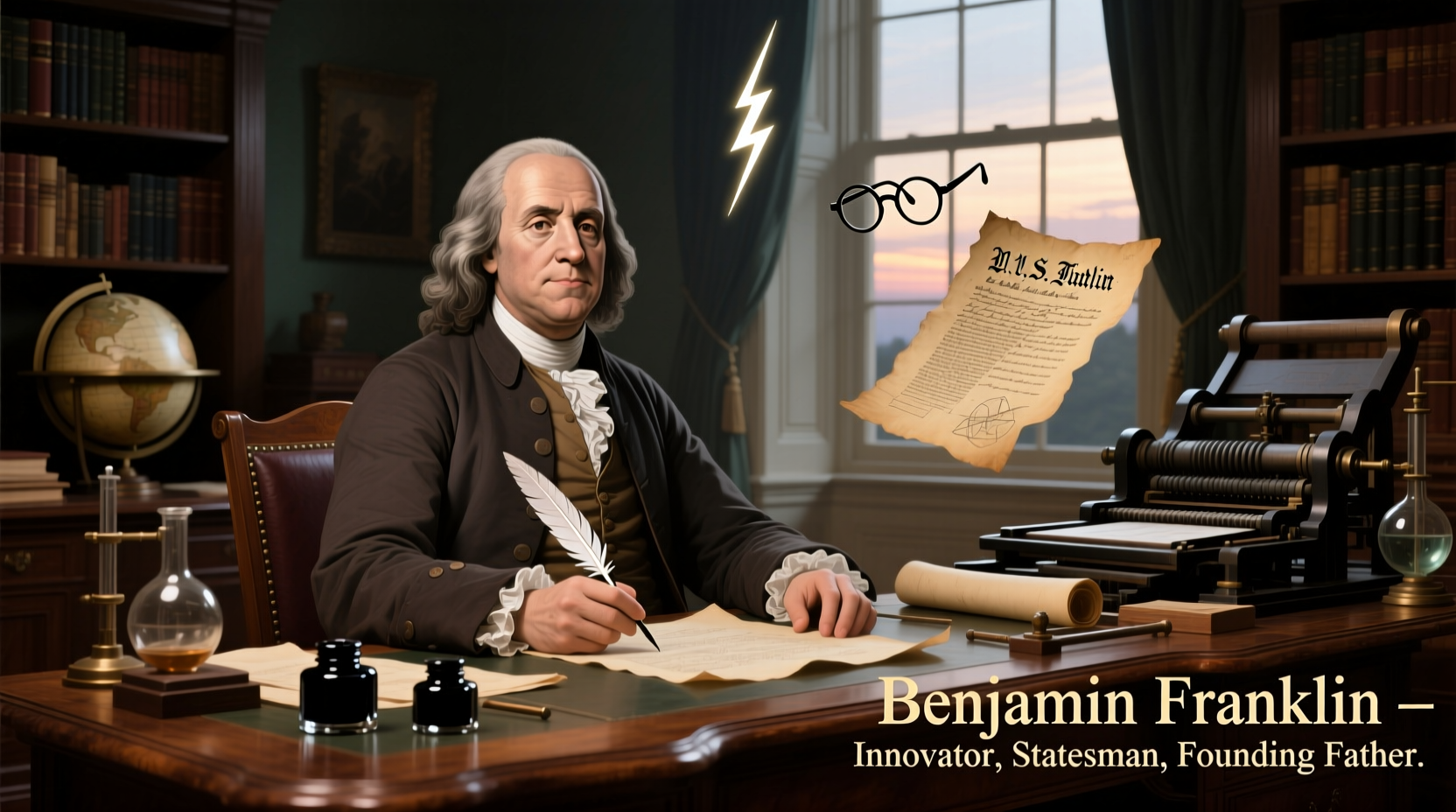
Franklin played a pivotal role in the founding of the United States. Though not a military leader like Washington or a primary author of the Constitution like Madison, his diplomatic acumen and moral authority were indispensable. He was the only person to sign all four key documents that established the U.S.: the Declaration of Independence (1776), the Treaty of Alliance with France (1778), the Treaty of Paris (1783), and the U.S. Constitution (1787).
During the American Revolution, Franklin's greatest contribution may have been securing French support. As ambassador to France from 1776 to 1785, he leveraged his international reputation and charm to win both financial aid and military assistance—critical factors in the American victory at Yorktown.
“Nothing can be said to be certain, except death and taxes.” — Benjamin Franklin
This oft-quoted line reflects Franklin’s wit and pragmatic worldview. Yet behind the humor lay deep insight into governance and human nature—qualities that made him respected across political divides.
Scientific Innovations and Electrical Discoveries
Franklin’s scientific work earned him acclaim in Europe long before he became a statesman. His experiments with electricity in the 1740s and 1750s transformed understanding of this mysterious force.
In 1752, he famously conducted the kite experiment, flying a silk kite during a thunderstorm with a metal key attached. This demonstrated that lightning was a form of electrical discharge. While some debate the exact details, the experiment led directly to one of his most practical inventions: the lightning rod.
The lightning rod saved countless buildings and lives by safely channeling lightning strikes into the ground. For this and other contributions, Franklin received the Royal Society’s Copley Medal in 1753, the highest scientific honor of the time.
He also coined now-standard terms such as “battery,” “charge,” “conductor,” and “positive” and “negative” in the context of electricity—laying linguistic groundwork still used in physics.
Civic Contributions and Social Reforms
Franklin believed progress came not just from grand ideas, but from organized community effort. In Philadelphia, he pioneered institutions that became models for American civic life:
- Founded the first public lending library in America (1731)
- Established the first fire department in Pennsylvania (1736)
- Helped create the University of Pennsylvania (1749)
- Organized a city hospital and improved street lighting and paving
- Developed an early postal system that evolved into the U.S. Post Office
His commitment to public welfare stemmed from Enlightenment ideals—he saw education, safety, and communication as essential to a functioning society.
Timeline of Key Civic Achievements
- 1731: Founded the Library Company of Philadelphia—the first subscription library in America.
- 1736: Organized the Union Fire Company, Philadelphia’s first volunteer fire department.
- 1743: Proposed the American Philosophical Society to promote scientific inquiry.
- 1751: Co-founded Pennsylvania Hospital, the first hospital in the American colonies.
- 1752: Appointed Deputy Postmaster for the British colonies; later became first Postmaster General of the United States.
Writer, Publisher, and Voice of Reason
Long before he entered politics, Franklin built his reputation through the written word. As a printer and publisher, he mastered the art of persuasion and public education.
Under the pseudonym “Poor Richard,” he published Poor Richard’s Almanack from 1732 to 1758. Filled with weather forecasts, household tips, and witty proverbs, it became one of the most popular publications in the colonies. Sayings like “Early to bed and early to rise, makes a man healthy, wealthy, and wise” entered the cultural lexicon.
Franklin also founded the Pennsylvania Gazette, a newspaper that promoted civic discussion and critical thinking. Through these platforms, he shaped public opinion and advocated for thrift, hard work, and self-improvement.
“He that falls in love with himself will have no rivals.” — Benjamin Franklin, Poor Richard’s Almanack
His autobiography, published posthumously, remains a classic of American literature and a foundational text on personal development and moral philosophy.
Key Inventions and Practical Ingenuity
Franklin was less interested in theoretical science than in solving everyday problems. Many of his inventions reflect this practical mindset:
| Invention | Purpose | Impact |
|---|---|---|
| Lightning Rod | Protect buildings from lightning strikes | Widely adopted globally; saved countless structures |
| Bifocal Glasses | Allow reading and distance vision in one lens | Precursor to modern multifocal lenses |
| Franklin Stove | More efficient home heating with less smoke | Improved indoor air quality and fuel efficiency |
| Glass Armonica | Musical instrument using rotating glass bowls | Adopted by Mozart and Beethoven; unique sound |
| Odometer | Measure postal route distances | Improved mail delivery logistics |
Notably, Franklin never patented his inventions. He believed innovations should benefit the public freely. “As we enjoy great advantages from the inventions of others, we should be glad of an opportunity to serve others by any invention of ours,” he wrote.
Frequently Asked Questions
Did Benjamin Franklin discover electricity?
No, electricity was already known, but Franklin was the first to demonstrate that lightning is a form of electrical discharge. His experiments provided crucial insights and helped develop practical applications like the lightning rod.
Was Benjamin Franklin ever president of the United States?
No, he never served as president. However, he was a senior statesman during the Constitutional Convention and signed the final document. At the time of his death in 1790, he was the most revered figure in America.
Why is Franklin on the $100 bill?
Franklin appears on the $100 bill—the highest denomination in circulation—as a tribute to his contributions to science, diplomacy, and nation-building. His image symbolizes wisdom, innovation, and civic responsibility.
Expert Insight: The Enduring Legacy
“Franklin embodied the ideal of the engaged citizen-scientist. He didn’t just study the world—he worked to improve it.” — Dr. Carla Hesse, Professor of History, University of California, Berkeley
Historians consistently rank Franklin among the most important Americans in history. Unlike many of his peers, he rose from humble beginnings—apprenticed as a printer at age 12—to become a global figure through sheer intellect and determination.
Actionable Checklist: Emulate Franklin’s Habits
To channel Franklin’s spirit of improvement and service, consider adopting these practices:
- Keep a daily journal to reflect on actions and moral progress
- Set clear goals for self-improvement (e.g., temperance, frugality, industry)
- Engage in community projects that solve real problems
- Read widely across disciplines to broaden perspective
- Share knowledge freely—mentor, write, or teach others
- Approach challenges with curiosity and experimentation
Conclusion: A Model for Modern Life
Benjamin Franklin’s fame endures because he represents what is possible when curiosity, discipline, and public service converge. He was neither perfect nor without controversy—his early ownership of slaves and complex views on race are rightly scrutinized today—but his evolution and lifelong commitment to betterment set a powerful example.
From the lightning rod to the Constitution, from aphorisms to academia, Franklin’s fingerprints are everywhere. His life reminds us that impact doesn’t require perfection—only persistence, purpose, and a willingness to serve something greater than oneself.




 浙公网安备
33010002000092号
浙公网安备
33010002000092号 浙B2-20120091-4
Comments
No comments yet. Why don't you start the discussion?