
There’s a peculiar kind of humor that arises when one person chases another—whether it’s a child sprinting after a friend on a playground, a romantic partner playfully pursuing their date, or a slapstick character being chased by an angry neighbor with a rake. It’s a trope repeated across sitcoms, viral videos, and everyday interactions. But why does this simple act of pursuit generate laughter? Behind the surface-level silliness lies a complex web of psychological, evolutionary, and social dynamics that shape how we interpret movement, intent, and control.
Chasing isn’t just physical—it’s symbolic. It reflects power shifts, vulnerability, and unpredictability, all of which are deeply tied to human emotion and cognition. Understanding why chasing is funny requires unpacking the roles of surprise, tension, and social context in humor, as well as examining how our brains respond to motion and interpersonal dynamics.
The Role of Surprise and Incongruity in Humor
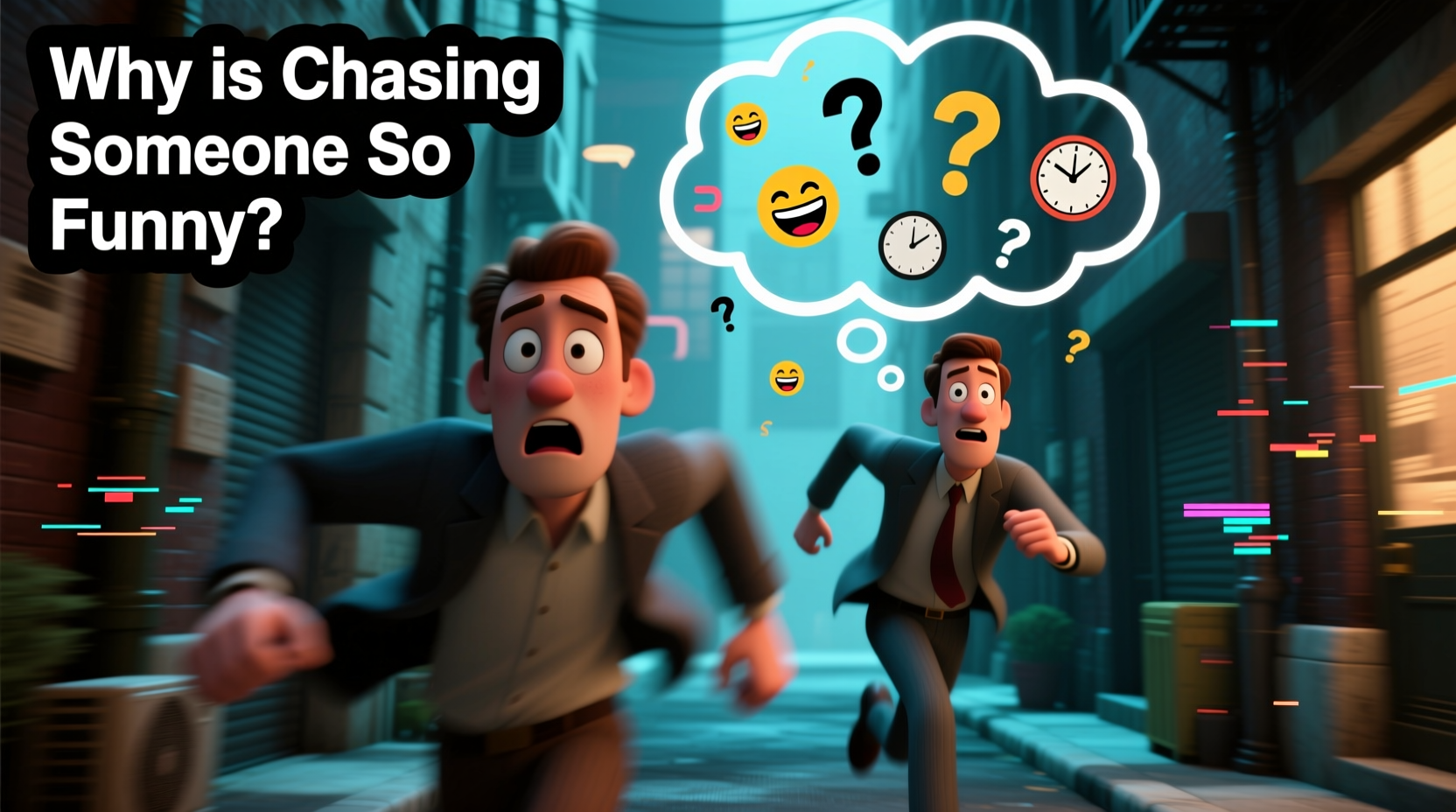
One of the most enduring theories of humor is the incongruity theory, which suggests that people laugh when expectations are subverted in a harmless way. A chase scene often begins with a normal situation—a conversation, a quiet moment, a routine task—and then abruptly escalates into chaotic motion. This sudden shift from order to disorder triggers cognitive dissonance, which the brain resolves through laughter.
For example, imagine two coworkers calmly discussing a report when one suddenly grabs a donut and sprints down the hallway, pursued by the other. The absurdity of the escalation—from professional decorum to childish pursuit—creates humor because it violates social norms in a non-threatening way. The chase becomes funny not because of the act itself, but because of the mismatch between expectation and reality.
Power Dynamics and Social Hierarchy
Chasing also plays into deep-seated perceptions of dominance and submission. The pursuer assumes a position of agency, while the pursued appears reactive, often evoking vulnerability. However, in humorous contexts, this dynamic is rarely threatening. Instead, it's reversed or mocked, turning traditional power structures into something laughable.
In romantic comedies, for instance, the “chase” is frequently used as a metaphor for courtship. One person avoids affection, prompting the other to pursue them through grand gestures or comedic stunts. When the pursued finally gives in, the resolution feels satisfying—not just romantically, but psychologically. The reversal of roles (from pursuer to pursued, or vice versa) creates narrative balance, and the journey there is filled with moments of awkwardness and exaggeration that audiences find amusing.
“Humor often serves as a social equalizer. A chase scene allows us to see authority figures—bosses, parents, partners—act irrationally, momentarily dismantling hierarchy.” — Dr. Lena Torres, Cognitive Psychologist
Evolutionary Roots of Chase-Based Humor
From an evolutionary perspective, humans are wired to respond intensely to movement, especially rapid or erratic motion. Our ancestors needed to detect predators or prey quickly, making fast-moving stimuli inherently attention-grabbing. While modern life doesn’t require constant vigilance, our brains still prioritize motion—particularly when it’s unexpected.
When someone starts running, even playfully, it activates primal alert systems. If no real danger follows, the tension dissipates as relief, which can manifest as laughter. This release of built-up nervous energy aligns with the relief theory of humor, where laughter functions as a physiological reset after perceived threat.
This explains why children love games like tag: they simulate danger without consequence. The heart races, adrenaline flows, and then—laughter. Over time, this pattern conditions us to associate playful pursuit with fun rather than fear.
Chasing as Performance and Play
Not all chases are spontaneous. Many are performative—intentionally staged for entertainment. Think of classic comedy duos like Laurel and Hardy, or modern influencers filming “prank” chases. These acts rely on timing, exaggeration, and audience awareness. The performers know they’re being watched, and the humor is heightened by the shared understanding that this is *play*, not conflict.
In such cases, the chase becomes a form of social bonding. Laughter signals group cohesion: “We all see the absurdity, and we’re in on the joke.” This aligns with the social bonding theory of humor, which posits that laughter strengthens relationships by creating shared emotional experiences.
| Type of Chase | Context | Why It’s Funny |
|---|---|---|
| Playful (e.g., kids playing tag) | Recreational, safe environment | Simulates danger without risk; releases energy |
| Romantic (e.g., running after a lover) | Dramatic or comedic storytelling | Subverts emotional restraint; highlights vulnerability |
| Slapstick (e.g., slipping during pursuit) | Physical comedy | Exaggerates failure; violates dignity in harmless way |
| Social prank (e.g., fake chase) | Viral video, public space | Breaks social norms; surprises bystanders |
Mini Case Study: The Office Prank Chase
At a tech startup in Portland, an employee named Jordan taped a Post-it note saying “I stole the last coffee pod” to a colleague’s back. Within minutes, three coworkers began mock-chasing Jordan through the open office, dodging desks and dramatically yelling, “Justice for caffeine!” The incident was recorded and later shared internally, becoming a running joke.
What made it funny wasn’t the note or the pods—it was the escalation. The transition from quiet work mode to theatrical pursuit disrupted routine in a safe, consensual way. Observers laughed not just at the chase, but at the collective willingness to participate in absurdity. It reinforced team culture: high performance didn’t require seriousness all the time. Playfulness had a place.
When Chasing Isn’t Funny: Boundaries and Context
It’s crucial to recognize that not all chasing is humorous. In real-life situations involving fear, coercion, or lack of consent, pursuit is alarming, not amusing. The line between funny and frightening depends on context, tone, and mutual understanding.
For a chase to be perceived as humorous, certain conditions must be met:
- Perceived safety: No real threat of harm.
- Consent (explicit or implied): All parties are willing participants.
- Shared frame of mind: Everyone understands it’s play, not conflict.
- Controlled duration: The chase ends before discomfort sets in.
When these elements are missing—such as in cases of stalking or harassment—the same physical actions evoke anxiety, not laughter. This contrast underscores how deeply context shapes perception.
Checklist: Creating a Funny, Safe Chase Scenario
- Ensure all participants are comfortable with physical activity.
- Choose a safe environment (open space, no obstacles).
- Use clear signals (a whistle, a shout) to start and end the game.
- Avoid impersonal or sensitive topics as motivators (e.g., debt, appearance).
- End on a positive note—group laugh, high-five, or shared reward.
FAQ
Can chasing be a sign of attraction?
Yes—in social and romantic contexts, playful chasing can signal interest. It introduces mild tension and excitement, both of which can enhance emotional connection. However, it must remain consensual and lighthearted to avoid misinterpretation.
Why do people laugh during a chase even if they’re scared?
Nervous laughter is a common response to stress or uncertainty. It helps regulate emotions when the brain detects potential threat but lacks clarity. In ambiguous situations—like a surprise chase—the body may default to laughter as a coping mechanism, even if the person feels startled.
Is the “chase” phase in dating healthy?
While the thrill of pursuit can feel exciting early in a relationship, long-term dynamics should shift toward mutual effort and communication. Relying on chase-like behavior (e.g., playing hard to get) can create insecurity. Healthy relationships are built on consistency, not prolonged games of pursuit and evasion.
Conclusion
The humor in chasing someone goes far beyond the physical act. It taps into ancient instincts, social rituals, and cognitive patterns that define how we process surprise, power, and connection. When done right, a chase becomes more than a joke—it becomes a shared moment of release, a reminder that not everything needs to be serious.
But like all forms of humor, it requires awareness. The same behavior that brings people together in laughter can alienate or unsettle if boundaries are ignored. The key is intention: Is the chase inclusive? Is it kind? Does it leave everyone smiling?




 浙公网安备
33010002000092号
浙公网安备
33010002000092号 浙B2-20120091-4
Comments
No comments yet. Why don't you start the discussion?