
Dexter Morgan, the protagonist of the acclaimed series *Dexter*, is a man of contradictions: a forensic blood spatter analyst by day, a meticulous serial killer by night. To many, his actions seem unfathomable. Yet, over eight seasons (and revived in *Dexter: New Blood*), audiences were drawn into his psyche, not to justify murder, but to understand how a person could become both a monster and a moral arbiter. The answer lies not in simple villainy, but in a layered interplay of childhood trauma, psychological conditioning, moral ambiguity, and the human need for identity.
The Origin of a Code: Trauma and Early Conditioning
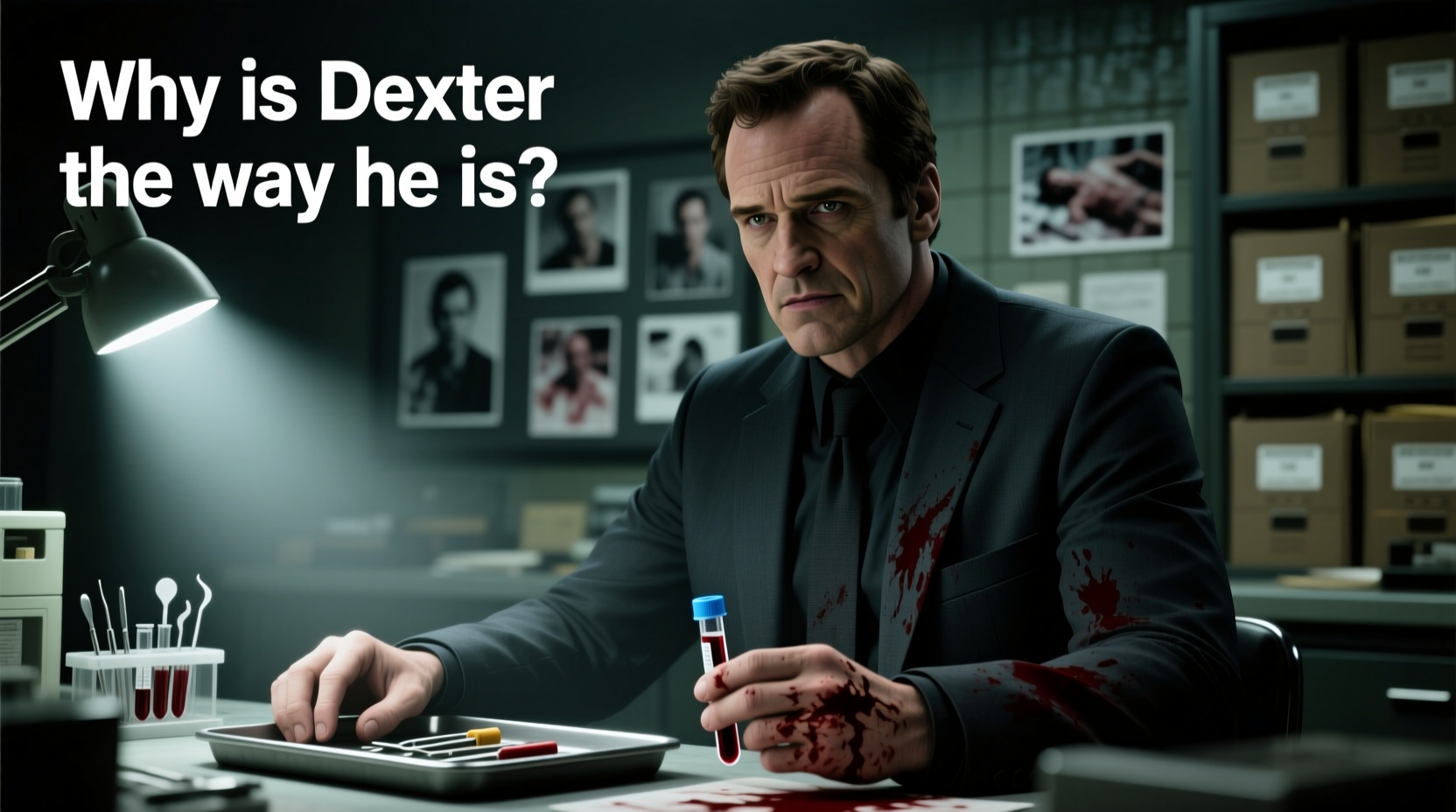
Dexter’s foundation was built on profound early trauma. At the age of three, he witnessed the brutal murder of his mother, Laura Moser, inside a shipping container. For two days, he sat in a pool of her blood before being rescued by his adoptive father, Harry Morgan, a Miami police officer. This event wasn’t just a tragedy—it rewired Dexter’s developing brain. Psychologists refer to such experiences as “toxic stress,” capable of altering emotional regulation, empathy development, and impulse control.
Rather than seek traditional therapy, Harry made a radical decision: he recognized Dexter’s emerging psychopathic tendencies—notably lack of empathy, fascination with death, and violent impulses—and chose to channel them. He instilled “The Code of Harry”: a set of rules designed to direct Dexter’s urges toward killing only those who “deserve it”—other murderers who evade justice.
“Harry didn’t save me from myself. He trained me to survive within it.” — Dexter Morgan, *Dexter: New Blood*
This paradoxical parenting strategy—simultaneously protective and enabling—created a moral framework where violence became a form of justice. It wasn’t nurture or nature alone that shaped Dexter, but a calculated fusion of both.
The Psychology of a Sociopath with a Conscience
Dexter exhibits traits consistent with antisocial personality disorder (ASPD), including superficial charm, lack of remorse, and manipulative behavior. Yet, he also displays something rare in clinical sociopathy: a structured moral compass. This contradiction has fascinated psychologists and viewers alike.
Dr. Robert Hare, developer of the widely used Hare Psychopathy Checklist, notes that while true psychopaths lack empathy entirely, some individuals can develop what he calls “secondary psychopathy”—a condition influenced more by environment than innate biology. Dexter fits this profile: his emotional detachment appears learned, not inherent. His attempts to mimic human emotions (“I must seem cold, but I assure you, I care”) suggest not absence, but suppression.
What makes Dexter compelling is his internal struggle. He desires connection—to Rita, to his children, to his sister Deb—but feels fundamentally disconnected. His narration throughout the series reveals a man constantly observing human behavior like an anthropologist, trying to decode emotions he cannot feel.
Dexter’s Emotional Mask: Performance vs. Authenticity
- Mimicry: Dexter learns social cues through repetition, not intuition.
- Guilt: Not for killing, but for breaking Harry’s code or endangering loved ones.
- Love: Expressed through protection, not affection—evident in his relationship with Harrison.
He doesn’t love like others do; he loves through control, precision, and elimination of threats. This warped expression of care becomes his version of intimacy.
The Role of Identity: Who Is Dexter When the Mask Slips?
One of the central questions of the series is whether Dexter is truly a monster, a hero, or something in between. His identity hinges on the code. Without it, he risks becoming the very thing he hunts: a killer without purpose.
In *Dexter: New Blood*, this crisis reaches its peak. Living under an assumed identity in a small town, Dexter suppresses his urges for nearly a decade. But repression doesn’t erase instinct. When he finally kills again—this time breaking his own rule by killing an innocent—he confronts the truth: the code was never about morality. It was about control. And when control slips, so does his fragile self-concept.
“If I’m not the Dark Passenger… then who am I?” — Dexter Morgan
The “Dark Passenger,” as Dexter calls his inner drive, is less a supernatural force and more a metaphor for repressed trauma and unmet emotional needs. It grows stronger when ignored, demanding release. His killings are not just about vengeance—they’re rituals that reaffirm his sense of self.
A Step-by-Step Descent: How Dexter’s World Unravels
Dexter’s journey follows a tragic arc. Each season peels back another layer of denial until he can no longer sustain the illusion of balance. Here’s how his psychological structure collapses over time:
- Season 1–2: Confidence in the code. Dexter believes he’s above the law, serving a higher justice.
- Season 3–4: Emotional entanglements intensify. Relationships with Rita and Lila challenge his emotional detachment.
- Season 5: The Trinity Killer forces Dexter to confront the consequences of his double life—especially on his family.
- Season 6–7: Spiritual crisis. Encounters with religious fanaticism and Deb’s discovery of his secret fracture his worldview.
- Season 8 / New Blood: Total collapse. The code fails. Dexter realizes he cannot be both father and killer. Redemption requires sacrifice.
This progression mirrors real-world patterns seen in individuals with untreated trauma and behavioral disorders: increasing isolation, rationalization of harmful actions, and eventual breakdown when cognitive dissonance becomes unsustainable.
Expert Insight: Can Dexter Be Redeemed?
Dr. Jill Sztul, a clinical psychologist specializing in trauma and identity disorders, offers perspective:
“Dexter represents the danger of moral absolutism in the absence of empathy. His code gives him structure, but it doesn’t heal him. True redemption would require accountability, not just self-punishment. What he lacks isn’t a better rulebook—it’s the ability to feel remorse for the act itself, not just the consequence.”
Redemption, in therapeutic terms, demands more than atonement. It requires insight, restitution, and emotional growth. Dexter spends years avoiding all three—until the end.
Case Study: The Trinity Killer and the Mirror of Self
Arthur Mitchell, aka the Trinity Killer, serves as one of Dexter’s most revealing antagonists. On the surface, Mitchell is a devout family man by day and a ritualistic murderer by night—much like Dexter. But their differences expose Dexter’s delusions.
Where Dexter believes he kills with purpose, Trinity kills out of compulsion, driven by childhood abuse and religious obsession. Dexter initially sees him as a challenge to outsmart. But when Trinity targets Dexter’s family, the lines blur. Dexter realizes that, despite his code, he shares the same capacity for destruction.
This confrontation forces Dexter to ask: If I’m not defined by my victims, what defines me? The answer terrifies him—because it suggests he may be no different.
Do’s and Don’ts: Understanding Dexter Morgan
| Do | Don’t |
|---|---|
| Recognize his trauma as foundational, not an excuse | Assume he’s purely evil or purely heroic |
| Analyze his code as a coping mechanism | Igore the role of Harry’s moral compromise |
| Consider the show as a study in moral relativism | Treat his actions as justified simply because his victims were criminals |
| Reflect on how society enables vigilante fantasies | Overlook the psychological realism behind his emotional detachment |
Frequently Asked Questions
Was Dexter born a psychopath, or did trauma create him?
Likely both. While early trauma played a critical role, Dexter displayed signs of emotional detachment even before his mother’s murder. The series suggests he had a predisposition that trauma and Harry’s intervention shaped into a functional—but dangerous—identity.
Does Dexter ever feel guilt?
Yes, but not in the way most people do. He feels guilt when he breaks the code, endangers his family, or fails to protect loved ones. However, he rarely expresses remorse for the act of killing itself—unless it violates his internal rules.
Can someone like Dexter exist in real life?
While few individuals match Dexter exactly, forensic psychologists have documented cases of “high-functioning” sociopaths who maintain careers and relationships while committing crimes. The combination of ritualistic behavior, moral justification, and emotional mimicry has real-world parallels, though rarely with such narrative symmetry.
Conclusion: Beyond the Code
Dexter Morgan endures as a cultural figure because he forces us to question our own definitions of justice, identity, and humanity. He is not a hero, nor is he a straightforward villain. He is a product of broken systems—of failed parenting, institutional gaps in justice, and unresolved grief. His story warns against the seduction of moral superiority and the cost of emotional suppression.
To understand why Dexter is the way he is, we must look beyond the bloodstains and body counts. We must see the child in the shipping container, the son desperate for approval, the man who mistook control for virtue. In doing so, we don’t excuse his actions—we comprehend the tragedy of a life spent searching for meaning in the dark.




 浙公网安备
33010002000092号
浙公网安备
33010002000092号 浙B2-20120091-4
Comments
No comments yet. Why don't you start the discussion?