
Dio Brando, the infamous antagonist of Hirohiko Araki’s *JoJo’s Bizarre Adventure*, stands as one of anime and manga’s most compelling villains. His rise from a street urchin to an immortal vampire bent on world domination has captivated fans for decades. But what truly makes Dio evil? Is it merely his thirst for power, or is there a deeper psychological architecture behind his malevolence? To understand Dio’s villainy, we must dissect not only his actions but also the motivations that drive them—revealing a character whose evil is both calculated and deeply rooted in personal trauma, ambition, and nihilism.
The Origins of Malice: A Childhood Forged in Resentment
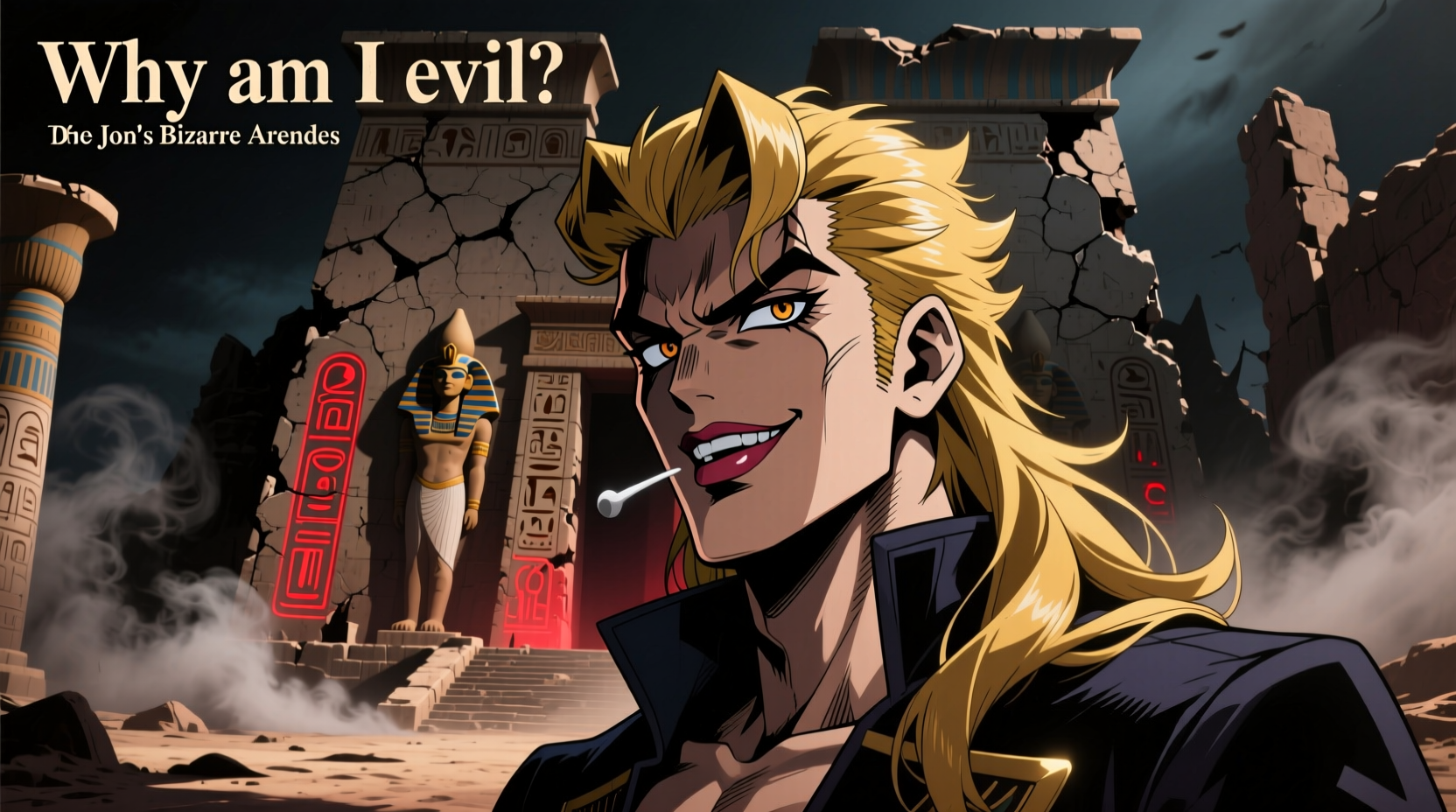
Dio’s descent into evil begins long before he drinks the ancient Stone Mask blood. Born into poverty, Dio grows up in the shadow of privilege, resenting George Joestar—the wealthy man who reluctantly takes him in after his father’s death. From the outset, Dio views kindness as weakness and charity as humiliation. He manipulates his adoptive father, seduces his sister, and ultimately frames Jonathan Joestar, the true heir, for crimes he himself commits.
This early behavior isn’t just rebellion—it’s a systematic dismantling of morality. Dio doesn’t merely act out of anger; he constructs an ideology where strength justifies cruelty, and survival demands dominance. His childhood environment doesn’t excuse his actions, but it contextualizes them. He learns that love is conditional, trust is exploitable, and power is the only currency that matters.
“Power is everything. With it, you can crush your enemies, make gods bleed, and rewrite fate.” — Dio Brando
Actions That Define Evil: A Pattern of Domination and Destruction
Dio’s actions across the series form a consistent pattern of exploitation and dehumanization. He doesn’t merely seek to win—he seeks to erase the agency of others. Consider the following key behaviors:
- Manipulation of Jonathan Joestar: Dio systematically undermines Jonathan’s reputation, turning allies against him and seducing Erina to sever emotional ties.
- Transformation into a Vampire: By using the Stone Mask, Dio embraces supernatural power at the cost of humanity, symbolizing his rejection of moral limits.
- Murder and Possession: After defeating Jonathan, Dio steals his body through the Stand ability *The World*, erasing Jonathan’s identity entirely.
- Global Tyranny: In *Stardust Crusaders*, Dio plans to use his influence to control world leaders, plunging civilization into chaos under his rule.
Each act escalates not just in scale, but in symbolic meaning. Dio doesn’t want wealth or fleeting pleasure—he wants absolute control over life, time, and destiny. His use of vampirism and Stands reflects this: abilities that stop time or drain life force are metaphors for his desire to freeze reality in a state of perpetual dominance.
Psychological Motivations: Beyond Power Lust
While many villains crave power, Dio’s motivation runs deeper than mere ambition. His worldview is fundamentally nihilistic. He believes that morality is a myth invented by the weak to restrain the strong. In one pivotal monologue, he declares: “If I wasn’t born, then God would be mocking me. So God must exist… so I can destroy Him.” This statement reveals more than arrogance—it reveals a warped sense of cosmic entitlement.
Dio positions himself not just as a conqueror, but as a challenger to divine order. He sees himself as evolution incarnate: a being who transcends human limitations and moral constraints. This belief system allows him to justify any atrocity. Killing innocents, betraying allies, even murdering his own followers—they are all acceptable if they serve his ascent.
Moreover, Dio exhibits traits consistent with narcissistic personality disorder and psychopathy. He lacks empathy, displays grandiosity, and uses charm strategically. Yet, unlike a mindless monster, Dio is intelligent, articulate, and self-aware. This combination makes him terrifying: he knows he’s evil, and he revels in it.
Comparison: Dio vs. Other Anime Villains
| Villain | Motivation | Moral Complexity | Redemption Arc? |
|---|---|---|---|
| Dio Brando | Total domination, rejection of morality | High (self-aware, philosophical) | No |
| Itachi Uchiha | Peace through sacrifice | Very high (sympathetic motives) | Yes |
| Griffith (*Berserk*) | Fulfilling a dream at any cost | Extreme (charismatic, tragic fall) | Debated |
| Aizen (*Bleach*) | Boredom with divine order | High (intellectual, god complex) | Limited |
Unlike Itachi, who commits atrocities for a greater good, or Griffith, whose betrayal stems from desperation, Dio acts purely out of ego. There is no hidden nobility in his cause. He does not suffer from regret or inner conflict. This lack of redeeming qualities is what solidifies his status as “evil” rather than “anti-villain.”
Mini Case Study: The Death of Kakyoin
In *Stardust Crusaders*, Dio’s Stand, *The World*, kills Noriaki Kakyoin—a young Stand user dedicated to protecting his friends. The scene is brief but significant. Dio doesn’t gloat or explain. He simply stops time, delivers a fatal blow, and resumes his conversation as if nothing happened. This moment encapsulates his philosophy: life is irrelevant unless it serves his purpose.
Kakyoin’s death shocks viewers not because of its brutality, but because of Dio’s indifference. He doesn’t hate Kakyoin. He doesn’t fear him. He erases him with the same ease one might swat a fly. This detachment from consequence is perhaps the purest expression of evil—not rage, not vengeance, but cold, emotionless supremacy.
Step-by-Step: How Dio Justifies His Evil
- Rejects societal morality: From childhood, Dio sees rules as tools of oppression used by the weak.
- Embraces strength as virtue: Physical, mental, and supernatural superiority become his only ethical standard.
- Seeks transcendence: Becomes a vampire to escape human limits, viewing immortality as proof of his superiority.
- Destroys rivals completely: Doesn’t just defeat enemies—he humiliates, possesses, or erases them (e.g., Jonathan’s body).
- Imposes will on reality: Uses time-stop ability to control outcomes, treating causality itself as subservient to his desires.
This progression shows that Dio’s evil isn’t impulsive—it’s ideological. Each step reinforces his belief that he exists beyond good and evil, answerable to no law but his own.
FAQ
Is Dio purely evil, or does he have redeeming qualities?
Dio has no redeeming qualities in the traditional sense. While he is charismatic and intelligent, these traits serve his tyranny. Unlike complex antagonists such as Madara Uchiha or Light Yagami, Dio never expresses remorse or a higher ideal. His charisma is manipulation, not virtue.
Could Dio’s evil stem from abuse or neglect?
Possibly. His abusive father and impoverished upbringing may have contributed to his worldview. However, other characters—like Jotaro Kujo—face adversity without embracing cruelty. Dio chooses evil consciously, making his actions deliberate rather than inevitable.
Why do fans admire Dio despite his evil?
Dio’s confidence, power, and iconic presence make him compelling. Phrases like “WRYYYY!” and “Muda Muda Muda!” have become cultural memes. But admiration for his character design or catchphrases doesn’t equate to endorsing his actions. He remains a cautionary figure of unchecked ego.
Conclusion: Embracing the Darkness—And Rejecting It
Dio Brando is evil not because he is powerful, but because he weaponizes power against meaning itself. He doesn’t fight for freedom, justice, or even revenge. He fights for the right to dominate unchallenged, to exist as a law above laws. His motives are clear, his actions consistent, and his philosophy terrifyingly coherent.
Understanding Dio’s evil isn’t about vilifying him further—it’s about recognizing how real-world ideologies of supremacy, nihilism, and toxic individualism can manifest in fiction. By examining his character with depth and honesty, we gain insight not only into storytelling but into the dangers of believing that strength alone should govern human conduct.




 浙公网安备
33010002000092号
浙公网安备
33010002000092号 浙B2-20120091-4
Comments
No comments yet. Why don't you start the discussion?