
Easter is one of the most significant holidays in the Christian calendar, commemorating the resurrection of Jesus Christ. Unlike fixed-date holidays such as Christmas, Easter moves each year—sometimes landing in March, other times in April. This variability often raises questions: Why does Easter shift? What determines whether it appears in March or April? The answer lies in a fascinating blend of astronomy, ancient tradition, and ecclesiastical calculation.
The timing of Easter is not arbitrary. It follows a precise set of rules rooted in both lunar cycles and historical church decisions. Understanding these principles reveals why Easter can occur as early as March 22 and as late as April 25—and why, occasionally, it arrives in March.
The Ecclesiastical Definition of Easter
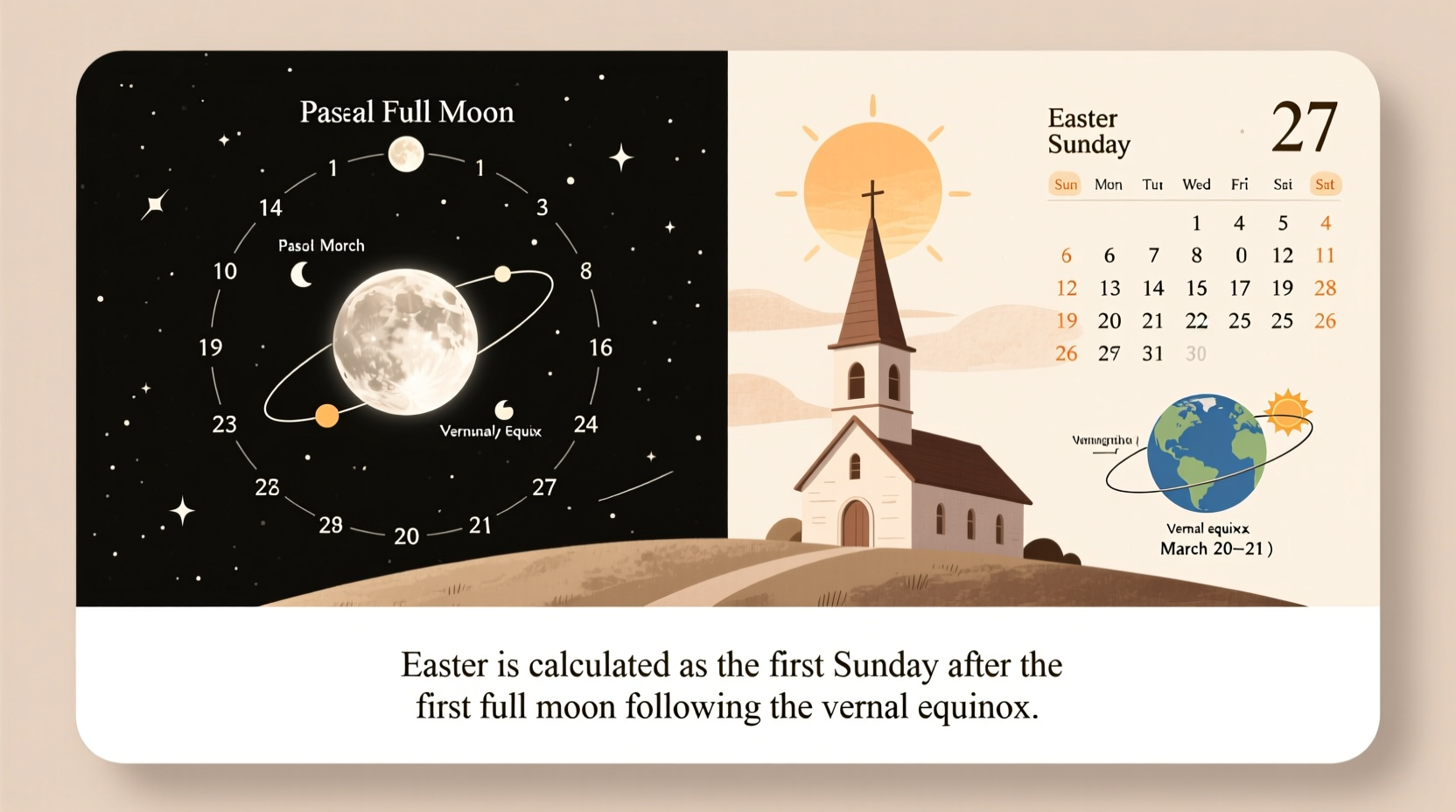
Easter Sunday is defined as the first Sunday after the Paschal Full Moon—the first full moon that occurs on or after the ecclesiastical spring equinox, which is fixed on March 21 regardless of the actual astronomical event. This rule was established during the First Council of Nicaea in 325 AD to standardize the celebration across all Christian churches.
Because the lunar cycle does not align perfectly with the solar calendar, the date of the Paschal Full Moon shifts from year to year. When this full moon occurs shortly after March 21, and the following Sunday falls within the same month, Easter lands in March.
How the Date Is Calculated: A Step-by-Step Process
Determining the date of Easter involves a structured method combining solar and lunar calendars. Here’s how it works:
- Establish the ecclesiastical equinox: Fixed on March 21, even if the astronomical equinox varies.
- Find the Paschal Full Moon: Use ecclesiastical tables to identify the first full moon on or after March 21.
- Determine the following Sunday: Easter is always the first Sunday after this full moon.
- Adjust for exceptions: If the full moon falls on a Sunday, Easter is the next Sunday.
This system ensures consistency across years and regions, though it relies on approximated lunar data rather than real-time observation. For example, in 2016, the Paschal Full Moon occurred on March 23, and since that was a Wednesday, Easter was celebrated the following Sunday—March 27. That year, Easter fell in March due to the early lunar cycle.
Historical Examples of March Easters
While Easter more commonly appears in April, it has occurred in March multiple times in recent decades. These instances illustrate how the interplay of lunar and solar calendars affects the holiday’s placement.
| Year | Paschal Full Moon | Easter Sunday | Notes |
|---|---|---|---|
| 2008 | March 21 | March 23 | Full moon on equinox; Easter two days later |
| 2016 | March 23 | March 27 | Early full moon led to March celebration |
| 2024 | March 25 | March 31 | Latest possible March Easter |
| 2025 | April 13 | April 20 | Example of April Easter for contrast |
As shown, when the Paschal Full Moon occurs in the final week of March, Easter will fall in March. But if the full moon is delayed until April, so too is Easter.
Why March Easters Are Less Common
Statistically, Easter falls in March about 30% of the time over a long-term cycle. The reason it feels less frequent is due to the average position of the lunar cycle relative to the equinox. Most often, the first full moon after March 21 occurs in early April, pushing Easter into that month.
Moreover, the Gregorian calendar's leap year system slightly alters the alignment of dates over time, influencing when lunar events coincide with the ecclesiastical calendar. This complexity is why some years produce rare early Easters, while others delay the celebration.
“Easter’s date reflects a delicate balance between solar time, lunar phases, and centuries-old religious tradition. It’s a living example of how science and faith once shaped our calendar.” — Dr. Lydia Chen, Historian of Religion and Timekeeping
Tips for Predicting Future Easter Dates
While you don’t need to calculate Easter manually, understanding patterns can help anticipate its arrival. Consider these practical insights:
- Easter cannot occur before March 22 or after April 25 under the current system.
- If March 21 is a Saturday and the full moon is that day, Easter will be March 22—the earliest possible date.
- Years with a January 1st falling on a Sunday often correlate with earlier Easters due to calendar alignment.
Mini Case Study: The 2008 March Easter
In 2008, Easter Sunday fell on March 23—one of the earliest dates in recent memory. The Paschal Full Moon occurred precisely on March 21, the ecclesiastical equinox. Since that date was a Friday, the following Sunday became Easter.
This created logistical challenges for some churches and schools that typically plan for an April holiday. In response, many dioceses revised their long-term planning models to account for March Easters, incorporating calendar forecasting tools to better schedule Lenten programs, vacation periods, and community events.
The case highlights how even predictable calendar variations can impact real-world planning—emphasizing the importance of understanding Easter’s variable nature.
Frequently Asked Questions
Can Easter ever be on March 21?
No. By definition, Easter must fall on the Sunday *after* the first full moon on or after March 21. Even if the full moon occurs on March 21, Easter will be the following Sunday at the earliest—March 22.
Why doesn’t the church use the actual full moon?
The church uses a standardized “ecclesiastical” full moon based on historical tables (the Metonic cycle) rather than astronomical observations. This ensures global uniformity and avoids reliance on local sky conditions or time zones.
Do Orthodox churches celebrate Easter on the same date?
Not always. Many Orthodox churches use the older Julian calendar for calculating Easter, which often results in a different date—sometimes weeks later than the Western (Gregorian) observance.
Actionable Checklist: Track Easter Dates Like an Expert
Stay ahead of shifting holiday schedules with this simple checklist:
- Bookmark a reliable Easter date calculator (e.g., timeanddate.com).
- Note the Paschal Full Moon date each year (available in almanacs or liturgical guides).
- Mark your calendar for Easter Sunday immediately after confirming the date.
- Review school and public holiday schedules, especially if planning travel or events.
- Update recurring reminders every five years to maintain accuracy.
Conclusion: Embrace the Rhythm of the Liturgical Calendar
The fact that Easter sometimes appears in March is not an error—it’s a feature of a deeply intentional system that links faith, nature, and time. Whether in March or April, the date serves as a reminder of the harmony between celestial cycles and spiritual tradition.
Understanding why Easter moves empowers individuals, families, and institutions to plan with confidence and appreciate the rich history behind this sacred celebration. As we navigate future Easters—whether early blooms in March or springtime peaks in April—we gain deeper respect for the wisdom embedded in our shared calendar.




 浙公网安备
33010002000092号
浙公网安备
33010002000092号 浙B2-20120091-4
Comments
No comments yet. Why don't you start the discussion?