
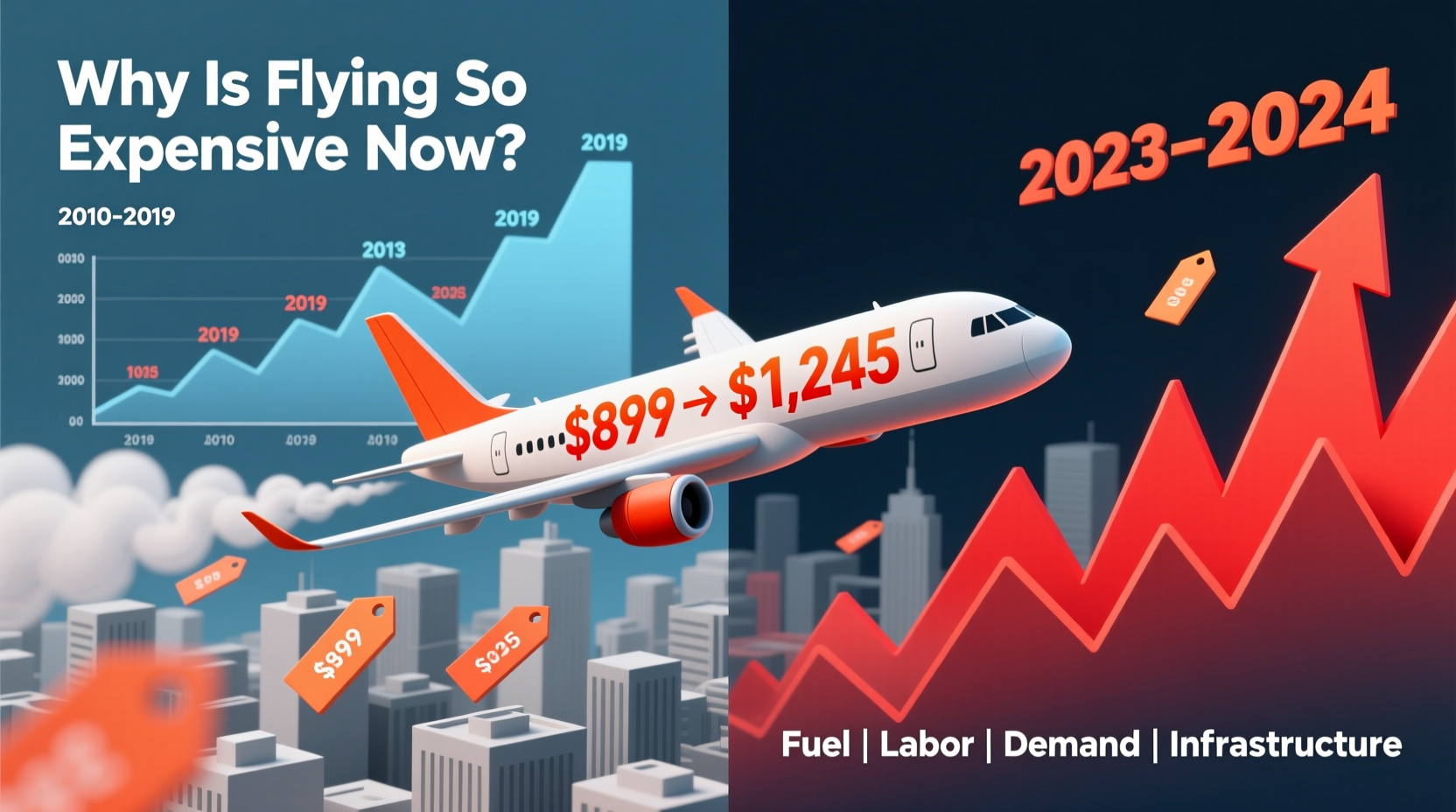
If you’ve recently searched for a plane ticket, you’ve likely flinched at the price. Whether it’s a cross-country flight or an international vacation, airfare in 2024 and 2025 feels significantly higher than just a few years ago. It’s not your imagination—domestic U.S. airfares are up nearly 30% since 2019, and international routes have seen even steeper increases. But why exactly is flying so expensive now? The answer lies in a complex web of economic forces, operational costs, and dynamic pricing models that airlines use to maximize revenue.
This article breaks down the real reasons behind today’s sky-high ticket prices, from fuel surges to post-pandemic travel demand, and reveals how airlines decide what you’ll pay. More importantly, we’ll show you how to navigate this new reality with smarter booking strategies and cost-saving insights.
The Anatomy of Airline Pricing: More Than Just Supply and Demand
Airlines don’t set prices like traditional retailers. Instead, they use sophisticated algorithms known as “revenue management systems” to adjust fares in real time based on dozens of variables. These include seat availability, booking window, historical trends, competitor pricing, and even your browsing behavior.
Every flight has hundreds of fare classes, each tied to different restrictions and refundability options. A $350 non-refundable economy ticket might sit on the same plane as a $1,200 fully flexible one. Airlines deliberately create this tiered structure to extract maximum value from each passenger segment—business travelers willing to pay more, leisure travelers seeking deals, and everyone in between.
“Dynamic pricing in aviation isn’t just about filling seats—it’s about optimizing every inch of capacity across thousands of routes daily.” — Dr. Sarah Lin, Aviation Economist at MIT Transport Lab
Key Factors Driving Up Airfare Today
While dynamic pricing explains *how* airlines charge what they do, several macro-level factors are pushing base fares higher across the board. Here are the most significant contributors:
1. Soaring Fuel Costs
Jets don’t run on wishes—they run on jet fuel, which accounts for roughly 25–30% of an airline’s operating costs. Since 2021, global fuel prices have fluctuated dramatically due to geopolitical instability, including the war in Ukraine and tensions in the Middle East. In early 2022, jet fuel prices spiked over 70% year-over-year.
Though prices have stabilized somewhat, they remain elevated compared to pre-pandemic levels. Airlines pass much of this cost directly to consumers through fuel surcharges and higher base fares. Even small changes in oil prices can add tens of dollars per ticket.
2. Post-Pandemic Travel Surge
After two years of lockdowns and restrictions, pent-up demand exploded in 2022 and 2023. People rushed to reunite with family, take postponed vacations, and attend events. This surge outpaced airline capacity, creating temporary shortages and driving up prices.
Unlike other industries, airlines can’t instantly scale up. They need trained pilots, certified aircraft, and airport slots—all limited resources. While carriers added flights, staffing shortages and supply chain delays slowed recovery. The imbalance between strong demand and constrained supply gave airlines pricing power.
3. Labor and Operational Costs
The pandemic disrupted airline staffing. Thousands of workers were furloughed or left the industry. Now, as travel rebounds, airlines face a shortage of pilots, mechanics, and ground crew. To attract talent, carriers have raised wages significantly—United Airlines increased pilot pay by up to 34% in 2022, and Delta followed suit.
Higher labor costs, combined with rising maintenance, insurance, and navigation fees, squeeze profit margins. Airlines respond by increasing fares to maintain financial stability.
4. Reduced Competition on Key Routes
Fewer competitors mean less price pressure. Over the past decade, major airlines have consolidated routes and eliminated overlapping services. On many regional or secondary routes, only one carrier operates direct flights, creating de facto monopolies.
For example, Alaska Airlines’ acquisition of Virgin America, American’s dominance at certain hubs like Dallas/Fort Worth, and United’s stronghold in Newark all reduce consumer choice. Without competitive pressure, airlines can sustain higher prices.
5. Ancillary Revenue Pressures
Airlines now rely heavily on add-ons—baggage fees, seat selection, priority boarding, inflight Wi-Fi—to boost profits. Spirit and Frontier earn over 40% of their revenue from ancillaries. But when passengers push back against nickel-and-diming, airlines may raise base fares to compensate.
In response to regulatory scrutiny and customer complaints, some carriers are simplifying bundles. However, these bundled packages often cost more than à la carte options would have in the past, contributing to the perception—and reality—of higher overall trip costs.
How Airlines Use Data to Maximize Your Fare
You might think prices are fixed, but they change dozens of times a day. Airlines monitor real-time data to predict willingness to pay. If a route shows strong last-minute bookings (a sign of business travelers), prices rise. If sales lag, discounts appear.
Your own behavior can influence pricing. Repeatedly searching for the same route without booking may trigger algorithmic suspicion that you’re ready to buy—prompting a fare increase. Using incognito mode and clearing cookies can sometimes help avoid this.
Additionally, connecting flights are often priced not by distance, but by market power. A flight from Buffalo to Miami via Charlotte might cost more than a direct New York–Miami flight—even though it’s longer—because the airline knows Buffalo travelers have fewer alternatives.
Real Example: The $450 vs. $900 Round-Trip Paradox
Consider Sarah, planning a trip from Chicago to Las Vegas. She searches for flights three weeks in advance and sees round-trip fares around $450. She waits a week, thinking prices might drop. Instead, they jump to $720.
Meanwhile, her colleague Mark books a last-minute trip for a work conference. His flight departs in two days, yet he pays $900. Why?
The airline’s system recognizes that leisure travelers like Sarah typically book earlier and are more price-sensitive. As departure nears and seats remain unsold, the system raises prices slightly, betting that remaining demand comes from urgent, less price-conscious travelers. Mark fits that profile. The same physical seat costs more because of timing and perceived urgency.
What You Can Do: Smart Strategies to Save on Flights
You can’t control global fuel prices or airline mergers, but you can adapt your booking habits to minimize costs. Here’s a practical checklist to help you find better fares in today’s expensive environment.
✈️ Flight Booking Checklist
- Set price alerts using Google Flights, Hopper, or Skyscanner
- Be flexible with dates—shifting by even one day can save hundreds
- Fly mid-week (Tuesdays, Wednesdays) for lower demand
- Consider nearby airports (e.g., Oakland instead of SFO, Trenton instead of JFK)
- Book international flights 2–5 months in advance; domestic 1–3 months
- Avoid holidays, school breaks, and major event weekends
- Use airline credit card points or frequent flyer miles strategically
- Check budget carriers—but factor in baggage and seat fees
Step-by-Step Guide: How to Find the Best Fare
- Start with flexibility: Choose a calendar view to compare prices across multiple dates.
- Compare aggregators: Check Google Flights first, then verify results on Kayak and Momondo.
- Look for hidden city tickets (cautiously): Sometimes flying to a longer destination is cheaper than a direct route. (Note: Only do this with one-way tickets and no checked bags.)
- Clear browser data: Search in incognito mode to reduce tracking-based price hikes.
- Wait for sales: Major carriers often launch promotions on Sundays or Mondays.
- Book at the right time: Studies suggest booking domestic flights 44–67 days before departure yields the best average prices.
- Recheck prices after booking: Many airlines offer 24-hour refunds. If fares drop, cancel and rebook.
Price Comparison: Average Round-Trip Fares (2019 vs. 2024)
| Route | 2019 Average | 2024 Average | Change |
|---|---|---|---|
| New York (JFK) to Los Angeles (LAX) | $290 | $385 | +32.8% |
| Chicago (ORD) to Miami (MIA) | $260 | $340 | +30.8% |
| Atlanta (ATL) to Denver (DEN) | $240 | $310 | +29.2% |
| Seattle (SEA) to Honolulu (HNL) | $480 | $670 | +39.6% |
| Philadelphia (PHL) to London (LHR) | $620 | $890 | +43.5% |
Note: Data sourced from Bureau of Transportation Statistics and Hopper’s 2024 Airfare Report. Increases reflect inflation, fuel costs, and reduced competition.
Frequently Asked Questions
Why are flights more expensive even when planes are full?
Full planes indicate high demand, which gives airlines leverage to maintain or raise prices. Unlike retail, where volume discounts apply, airlines aim to capture peak willingness to pay. Once a flight reaches a certain occupancy threshold, remaining seats are priced at premium levels.
Will flight prices ever go back down?
Significant drops are unlikely in the near term. Structural costs—fuel, labor, aircraft financing—are permanently higher than in 2019. However, increased competition on certain routes, entry of new low-cost carriers, and improved efficiency could stabilize prices. Expect gradual moderation, not a return to pre-pandemic lows.
Are budget airlines still worth it?
Yes, but with caveats. Carriers like Southwest, JetBlue, and Alaska often offer lower base fares and fewer hidden fees. Ultra-low-cost carriers (Spirit, Frontier) can be economical if you travel light and avoid add-ons. Always calculate the total cost—including bags and seat selection—before comparing.
Conclusion: Navigating the New Era of Air Travel
Flying is more expensive today because the entire ecosystem has changed. Higher operating costs, concentrated market power, and sustained demand have reshaped pricing. While we may never return to the ultra-cheap fares of the late 2010s, informed travelers can still find value.
The key is understanding how airlines think and act accordingly. Use tools, stay flexible, and plan ahead. Monitor trends, leverage rewards programs, and question assumptions about “normal” pricing. Air travel remains one of the most efficient ways to cover long distances—just at a new price point.




 浙公网安备
33010002000092号
浙公网安备
33010002000092号 浙B2-20120091-4
Comments
No comments yet. Why don't you start the discussion?