
In the world of Jujutsu Kaisen, few characters command attention like Satoru Gojo. With his effortless charisma, overwhelming power, and signature blindfold, Gojo stands as both a mentor and a mystery. One of the most frequently asked questions among fans is: Why are Gojo Satoru’s eyes always covered? Is it a fashion statement? A necessity? Or something deeper rooted in the series’ intricate lore? The answer lies at the intersection of ability mechanics, sensory control, and narrative symbolism.
Gojo’s blindfold isn’t merely aesthetic—it plays a crucial role in how he interacts with the world, controls his cursed energy, and maintains balance despite possessing one of the most powerful innate techniques in the series. To understand this fully, we must explore the nature of his abilities, the burden they impose, and how covering his eyes serves both practical and thematic purposes.
The Six Eyes: More Than Just Vision
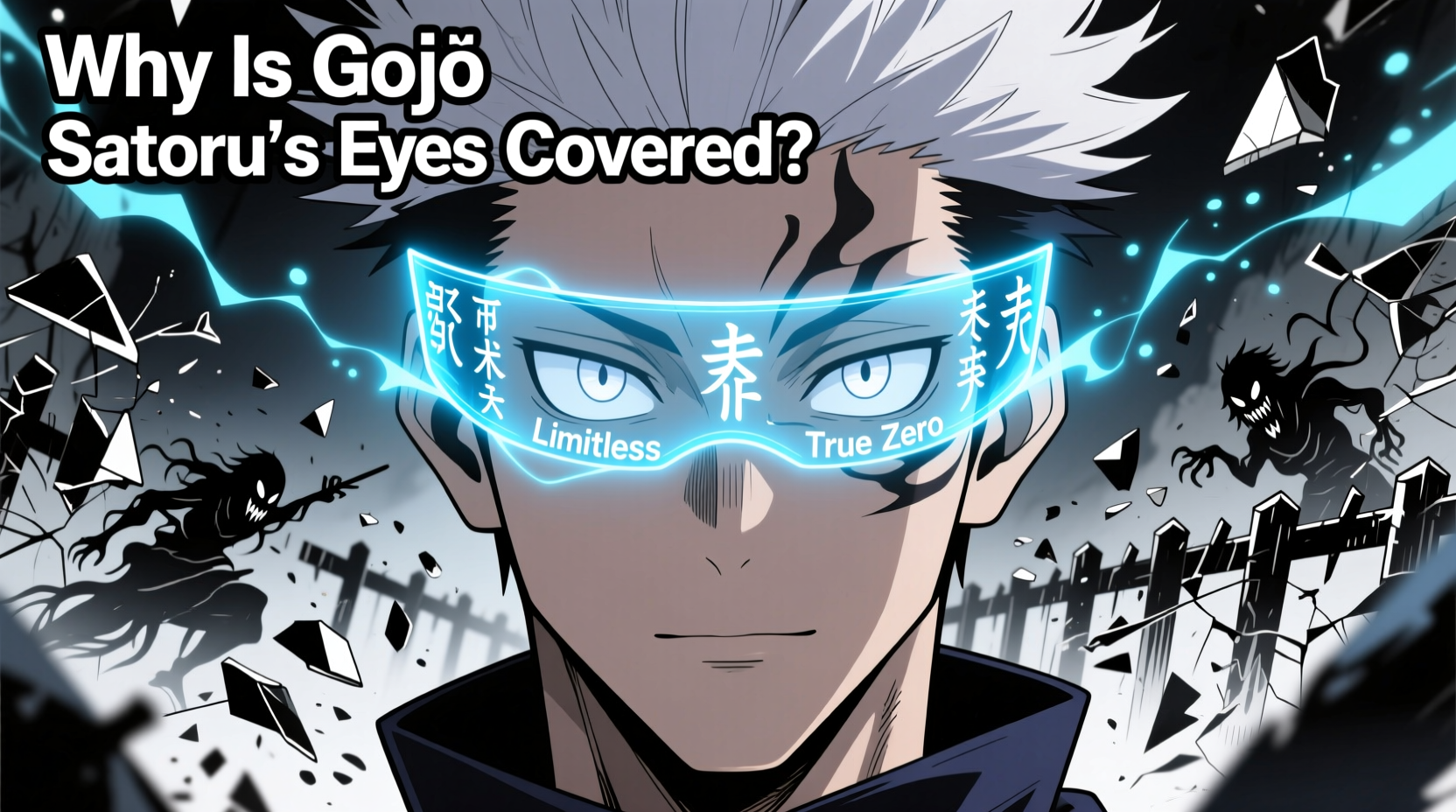
At the core of Gojo’s ocular mystery is his inherited trait known as the Six Eyes (Rikugan). This rare genetic ability is passed down within the Gojo family and grants him unparalleled perception of cursed energy. Unlike ordinary humans who can barely sense cursed energy—if at all—Gojo sees it constantly, in vivid detail, across vast distances.
The Six Eyes allow him to:
- Perceive cursed energy with extreme precision, including its density, flow, and origin.
- Track movements at high speed by visualizing energy trails.
- Analyze an opponent’s technique in real time, identifying weaknesses instantly.
- Maintain full awareness even when physically blinded or surrounded.
This level of perception is not just an advantage—it’s overwhelming. Imagine seeing every particle of energy around you at all times: the flicker of emotions, the invisible residue of curses, the pulsing life force of every living being nearby. For most people, such constant input would lead to sensory overload. But for Gojo, it’s a daily reality.
“With the Six Eyes, I see everything—too much, sometimes.” — Satoru Gojo, Jujutsu Kaisen Volume 0
Why Cover Overwhelming Senses?
Given that the Six Eyes enhance vision rather than impair it, why cover them? The answer lies in **control**. While Gojo’s eyes grant god-like perception, they also demand immense mental energy to process. Leaving them uncovered means enduring perpetual sensory bombardment, which can fatigue even someone of his caliber.
By wearing a blindfold or sunglasses (he alternates between the two), Gojo effectively filters out unnecessary stimuli. Think of it like noise-canceling headphones for the mind—blocking excess data so he can focus on what matters. This selective filtering allows him to conserve cursed energy and remain sharp during prolonged battles or teaching duties.
Moreover, Gojo doesn’t rely on conventional sight. His mastery of cursed energy and spatial manipulation via his domain expansion, Infinity, renders physical vision almost redundant. He navigates the world through energy signatures, making visual input secondary. In fact, removing his blindfold often signals serious intent—a shift from casual observer to active combatant.
The Infinity Technique and Sensory Manipulation
One of Gojo’s defining abilities is Infinity, a cursed technique that exploits the gap between actions by infinitely dividing the distance between himself and any incoming attack. As a result, objects or attacks never reach him—they’re perpetually halted just short of contact.
This technique is intrinsically linked to his vision. Infinity operates by processing infinite micro-distances in real time, requiring split-second calculations based on visual and energetic inputs. The Six Eyes provide the precision needed to sustain this barrier continuously. However, maintaining Infinity without regulation could drain his reserves rapidly.
Thus, covering his eyes helps regulate how much data flows into his brain. By limiting visual input, he reduces the cognitive load required to maintain passive defenses like Infinity. It’s a form of energy efficiency—akin to putting a powerful machine into standby mode until full power is needed.
When Gojo removes his blindfold, especially in battle, he’s not regaining sight—he’s unleashing full sensory engagement. His Infinity becomes sharper, his reaction time near-instantaneous, and his tactical analysis flawless. This moment is often accompanied by a chilling calmness, underscoring his transition into “Serious Mode.”
Symbolism and Character Design
Beyond mechanics, Gojo’s covered eyes serve a strong symbolic function. Visually, they create an air of mystery and detachment. You cannot read his gaze—his emotions are hidden behind fabric or tinted lenses. This reflects his position as an untouchable figure, both literally (due to Infinity) and metaphorically (as the strongest sorcerer).
The blindfold also reinforces the idea that true power doesn’t depend on sight. In many mythologies and martial arts traditions, the most enlightened warriors “see” beyond the physical realm. Gojo embodies this trope—he perceives truths invisible to others, not through emotion or intuition, but through raw data and cursed energy literacy.
Additionally, the contrast between his youthful appearance and obscured eyes adds depth to his character. He looks approachable, even playful, yet remains fundamentally unknowable. This duality makes him compelling: a teacher who jokes with students, yet carries the weight of isolation due to his unmatched strength.
Blindfold vs. Sunglasses: Contextual Use
Fans may notice that Gojo uses both a black blindfold and reflective sunglasses interchangeably. While stylistically similar, their usage varies by context:
| Accessory | When Used | Purpose |
|---|---|---|
| Black Blindfold | During training, casual moments, school settings | Maximizes sensory filtering; emphasizes relaxation and control |
| Reflective Sunglasses | Battles, formal appearances, public outings | Retains intimidation factor while offering partial visibility; more socially acceptable |
The blindfold represents internal focus, while the sunglasses project dominance. Both serve to shield his eyes—but each communicates a different facet of his personality.
Expert Insight: What the Creator Says
Gege Akutami, the creator of Jujutsu Kaisen, has commented on Gojo’s design choices in interviews and fanbooks. According to official sources:
“The blindfold isn’t there because he can’t see—it’s because he sees too well. Gojo lives in a world flooded with information. The covering is his way of choosing when to engage fully.” — Gege Akutami, Jujutsu Kaisen Official Fanbook
This insight confirms that the blindfold is less about disability and more about discipline. It’s a voluntary limitation, a tool of mastery rather than a crutch.
Common Misconceptions About Gojo’s Eyes
Several myths persist about Gojo’s eye covering. Let’s clarify them with lore-based facts:
- Myth: He’s blind under the blindfold.
Truth: His vision is perfect. The Six Eyes give him superior sight, not impaired vision. - Myth: The blindfold seals his power.
Truth: Nothing seals his power—it’s inherent and always active. The blindfold simply regulates input. - Myth: Removing it gives him a power-up.
Truth: It doesn’t increase power; it enables full utilization of existing senses and techniques.
Practical Implications in Battle
Understanding Gojo’s eye mechanics reveals key strategic elements in fight scenes. Consider his battle against Jogo in the prequel arc. Initially, Gojo wears his blindfold, effortlessly deflecting attacks using only cursed energy perception. Only when Jogo summons a massive fire dragon does Gojo remove it—signaling his intent to end the fight decisively.
This progression isn’t random. It demonstrates a hierarchy of engagement:
- Passive Defense: Blindfold on, Infinity active, minimal effort.
- Assessment Phase: Observing opponent’s cursed technique output.
- Full Engagement: Blindfold removed, Six Eyes fully analyzing and countering.
- Conclusion: Application of overwhelming force (e.g., Hollow Purple).
This sequence repeats across his fights, establishing a reliable pattern that enriches viewer anticipation and narrative tension.
Mini Case Study: Gojo vs. Sukuna (Shibuya Incident)
During the Shibuya Incident arc, Gojo faces off against Sukuna in a brief but pivotal clash. Though restrained by the Prison Realm, Gojo briefly breaks free and engages Sukuna directly—all while blindfolded.
This scene is telling. Even under extreme magical suppression, Gojo relies on non-visual perception. He dodges Sukuna’s slashes, counters with precise strikes, and nearly defeats the King of Curses using only cursed energy sensing. The fact that he doesn’t remove his blindfold underscores his confidence and control—he doesn’t need to “see” Sukuna to dominate him.
Only after being re-contained does the blindfold come off—revealing his eyes one last time before his apparent demise. That final reveal carries emotional weight: it’s the last glimpse of the strongest sorcerer, fully present, accepting his fate with clarity.
Frequently Asked Questions
Can Gojo see with his blindfold on?
Yes, absolutely. The blindfold doesn’t block his vision—it’s worn over functional eyes. However, he chooses not to use visual input extensively, relying instead on cursed energy perception. He can open his eyes beneath the fabric whenever needed.
Does removing the blindfold make Gojo stronger?
Not technically. His power level doesn’t increase, but his situational awareness and precision do. Removing the blindfold signifies full activation of the Six Eyes, allowing him to process maximum data for complex techniques like Domain Expansion or Hollow Purple.
Why don’t other sorcerers wear blindfolds?
Because they lack the Six Eyes. Most sorcerers struggle to perceive cursed energy clearly. Gojo’s condition is unique—an overload of information, not a lack of it. The blindfold solves a problem only he has.
Actionable Checklist: Understanding Gojo’s Eye Lore
To deepen your appreciation of Gojo’s character and abilities, follow this checklist:
- Review chapters where Gojo removes his blindfold (e.g., vs. Jogo, vs. Mahito, Shibuya climax).
- Analyze how his demeanor changes post-blindfold removal—note tone, posture, and dialogue.
- Compare his fighting style with and without full Six Eyes engagement.
- Study the mechanics of Infinity and how visual processing supports it.
- Read Gege Akutami’s commentary in official guides for creator insights.
Conclusion: Seeing Beyond Sight
Gojo Satoru’s covered eyes are far more than a stylistic quirk—they represent a profound balance between power and restraint. In a series defined by sacrifice, growth, and the cost of strength, Gojo’s blindfold symbolizes the burden of perfection. He sees everything, knows too much, and yet chooses moments of simplicity.
His story reminds us that true mastery isn’t about using all your power all the time—it’s about knowing when to hold back, when to engage, and how to protect your mind from the weight of infinite perception.




 浙公网安备
33010002000092号
浙公网安备
33010002000092号 浙B2-20120091-4
Comments
No comments yet. Why don't you start the discussion?