
Google powers a vast ecosystem of services used by billions every day — from Search and Gmail to YouTube, Google Drive, and Cloud infrastructure. When any part of this network stumbles, the impact is immediate and widespread. Users often rush to ask: \"Is Google down?\" Whether you're unable to send an email, stream a video, or access cloud-hosted files, understanding the real-time status of Google’s services — and how to respond — is essential in today’s connected world.
This guide provides clarity on tracking Google outages, interpreting service health data, and distinguishing between local connectivity issues and global disruptions. You’ll also learn practical steps to diagnose problems, stay informed during incidents, and minimize downtime.
How to Check If Google Is Down Right Now
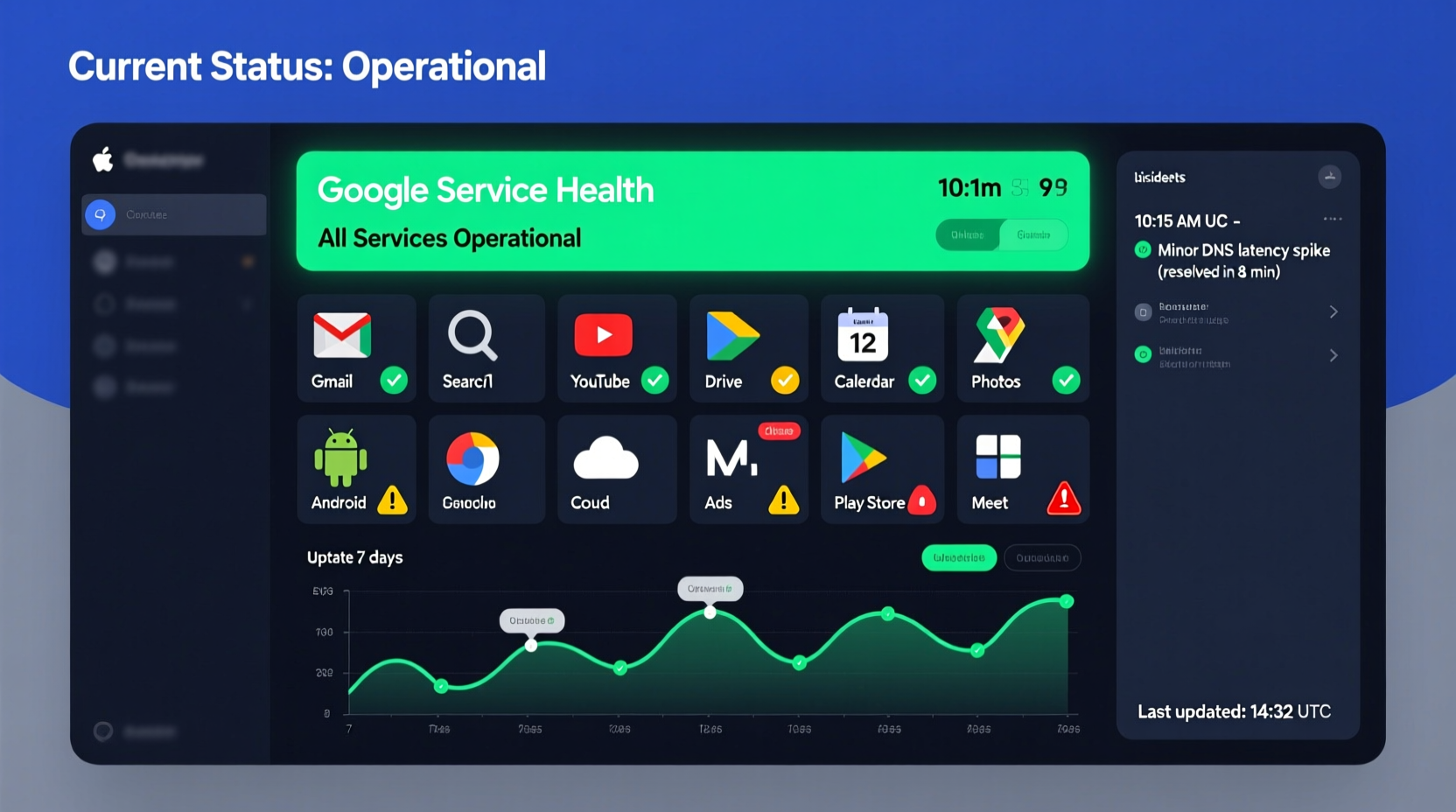
The first step when Google services seem inaccessible is verification. Before assuming a global outage, confirm whether the issue affects only your device, network, or the entire platform.
Start by visiting third-party outage tracking platforms that aggregate user reports and monitor service availability in real time:
- Downdetector: Displays real-time outage maps and user-submitted reports for Google services like Gmail, YouTube, and Google Meet.
- Outage.Report: Offers clean visualizations of trending issues based on social media mentions and network monitoring.
- Cloudflare Radar: Provides global internet performance insights, including regional Google outages.
Additionally, check Google's official Google Workspace Status Dashboard, which logs real-time updates across its enterprise and consumer services. This dashboard shows active incidents, resolved events, and historical uptime data for products like Google Calendar, Docs, and Drive.
Common Causes of Google Service Outages
Despite Google’s advanced infrastructure, outages do occur. Most are short-lived but can stem from various technical and operational sources.
- Software Deployment Errors: Pushing faulty code updates to live systems can disrupt core functionality. In December 2021, a configuration change caused a global Google outage affecting Gmail, YouTube, and Google Drive for nearly an hour.
- Authentication System Failures: Since many Google services rely on centralized login (OAuth), a breakdown in authentication cascades across platforms. That same 2021 incident originated in the identity management system.
- Network Infrastructure Issues: Problems with backbone routing, DNS propagation, or load balancer misconfigurations can isolate users from services.
- Third-Party Dependencies: Though rare, reliance on external CDNs or security providers may introduce vulnerabilities.
- Regional Disruptions: Natural disasters, ISP failures, or government-level internet throttling can affect localized access without impacting global operations.
“Even the most resilient systems face edge cases. What separates reliable platforms is not perfection, but speed of detection and recovery.” — Dr. Lena Patel, Senior SRE at a major cloud provider
Google Service Health Monitoring: A Practical Checklist
When Google feels “slow” or unresponsive, follow this checklist to assess and act efficiently:
- ✅ Test multiple Google services (e.g., Search, Gmail, YouTube) to see if the issue is isolated.
- ✅ Try accessing Google from another device or network (e.g., mobile data).
- ✅ Visit Google Workspace Status Dashboard for active alerts.
- ✅ Check Downdetector or Outage.Report for user-reported issues.
- ✅ Flush DNS cache (
ipconfig /flushdnson Windows,sudo dscacheutil -flushcacheon macOS). - ✅ Restart router and modem to refresh connection.
- ✅ Disable browser extensions temporarily to rule out interference.
Real-World Example: The December 2021 Global Outage
In one of the most significant Google outages in recent history, millions lost access to critical services on December 14, 2021. Users couldn’t log into Gmail, YouTube stopped loading videos, and Google Drive became unreachable. The disruption lasted approximately 45–75 minutes and impacted both consumers and businesses relying on Workspace tools.
According to Google’s post-mortem report, the root cause was a routine update to the company’s automated traffic management system that inadvertently triggered a cascade failure in authentication infrastructure. Internal safeguards failed to catch the error before deployment, and the system could not scale under the sudden load of re-authentication requests.
This case highlights two key lessons: even minor backend changes require rigorous testing, and single points of failure — especially in identity systems — pose disproportionate risks. For end users, it reinforced the importance of having offline backups and alternative communication channels during digital blackouts.
Do’s and Don’ts During a Google Outage
| Do | Don’t |
|---|---|
| Wait 5–10 minutes before troubleshooting — many outages resolve automatically. | Panic or assume account compromise; outages are rarely related to personal security breaches. |
| Use official status dashboards for accurate information. | Rely solely on social media rumors or unverified forums. |
| Switch to mobile data or hotspot to test network independence. | Repeatedly reset passwords or re-login attempts, which may trigger temporary locks. |
| Save work locally if using Google Docs/Sheets when connectivity returns. | Assume data is lost — Google typically restores service with no data deletion. |
Understanding Google’s Uptime and Reliability Standards
Google commits to high availability across its services, often guaranteeing 99.9% uptime in service level agreements (SLAs), particularly for paid Workspace and Cloud customers. This means planned downtime should not exceed about 43 minutes per year.
However, unplanned outages still occur. Google’s engineering teams use Site Reliability Engineering (SRE) principles to monitor system health, automate responses, and reduce human error. Automated rollback mechanisms, canary deployments, and distributed redundancy help contain issues before they escalate.
Still, no system is immune. Regional data center failures, cyberattacks (though Google has robust DDoS protection), and human errors during maintenance windows remain potential triggers.
Frequently Asked Questions
Is there a way to get real-time alerts when Google services go down?
Yes. You can subscribe to the Google Workspace Updates Blog or set up notifications via third-party tools like StatusGator or StatusCake, which monitor Google’s status feed and alert you via email or SMS during incidents.
Why can I access Google Search but not Gmail?
This usually indicates a targeted outage affecting specific services rather than the entire domain. Google runs each product on independent microservices. A failure in the authentication or mail delivery subsystem may disable Gmail while Search remains functional. It could also be a local cache issue — try clearing cookies for accounts.google.com.
Does Google compensate users for downtime?
For individual users, no compensation is offered. However, enterprise customers with paid Google Workspace or Google Cloud agreements may be eligible for service credits if uptime falls below the SLA threshold (typically 99.9%). These are applied automatically based on monthly reporting.
Conclusion: Stay Informed, Stay Prepared
Google’s infrastructure is among the most resilient in the world, but outages — though infrequent — remind us of our dependence on centralized digital ecosystems. Knowing where to check for real-time status, how to troubleshoot effectively, and what to expect during disruptions empowers you to respond calmly and efficiently.
Whether you’re a student relying on Docs, a professional using Gmail, or a business running on Google Cloud, preparation reduces frustration. Bookmark the official status dashboard, understand your network setup, and keep contingency plans in place. Digital resilience isn’t just about technology — it’s about awareness and action.




 浙公网安备
33010002000092号
浙公网安备
33010002000092号 浙B2-20120091-4
Comments
No comments yet. Why don't you start the discussion?