
Hawaii’s status as the 50th state of the United States is often taken for granted today, but its path to statehood was neither simple nor inevitable. Nestled in the central Pacific Ocean over 2,000 miles from the nearest continental shore, Hawaii stands apart geographically, culturally, and historically from the rest of the nation. Yet on August 21, 1959, it officially became part of the Union—a milestone that capped decades of political struggle, racial tension, and strategic maneuvering. Understanding why Hawaii is a state requires delving into a story of indigenous sovereignty, colonial ambition, military necessity, and civil rights.
The Kingdom of Hawaii and Early Western Contact
Prior to European contact, Hawaii was an independent Polynesian kingdom with a rich cultural tradition, a structured social hierarchy, and a thriving agricultural society. The islands were unified under King Kamehameha I in 1795, establishing a centralized monarchy that lasted nearly a century. However, the arrival of American missionaries and traders in the early 1800s began a slow transformation of Hawaiian society.
American businessmen, particularly those involved in the sugar industry, gained increasing influence. By the mid-1800s, they controlled vast tracts of land and relied heavily on imported labor from China, Japan, Portugal, and the Philippines. These economic shifts diluted native Hawaiian political power and laid the groundwork for foreign intervention.
“Hawaii was never conquered in war, yet it lost its independence through political manipulation and economic pressure.” — Dr. Lilikala Kame‘eleihiwa, Native Hawaiian Historian
Overthrow of the Monarchy and Annexation
The turning point came in 1893, when a group of American and European businessmen, backed by U.S. Marines, orchestrated the overthrow of Queen Liliʻuokalani, the last reigning monarch of Hawaii. The queen surrendered under protest, hoping the U.S. government would restore her throne. Instead, the provisional government declared itself the Republic of Hawaii in 1894, with Sanford B. Dole as president.
The push for annexation by the United States intensified during the Spanish-American War in 1898. With Pearl Harbor serving as a critical coaling station and naval outpost, U.S. strategic interests in the Pacific grew. Congress passed the Newlands Resolution, annexing Hawaii as a U.S. territory without a referendum or consent from the native population. This act remains controversial, viewed by many Native Hawaiians as an illegal occupation.
Life as a U.S. Territory: 1898–1959
As a territory, Hawaii lacked full representation in Congress and its residents could not vote in presidential elections. Despite this, the islands played a pivotal role in U.S. military operations, especially after the attack on Pearl Harbor in 1941. The war transformed Hawaii’s economy and demographics, bringing in tens of thousands of service members and federal investment.
Post-war, a powerful movement for statehood emerged. Led by figures like Delegate Joseph Farrington and later Senator Daniel Inouye, advocates argued that Hawaii’s loyalty had been proven during the war and that its diverse population deserved equal rights. However, opposition persisted in Washington. Some lawmakers questioned whether a majority non-white population could assimilate, while others feared the admission of a state so far from the mainland.
Key Milestones in the Statehood Movement
- 1946: The International Longshore and Warehouse Union (ILWU) leads a series of strikes, uniting workers across ethnic lines and demonstrating political cohesion.
- 1947: Hawaii gains the right to elect its own governor—previously appointed by the President.
- 1954: The Democratic Revolution of 1954 ends Republican oligarchic control, paving the way for progressive leadership committed to statehood.
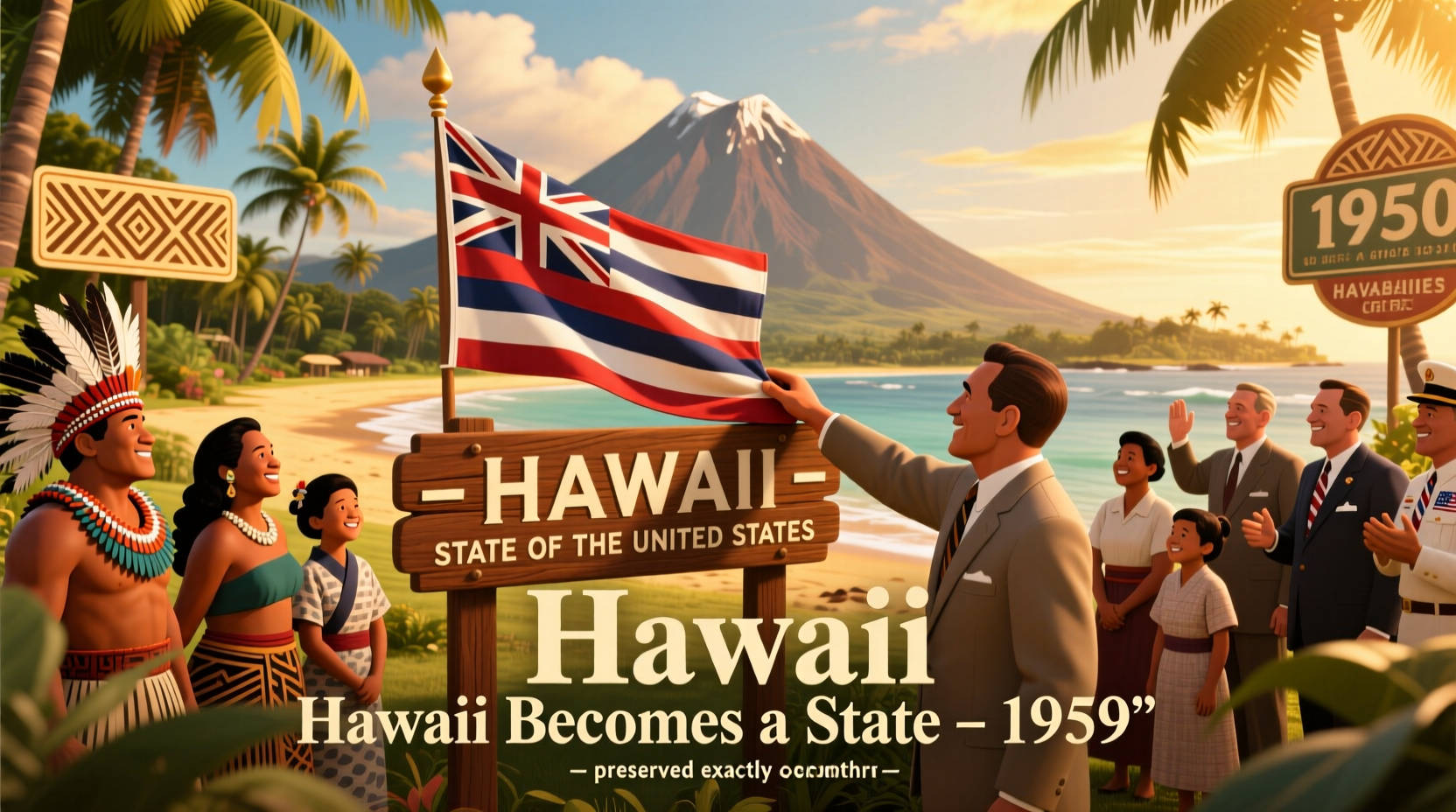
- 1959: Congress passes the Hawaii Admission Act; President Eisenhower signs it into law.
The Road to Statehood: A Step-by-Step Timeline
| Year | Event | Significance |
|---|---|---|
| 1893 | Overthrow of Queen Liliʻuokalani | End of Hawaiian monarchy; establishment of provisional government. |
| 1898 | Annexation via Newlands Resolution | Hawaii becomes a U.S. territory without native consent. |
| 1941 | Attack on Pearl Harbor | Highlights Hawaii’s strategic importance; strengthens ties to U.S. |
| 1954 | Democratic Party takes control of legislature | Shift in local politics accelerates statehood efforts. |
| 1959 | Congress approves Hawaii Admission Act | Resident vote favors statehood 17 to 1; Eisenhower proclaims statehood on August 21. |
Racial Politics and the Statehood Debate
One of the most contentious aspects of the statehood debate was race. In the 1950s, Hawaii’s population was less than 10% white, with large Japanese, Filipino, Chinese, and Native Hawaiian communities. Critics in Congress openly questioned whether such a racially diverse population could be “American” in values or governance.
Pro-statehood leaders countered by emphasizing Hawaii’s wartime loyalty, economic integration, and democratic institutions. They also downplayed ethnic diversity in their messaging to Washington, promoting an image of a harmonious, patriotic society. This careful framing helped overcome resistance rooted in racism and Cold War anxieties about communism in the Pacific.
The successful multiracial coalition in Hawaii contrasted sharply with the segregation still prevalent in much of the U.S. South. As historian Gunther Barth noted, Hawaii served as a model of pluralism at a time when the nation was grappling with civil rights.
Mini Case Study: The 1959 Referendum
In June 1959, a statewide referendum asked Hawaii’s residents whether they supported admission as a state. The results were overwhelming: 94.3% voted in favor, with a turnout of around 80%. However, the context matters. The ballot was only in English, disadvantaging older Native Hawaiians and immigrant elders. Moreover, the question assumed statehood within the U.S.—no option for independence or nationhood was presented.
While celebrated in Washington as a democratic endorsement, many Native Hawaiian activists today view the vote as flawed and symbolic of ongoing disenfranchisement. The Office of Hawaiian Affairs (OHA) continues to advocate for self-determination, citing the 1993 Apology Resolution, in which Congress formally acknowledged the illegality of the overthrow.
Frequently Asked Questions
Was Hawaii legally annexed by the United States?
The legality remains disputed. The U.S. government used the Newlands Resolution—an executive-congressional act without a treaty or popular vote—to annex Hawaii. Under international law, this method is questionable, especially given the lack of consent from the Hawaiian monarchy or people. The 1993 Apology Resolution acknowledges the U.S. role in the overthrow but does not reverse the annexation.
Why did it take so long for Hawaii to become a state?
Several factors delayed statehood: racial prejudice, concerns about loyalty due to the large Japanese-descended population before WWII, geopolitical uncertainty, and opposition from Southern senators who feared adding another non-segregationist state. It wasn’t until after Hawaii proved its loyalty during the war and demonstrated stable self-governance that Congress approved statehood.
Do Native Hawaiians support statehood?
Opinions are divided. While many Native Hawaiians are U.S. citizens and participate fully in state and federal systems, others identify as subjects of the Hawaiian Kingdom and reject U.S. authority. Movements for sovereignty or independence continue, advocating for federal recognition similar to Native American tribes.
Tips for Understanding Hawaii’s Political Status Today
- Educate yourself on the distinction between citizenship and sovereignty.
- Visit official resources like the Hawaii State Archives or OHA for balanced perspectives.
- Acknowledge place names in ʻŌlelo Hawaiʻi (Hawaiian language), such as “Kanaka Maoli” for Native Hawaiians.
- Support initiatives that preserve Hawaiian language and culture.
- Understand that tourism and military presence continue to shape Hawaii’s relationship with the mainland.
Conclusion: Beyond Statehood, Toward Reconciliation
Hawaii’s status as a state reflects a convergence of military strategy, economic interest, and mid-20th-century political will. But the story doesn’t end in 1959. For many, statehood was not a culmination but a continuation of a colonial process that began in 1893. The islands remain a unique blend of American governance and Pacific Islander identity—a place where U.S. flags fly alongside Hawaiian sovereignty banners.
Recognizing why Hawaii is a state means also recognizing the unresolved questions of justice, identity, and self-determination. The path forward may not lead to de-statehood, but it can lead to greater respect for Native Hawaiian rights, cultural revitalization, and honest dialogue about the past.




 浙公网安备
33010002000092号
浙公网安备
33010002000092号 浙B2-20120091-4
Comments
No comments yet. Why don't you start the discussion?