
Herpes simplex virus (HSV) affects hundreds of millions of people worldwide, yet despite decades of research, no cure exists. While antiviral medications can manage outbreaks and reduce transmission, they do not eliminate the virus from the body. The persistence of HSV in a latent state within nerve cells presents one of the most formidable obstacles in virology. Understanding why herpes remains incurable requires a deep dive into viral biology, immune evasion, and the limitations of current medical science.
The Nature of Herpes: Latency and Reactivation
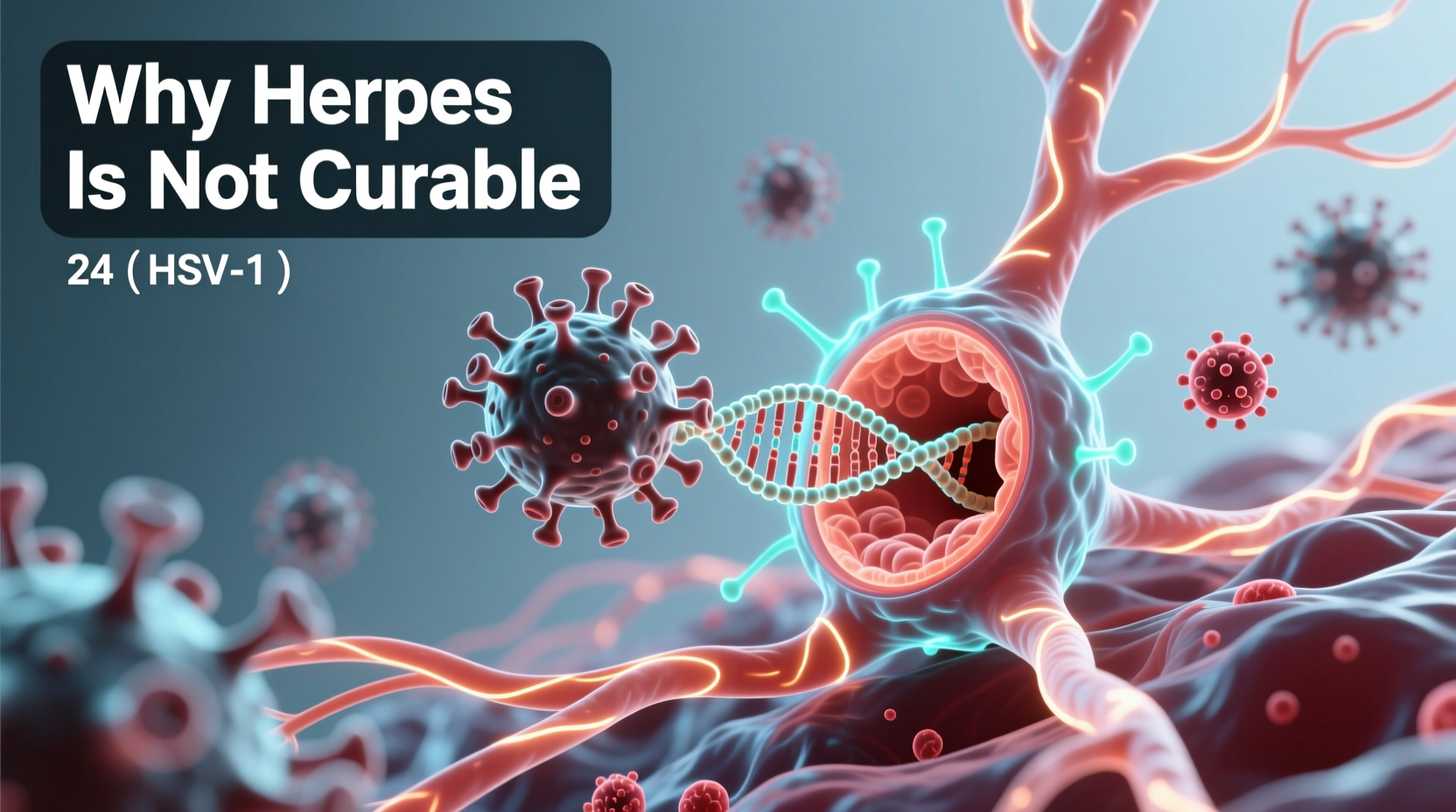
One of the primary reasons herpes is not curable lies in its ability to establish lifelong latency. After initial infection—typically through mucosal surfaces or broken skin—the virus travels along sensory neurons to the dorsal root ganglia, clusters of nerve cells near the spinal cord. Here, it enters a dormant phase, where its genetic material persists without producing new viral particles.
During latency, HSV minimizes its activity, expressing only a small set of non-coding RNAs known as latency-associated transcripts (LATs). This low-profile existence allows the virus to evade detection by the immune system. Periodically, due to triggers like stress, illness, hormonal changes, or UV exposure, the virus reactivates, travels back down the nerve axon, and causes recurrent symptoms such as cold sores (HSV-1) or genital lesions (HSV-2).
Immune Evasion and Stealth Mechanisms
The human immune system is remarkably adept at identifying and eliminating pathogens. However, HSV has evolved multiple strategies to avoid immune surveillance. Upon entering host cells, the virus interferes with antigen presentation—a process critical for T-cell recognition. It also produces proteins that block interferon responses, which are essential for early antiviral defense.
Once latent, the virus becomes virtually invisible. No viral proteins are produced in significant amounts, meaning there’s nothing for immune cells to target. Even when reactivation occurs, the virus often replicates locally before the immune response fully mobilizes, allowing transmission or lesion formation before control is reestablished.
“Herpes doesn’t just hide—it actively manipulates the host’s immune signaling to ensure its survival.” — Dr. Angela Chen, Virologist, National Institute of Allergy and Infectious Diseases
Challenges in Drug Development and Cure Research
Current antiviral drugs like acyclovir, valacyclovir, and famciclovir work by inhibiting viral DNA replication during active phases. They are effective at reducing symptoms and transmission but have no impact on latent viral reservoirs. Because these drugs require active viral replication to function, they cannot reach the dormant virus hiding in neurons.
Developing a cure would require one of two approaches: either eliminating every copy of the viral genome from all infected nerve cells, or permanently silencing the virus beyond reactivation. Both present immense technical hurdles:
- Delivery to neurons: The nervous system is protected by the blood-brain barrier, making it difficult for drugs or gene-editing tools to reach latent virus sites.
- Precision targeting: Any therapy must distinguish between viral DNA and human DNA to avoid damaging essential genes.
- Complete eradication: Missing even a few viral genomes could lead to future reactivation.
Emerging Strategies in Cure Research
Despite the challenges, researchers are exploring several promising avenues:
- Gene editing with CRISPR-Cas9: Scientists have used CRISPR to target and disrupt HSV DNA in animal models, significantly reducing viral load and reactivation rates.
- Therapeutic vaccines: Unlike preventive vaccines, these aim to boost the immune system’s ability to control or eliminate latent virus.
- Latency-reversing agents: These compounds force the virus out of hiding, making it vulnerable to antivirals or immune attack—a “shock and kill” strategy similar to HIV cure research.
- mRNA-based therapies: Leveraging mRNA technology to train immune cells to recognize and destroy infected neurons.
| Approach | How It Works | Status |
|---|---|---|
| CRISPR Gene Editing | Targets and cuts HSV DNA in nerve cells | Preclinical (animal trials) |
| Therapeutic Vaccines | Enhances T-cell response against HSV | Phase I/II trials |
| Shock and Kill | Reactivates virus for immune clearance | Conceptual/experimental |
| Antisense Oligonucleotides | Blocks viral gene expression | Early research |
Mini Case Study: The CRISPR Mouse Model Breakthrough
In a landmark 2020 study published in Nature Communications, researchers used CRISPR-Cas9 delivered via adeno-associated viruses (AAVs) to target HSV-1 in mice with established latent infections. After treatment, up to 90% of viral DNA was eliminated in sensory ganglia, and reactivation rates dropped dramatically. Some mice showed no signs of recurrence even after immunosuppression.
This experiment demonstrated, for the first time, that complete suppression of latent herpes was technically possible. However, translating this success to humans poses challenges: ensuring safe delivery to human neurons, avoiding off-target effects, and scaling the treatment across millions of widely dispersed nerve cells.
Do’s and Don’ts for Living with Herpes
While a cure remains elusive, individuals can take meaningful steps to manage the condition and reduce transmission risk.
| Do’s | Don’ts |
|---|---|
| Take antivirals as prescribed | Ignore outbreaks or delay treatment |
| Use condoms or dental dams consistently | Assume you’re non-infectious between outbreaks |
| Communicate openly with partners | Internalize stigma or shame |
| Maintain a healthy lifestyle to support immunity | Overuse alcohol or suppress the immune system unnecessarily |
Frequently Asked Questions
Can herpes ever be completely cleared from the body naturally?
No. Once infected, HSV establishes permanent latency in nerve cells. The immune system controls but does not eliminate the virus. Natural clearance does not occur.
Are there any vaccines for herpes?
As of now, no approved vaccine prevents or cures HSV. Several candidates are in clinical trials, including Moderna’s mRNA-1608 and GSK’s gD subunit vaccine, but none are commercially available yet.
If I have no symptoms, can I still spread herpes?
Yes. Asymptomatic shedding—when the virus is present on the skin without visible sores—accounts for a significant portion of transmissions. Antivirals and barrier methods reduce but do not eliminate this risk.
A Realistic Path Forward
The quest for a herpes cure is not abandoned—it is evolving. While early optimism in the 2000s gave way to sobering realizations about viral latency, recent advances in gene therapy and immunology have reignited hope. CRISPR-based strategies, though years from clinical application, represent the most direct path toward eradication. Meanwhile, therapeutic vaccines may offer functional cures—long-term remission without daily medication.
Public awareness and destigmatization are equally crucial. Millions live with HSV without severe complications, yet fear and misinformation persist. A cure will not only require scientific breakthroughs but also societal readiness to embrace prevention, testing, and open dialogue.
Conclusion
Herpes remains uncured not due to lack of effort, but because of the virus’s sophisticated biology and ability to hide in sanctuary sites within the nervous system. Current treatments effectively manage the disease, but true eradication demands unprecedented precision in targeting latent viral reservoirs. With ongoing research in gene editing, immunotherapy, and vaccine development, the possibility of a cure—once deemed distant—is now cautiously within sight.




 浙公网安备
33010002000092号
浙公网安备
33010002000092号 浙B2-20120091-4
Comments
No comments yet. Why don't you start the discussion?