
In American football, few penalties draw more frustration from fans and players than holding. Whether it's an offensive lineman wrapping up a defender or a receiver impeding a cornerback downfield, holding disrupts the natural flow of the game. But why exactly is holding penalized at 10 yards? And what makes this infraction so significant across both NFL and college football? The answer lies in the balance between player safety, competitive fairness, and the strategic integrity of the sport.
Holding is one of the most common penalties in football, yet its implications are often misunderstood. It’s not just about stopping a play—it’s about preserving the core principles of athletic competition: skill, speed, and legal physical engagement. The 10-yard penalty isn’t arbitrary; it’s carefully calibrated to deter illegal contact while maintaining game continuity.
The Definition and Mechanics of Holding
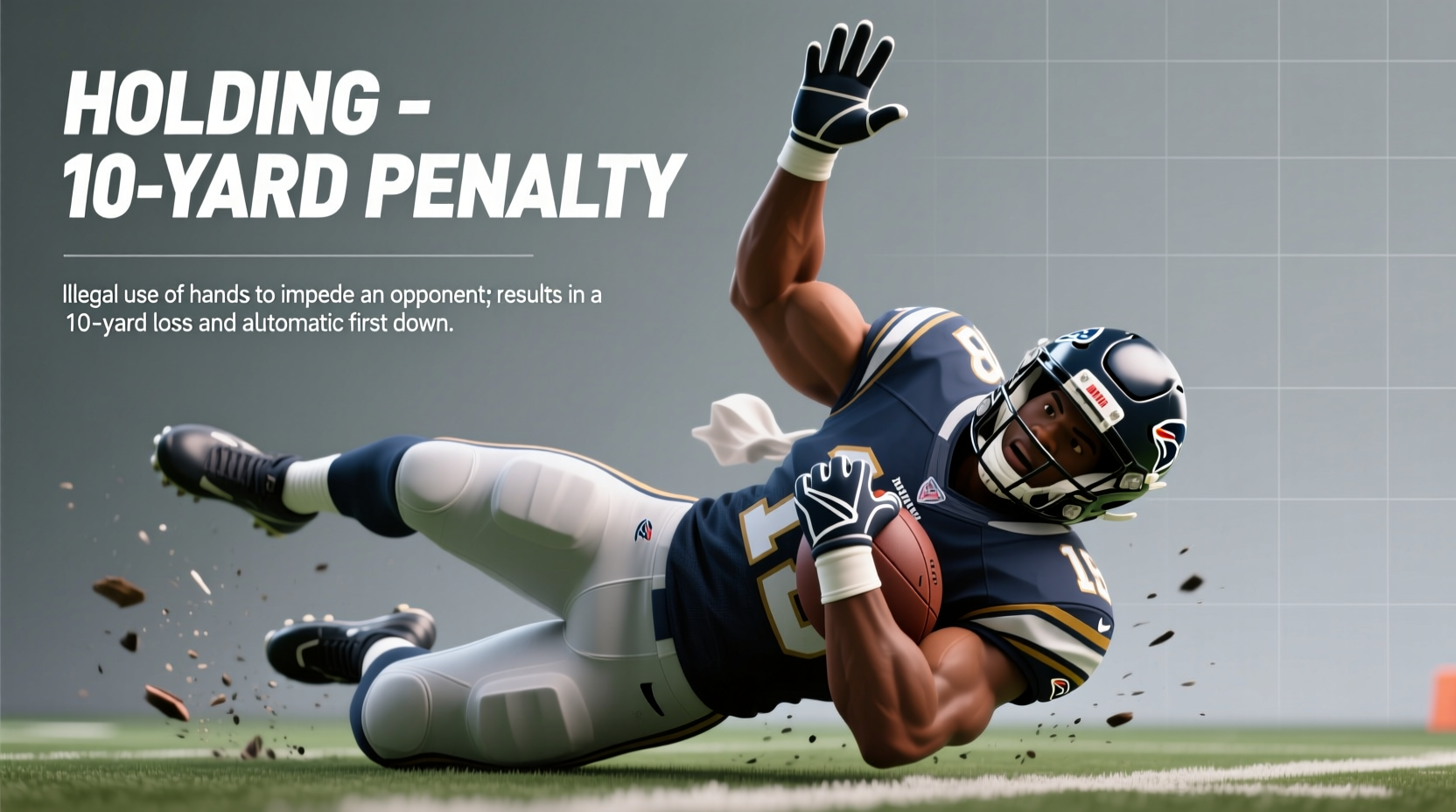
According to the official NFL Rulebook, holding is defined as “a player who restrains an opponent by grasping with hands or arms or by encircling with any part of the body.” This applies on both offense and defense. On offense, holding typically occurs when an offensive lineman grabs a defender’s jersey, arm, or body to prevent them from reaching the quarterback or ball carrier. On defense, it happens when a defender impedes a receiver’s route by grabbing or restricting their movement before the ball arrives.
The key distinction is that blocking is allowed through legal hand placement and body positioning—but once a player uses their hands or arms to restrict movement beyond initial contact, it becomes holding. The rule exists to ensure that blocks and routes are won through technique and athleticism, not brute restraint.
Why 10 Yards? The Strategic Rationale
The 10-yard penalty for holding strikes a balance between punishment and practicality. A shorter penalty might not be enough of a deterrent, especially in critical situations like third down. A longer penalty—say, 15 or 20 yards—could unfairly swing momentum or make games overly stop-and-start due to excessive yardage losses.
Consider this: on standard downs, a 10-yard penalty resets manageable situations into difficult ones. For example, a first-and-10 at midfield becomes first-and-20 after a holding call—effectively killing most drives. In the red zone, where field position is compressed, a 10-yard penalty can push a team out of scoring range entirely.
This yardage also aligns with other major penalties in football. False start, illegal formation, and pass interference (in college) are all 5-yard infractions, while personal fouls are 15 yards. Holding sits in the middle, signaling its seriousness without being excessively punitive.
“Holding undermines the fundamental contest between blockers and pass rushers. The 10-yard penalty ensures teams pay a real price for gaining an unfair advantage.” — Mike Pereira, Former NFL Vice President of Officiating
Offensive vs. Defensive Holding: Key Differences
While both types result in a 10-yard penalty, the enforcement and interpretation differ significantly.
| Type | When Called | Yardage Applied | Down Replayed? |
|---|---|---|---|
| Offensive Holding | During run or pass blocking | 10 yards from line of scrimmage | No – loss of down |
| Defensive Holding | Against a receiver before pass arrives | Automatic first down; spot of foul | Yes – down replayed |
Notice the asymmetry: offensive holding results in a loss of down, meaning a team cannot retry a third-down play. Defensive holding, however, grants the offense an automatic first down and the down is replayed. This reflects the greater disadvantage receivers face—if a defender illegally impedes a route, the offense may have no chance to complete the pass.
Real-Game Impact: A Case Study
In a pivotal 2022 NFC playoff game, the Green Bay Packers faced a third-and-7 late in the fourth quarter, trailing by four points. Quarterback Aaron Rodgers dropped back to pass, but left tackle David Bakhtiari grabbed the defensive end’s jersey after being beaten off the edge. The official flagged the play for holding.
The 10-yard penalty turned third-and-7 into third-and-17. Instead of attempting a medium-range pass, the Packers were forced into a long-yardage situation. They failed to convert, turned the ball over on downs, and lost the game.
This moment underscores how a single holding call can alter outcomes. While Bakhtiari’s action prevented a sack, the cost was too high. Coaches often cite such plays when emphasizing discipline: “You can’t win with penalties,” said Packers head coach Matt LaFleur postgame. “Ten yards changes everything.”
Evolution of the Holding Rule
The holding penalty has evolved significantly since football’s early days. In the 1920s and 1930s, holding was rampant and rarely called. Linemen routinely wrestled defenders to the ground, leading to slow, brutal games. As passing became more central to the sport, officials began cracking down on illegal contact to open up the field.
The modern enforcement of holding gained momentum in the 1978 “Mel Blount Rule” era, named after the aggressive Steelers cornerback whose coverage tactics led the NFL to limit contact downfield. That rule change indirectly increased scrutiny on offensive holding as well, ensuring neither side could dominate through illegal restraint.
Today, technology like instant replay and advanced camera angles help officials identify subtle holds that might have gone unnoticed decades ago. Yet subjectivity remains—a tight grip versus a clean block can be a judgment call, which fuels ongoing debate among fans and analysts.
How to Avoid Holding Penalties: A Player’s Checklist
- Maintain proper hand placement: keep hands inside the frame of your body and on the opponent’s torso, not the jersey or arms.
- Focus on footwork and leverage instead of relying on strength to control defenders.
- Disengage quickly after initial contact—don’t sustain a grab or wrap.
- Practice legal blocking techniques in drills, such as the “rip” or “swim” move.
- Study film to recognize tendencies that lead to holding, especially under pressure.
Frequently Asked Questions
Can holding be called on a running play only?
No. Holding can occur on any play—running, passing, or even special teams. It’s most common during pass protection, but illegal restraint on a running play is equally punishable.
Is there a difference between holding and illegal use of hands?
Yes. Illegal use of hands is a less severe 5-yard penalty, typically for brief or minor contact (like a quick shove). Holding involves sustained restriction and carries a 10-yard penalty with a loss of down.
Do college and NFL rules differ on holding?
The definition is nearly identical, but enforcement can vary. College officials sometimes allow more physicality at the line, while the NFL emphasizes cleaner, faster play. However, the 10-yard penalty applies in both leagues.
Conclusion: Respecting the Game’s Balance
The 10-yard holding penalty is more than a number on the scoreboard—it’s a reflection of football’s commitment to fair competition. By penalizing illegal restraint, the rules protect the integrity of one-on-one matchups and reward skill over subterfuge. Whether you’re a player refining your technique, a coach designing schemes, or a fan analyzing a close game, understanding the logic behind the 10-yard rule deepens appreciation for the sport’s nuances.
Football thrives on controlled physicality, but it collapses under unchecked manipulation. The holding rule ensures that wins are earned through execution, not evasion. As the game continues to evolve, the 10-yard standard remains a cornerstone of fairness and strategy.




 浙公网安备
33010002000092号
浙公网安备
33010002000092号 浙B2-20120091-4
Comments
No comments yet. Why don't you start the discussion?