
Since Viktor Orbán’s Fidesz party came to power in 2010, Hungary has undergone a dramatic transformation. Once hailed as a model of post-communist transition, the country now stands at the center of one of the European Union’s most persistent institutional crises. Over the years, Brussels has repeatedly accused Budapest of undermining judicial independence, restricting press freedom, and eroding democratic norms. Yet, despite mounting criticism, legal battles, and frozen funds, Hungary remains a full member of the EU. This raises a critical question: Why hasn’t Hungary been expelled—or left voluntarily?
The answer lies not in a single policy or treaty clause, but in a dense web of legal constraints, geopolitical realities, economic dependencies, and strategic calculations. Understanding Hungary’s continued EU membership requires unpacking the foundational principles of the bloc, the limits of its disciplinary tools, and the broader implications of setting a precedent for expulsion.
Legal Framework: The EU Cannot Expel a Member Unilaterally
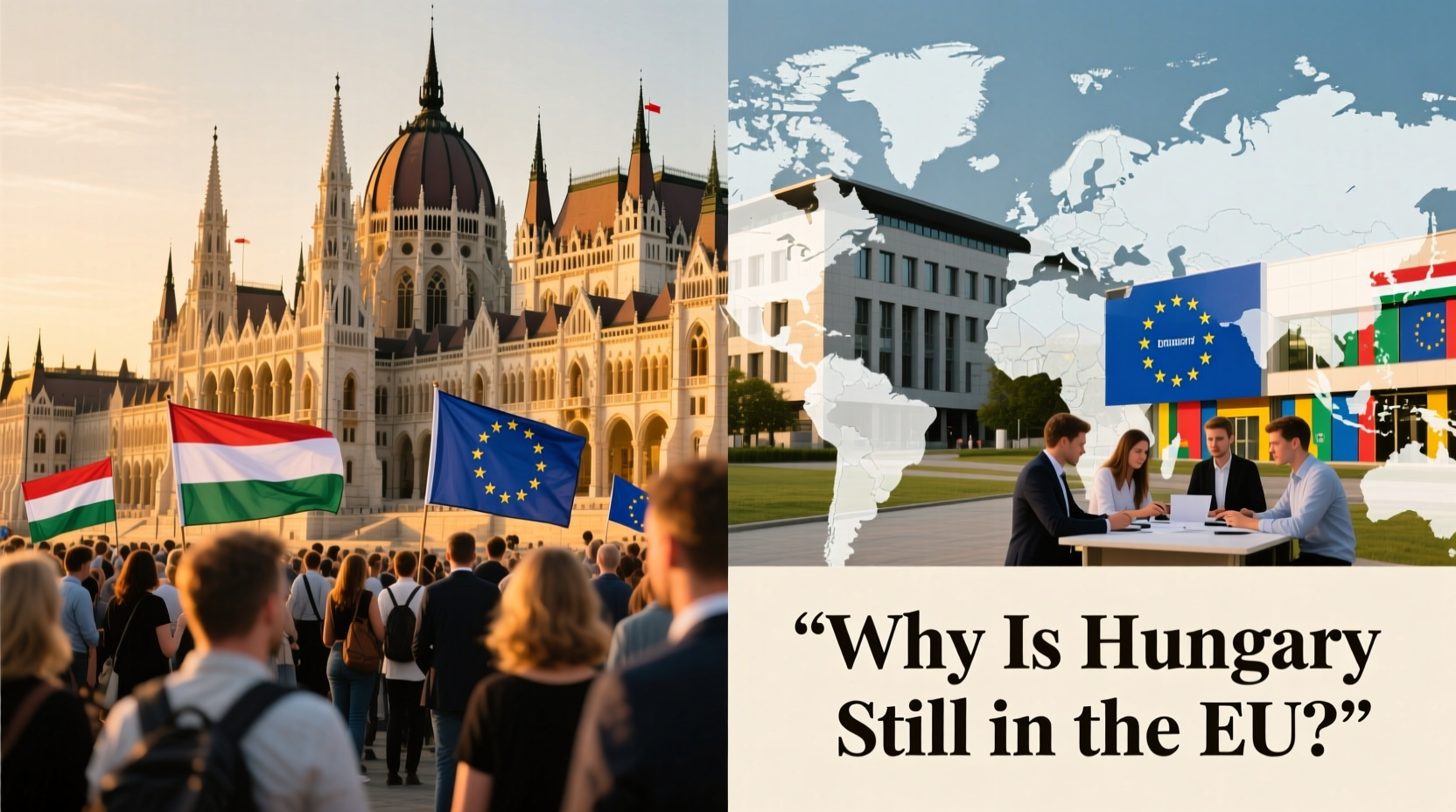
One of the most fundamental reasons Hungary remains in the EU is structural: there is no formal mechanism for expelling a member state against its will. Article 7 of the Treaty on European Union allows the Council to suspend certain rights of a member if it determines there is a “clear risk of a serious breach” of EU values (democracy, rule of law, human rights). However, triggering Article 7 requires unanimity among all other member states—including countries with similar governance models or strong bilateral ties to Hungary.
In 2018, the European Parliament voted to initiate Article 7 proceedings against Hungary, citing systemic threats to the rule of law. But the process has stalled. Countries like Poland, Slovakia, and even some Southern European members have resisted moving forward, fearing reciprocal scrutiny or weakening national sovereignty within the EU framework.
“We do not have a divorce procedure in the EU treaties. You can leave, but you cannot be kicked out.” — Jean-Claude Juncker, former President of the European Commission
This lack of an exit ramp for undemocratic regimes highlights a paradox at the heart of European integration: the union was built on shared values, yet lacks enforcement mechanisms robust enough to remove a member that systematically violates them.
Economic Ties and Financial Dependencies
Hungary’s economy is deeply integrated into the EU. In 2023, over 75% of Hungarian exports went to other EU countries, and the nation received approximately €6 billion annually in cohesion and agricultural funds. EU funding accounts for roughly 4% of Hungary’s GDP, supporting infrastructure projects, rural development, and regional modernization.
While the EU has withheld billions in recovery funds due to rule-of-law concerns—linking disbursements to judicial reforms and anti-corruption measures—this leverage is limited. Withholding funds pressures Hungary economically but does not compel departure. On the contrary, Budapest has every incentive to remain inside the club to access markets, subsidies, and diplomatic influence.
Diplomatic Strategy: Hungary’s Use of Veto Power
Hungary has skillfully used its position as a full member to shield itself from deeper sanctions. As one of 27 EU members, it holds veto power over key decisions requiring unanimity—such as foreign policy statements, accession talks with new members, and appointments to top EU roles.
In recent years, Budapest has leveraged this power to delay or block initiatives it opposes, particularly those related to Ukraine and sanctions on Russia. For example, Hungary delayed approval of the EU’s 2024 budget and obstructed military aid packages unless exemptions were granted for its energy imports from Russia. This behavior increases the cost of confrontation for other member states, making collective action more difficult.
In essence, Hungary turns its controversial stance into bargaining power. Other members may disapprove of its domestic policies, but they cannot afford prolonged gridlock on urgent issues like defense or enlargement.
Comparison: Hungary vs. Other Controversial Members
| Country | Rule of Law Concerns | Funds Suspended? | Article 7 Triggered? | Still in EU? |
|---|---|---|---|---|
| Hungary | High (judicial independence, media freedom) | Yes (partial) | Yes (initiated, not concluded) | Yes |
| Poland | High (similar issues) | Yes (temporarily, later released) | Yes (ongoing) | Yes |
| Greece (2010s) | Medium (austerity-related governance) | No | No | Yes |
| UK | N/A | N/A | No | No (left voluntarily) |
This comparison shows that while Hungary is not alone in facing criticism, its combination of persistent rule-of-law breaches and active obstructionism makes its case unique. Unlike Greece during the debt crisis, Hungary is not seeking financial rescue. Unlike the UK, it does not seek to leave. It seeks to stay—on its own terms.
Real Example: The 2022 Recovery Fund Standoff
In 2022, the European Commission refused to release Hungary’s share of the pandemic recovery package—approximately €10 billion—citing insufficient reforms to prevent misuse of EU funds. Budapest responded by challenging the legality of the conditionality mechanism at the European Court of Justice (ECJ).
After months of negotiations, Hungary implemented minor anti-corruption measures—widely seen as cosmetic—allowing the release of partial funds. Critics argued the compromise undermined the credibility of EU conditionality. Supporters claimed it preserved unity and ensured eventual compliance.
This episode illustrates the EU’s dilemma: how to enforce rules without fracturing the union. Hungary demonstrated that incremental concessions, combined with legal challenges and political pressure, can unlock benefits without genuine systemic reform.
Expert Insight: The Limits of Conditionality
“The EU’s tools are designed for persuasion, not punishment. When a government is determined to resist, the union runs out of options quickly.” — Dr. Anna Szentkirályi, Senior Fellow at the German Marshall Fund
Scholars increasingly refer to this dynamic as “democratic backsliding within the system.” Unlike outright autocracies outside the EU, countries like Hungary exploit the openness and consensus-based nature of the bloc to entrench illiberal practices while retaining membership privileges.
Checklist: Key Factors Keeping Hungary in the EU
- No expulsion mechanism: Article 7 requires unanimity and suspension—not removal.
- Economic incentives: Hungary benefits significantly from EU markets and funding.
- Veto power: Budapest can block decisions, raising the cost of confrontation.
- Lack of consensus: Other members hesitate to escalate due to sovereignty concerns.
- Gradual erosion: Changes occur incrementally, avoiding clear red lines.
- Geopolitical role: Hungary remains part of NATO and participates in EU defense coordination.
Frequently Asked Questions
Can the EU legally kick out Hungary?
No. There is no provision in the EU treaties for expelling a member state against its will. Article 7 can suspend voting rights but not terminate membership. Only voluntary withdrawal (like Brexit) is legally possible.
Why doesn’t Hungary just leave the EU?
Hungary relies heavily on EU funding and trade. Leaving would trigger severe economic consequences, including loss of market access, reduced investment, and financial instability. Politically, Orbán frames his agenda as defending Hungarian sovereignty *within* Europe, not outside it.
Has any country ever come close to being expelled?
No. While Article 7 has been initiated against Hungary and Poland, neither has faced actual suspension of rights. The process is politically fraught and has never been completed, reflecting the EU’s preference for dialogue over exclusion.
Conclusion: A Test Case for European Unity
Hungary’s continued presence in the EU is not an oversight—it is a symptom of deeper structural challenges. The union was designed for cooperation among democracies, not for managing internal adversaries. As long as member states prioritize consensus over confrontation, and economic integration outweighs ideological alignment, countries can push the boundaries of EU values without facing expulsion.
Yet this situation is not sustainable indefinitely. Persistent rule-of-law violations undermine trust, weaken institutions, and set dangerous precedents. The EU must decide whether to strengthen its accountability mechanisms, accept a looser federation of divergent systems, or risk fragmentation.




 浙公网安备
33010002000092号
浙公网安备
33010002000092号 浙B2-20120091-4
Comments
No comments yet. Why don't you start the discussion?