
The phrase “ear of corn” is common in American English, especially during harvest season or summer barbecues. But if you’ve ever paused to wonder why we call it an “ear,” you’re not alone. After all, it has nothing to do with hearing. The term sounds odd when taken literally—how did a cob full of kernels become associated with something as unrelated as an ear? The answer lies deep in etymology, agriculture, and centuries of linguistic evolution.
This seemingly simple question opens the door to a fascinating journey through Old English, ancient farming practices, and the way language adapts over time. Understanding why it’s called an “ear of corn” isn’t just about semantics—it reveals how human culture shapes the words we use every day.
The Etymological Roots of “Ear”
The word “ear” in “ear of corn” doesn’t originate from the body part used for hearing. Instead, it comes from the Old English word *ǣr*, which meant “spike” or “husk of grain.” This term traces further back to the Proto-Germanic *ausez* and ultimately to the Proto-Indo-European root *ōs-* or *ōsos*, meaning “grain” or “husk.”
In historical agricultural contexts across Europe, “ear” was commonly used to describe the seed-bearing head of a cereal plant—such as wheat, barley, or rye. So when early settlers in North America began cultivating maize (what we now call corn), they applied familiar terminology to the new crop. The central stalk bearing kernels became known as the “ear” because it resembled the grain heads they had long referred to by that name.
“Language evolves through practicality. Farmers didn’t invent new terms for every crop—they reused what they knew.” — Dr. Lydia Hartman, Historical Linguist at the University of Vermont
What Exactly Is an Ear of Corn?
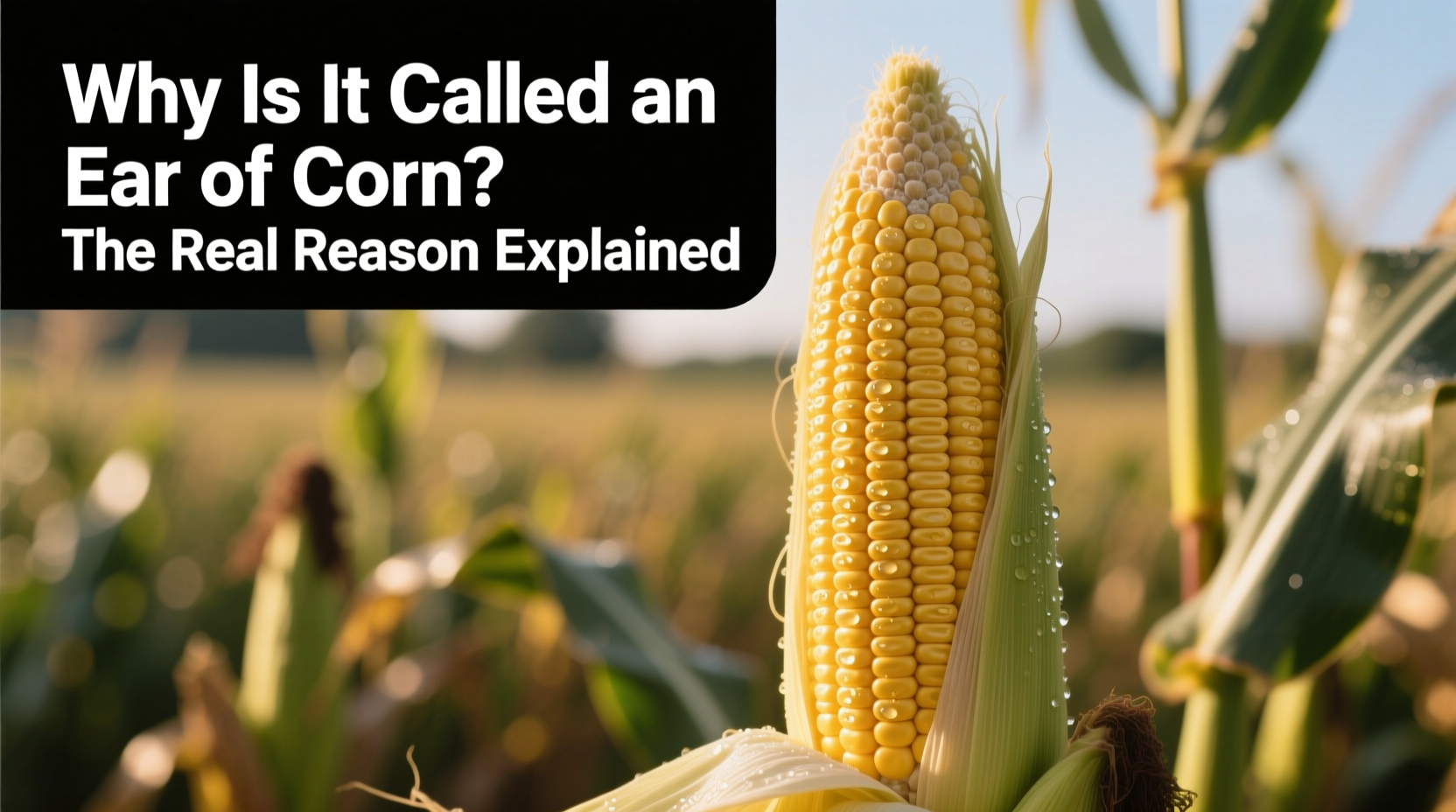
An ear of corn is the reproductive structure of the maize plant (*Zea mays*). It consists of a central core, called the cob, on which hundreds of individual kernels develop. Each kernel is technically a fruit, making corn botanically a type of caryopsis—a dry fruit with the seed fused to the pericarp.
The ear forms after pollination: silk strands emerging from the top capture pollen from the tassel (the male flower at the plant’s top), triggering kernel development along the cob. Once mature, the ear is encased in several layers of husk, which protect it from pests and weather.
Regional Differences in Terminology
Interestingly, the term “corn” itself varies significantly by region. In the United States, “corn” almost exclusively refers to maize. However, in the UK and much of the English-speaking world outside North America, “corn” historically meant the most important local grain—wheat in England, oats in Scotland, and so on.
Because of this, Britons might refer to the same part of a wheat plant as an “ear of corn,” even though no maize is involved. This broader usage underscores how context-dependent the word “corn” can be. In American English, however, “ear of corn” is unambiguously linked to maize.
How Language Preserves Agricultural Heritage
The persistence of the word “ear” reflects how deeply agriculture is woven into the fabric of language. Even as societies urbanized and fewer people grew their own food, farming-related terms remained embedded in everyday speech. Words like “harvest,” “sow,” “reap,” and yes, “ear,” carry forward agrarian metaphors.
For example, phrases such as “in the ear of the storm” or “turn a deaf ear” have no connection to plants—but the original meaning of “ear” as a fertile spike influenced its symbolic extension to receptivity and attention. This linguistic crossover shows how biological concepts can evolve into abstract ideas.
Timeline: Evolution of the Term “Ear of Corn”
- Pre-500 AD: Proto-Indo-European *ōsos* refers to grain or husk.
- 500–1100 AD: Old English *ǣr* denotes the spike of grain in wheat or barley.
- 15th Century: European farmers use “ear” broadly for cereal seed heads.
- Late 1490s: Columbus encounters maize in the Americas; Spanish call it *maíz*.
- 1600s: English colonists adopt “corn” for maize and apply “ear” to its cob.
- 1800s–Present: “Ear of corn” becomes standard in American agricultural and culinary language.
Common Misconceptions About the Term
Many assume the word “ear” must be a metaphor based on shape—perhaps the tuft of silk looks like a human ear? While tempting, this folk etymology lacks historical support. There’s no evidence that early speakers associated the plant part with the organ of hearing.
Another misconception is that “ear” refers to the act of “hearing” growth—like listening to the corn grow. Though poetic, especially given myths about hearing corn grow on quiet summer nights, this idea emerged long after the term was established.
| Misconception | Reality |
|---|---|
| The name comes from the shape resembling a human ear. | No linguistic or historical basis; the word predates any such visual association. |
| “Ear” refers to listening to corn grow. | A modern myth with no connection to etymology. |
| Only applies to sweet corn. | Used for field corn, popcorn, and all maize varieties. |
| “Corn” always means maize worldwide. | In British English, “corn” often means the primary local grain. |
Practical Tips for Handling and Identifying Ears of Corn
Whether you're shopping at a farmers market or growing your own, knowing how to select and store ears of corn ensures better flavor and texture.
- Check the silk: Fresh ears have moist, golden-brown silk. Dry or blackened strands indicate age.
- Feel the husk: It should be tight and green, not loose or yellowed.
- Test the kernels: Gently press one through the husk—if it releases milky liquid, it’s ripe.
- Avoid pre-husked corn: Exposure to air speeds up sugar-to-starch conversion, reducing sweetness.
Mini Case Study: A Farmer’s Perspective
On a family-run farm in Iowa, third-generation grower Mark Thompson explains how language persists in daily work. “We’ve always called it an ‘ear,’ even though my grandson once asked if corn listens to us out in the field,” he says with a laugh. “But seriously, when I say ‘harvest five hundred ears today,’ everyone knows exactly what I mean. It’s not just tradition—it’s precision.”
Thompson notes that despite technological advances—from GPS-guided planters to automated harvesters—the basic vocabulary of farming remains unchanged. “We still talk about ears, stalks, tassels, and husks. These words are efficient. They’ve stood the test of time.”
Frequently Asked Questions
Is an ear of corn a fruit, vegetable, or grain?
Botanically, each kernel is a fruit. Culinary-wise, fresh corn is treated as a vegetable. When dried and processed, it’s considered a grain. So corn fits all three categories depending on context.
Can you eat the cob?
While the cob softens slightly when boiled or grilled, it remains fibrous and tough. Most people eat only the kernels. However, cobs are used to make broths, infused liquids, or ground into masa harina in some traditional cuisines.
Why do some ears have missing kernels?
Kernels fail to develop when pollination is incomplete. If silk strands don’t receive pollen—due to drought, heat, or poor wind distribution—those spots remain empty. This is normal and doesn’t affect edibility.
Conclusion: Embracing the Language of Nature
The term “ear of corn” may seem strange at first glance, but it’s a testament to the continuity of language and agriculture. Rooted in ancient words for grain, preserved through generations of farmers, and still in active use today, it connects us to a shared history of cultivation and sustenance.
Every time you hold an ear of corn, you’re holding more than a summer staple—you’re engaging with a living piece of linguistic heritage. Understanding its name enriches not just vocabulary, but appreciation for the crops that feed us.




 浙公网安备
33010002000092号
浙公网安备
33010002000092号 浙B2-20120091-4
Comments
No comments yet. Why don't you start the discussion?