
The term \"D-Day\" evokes powerful images: paratroopers descending into darkness, landing craft cutting through choppy waters, soldiers storming fortified beaches under heavy fire. For many, D-Day refers specifically to June 6, 1944—the Allied invasion of Normandy during World War II. But why is it called D-Day? What does the \"D\" stand for, and how did a simple military designation become synonymous with one of history’s most decisive operations?
This article explores the linguistic roots of the term, its broader military usage, and the historical weight it carries today. Far from being a mysterious code or dramatic acronym, D-Day is grounded in practical battlefield planning—a system designed for clarity amid chaos.
The Literal Meaning of “D-Day”
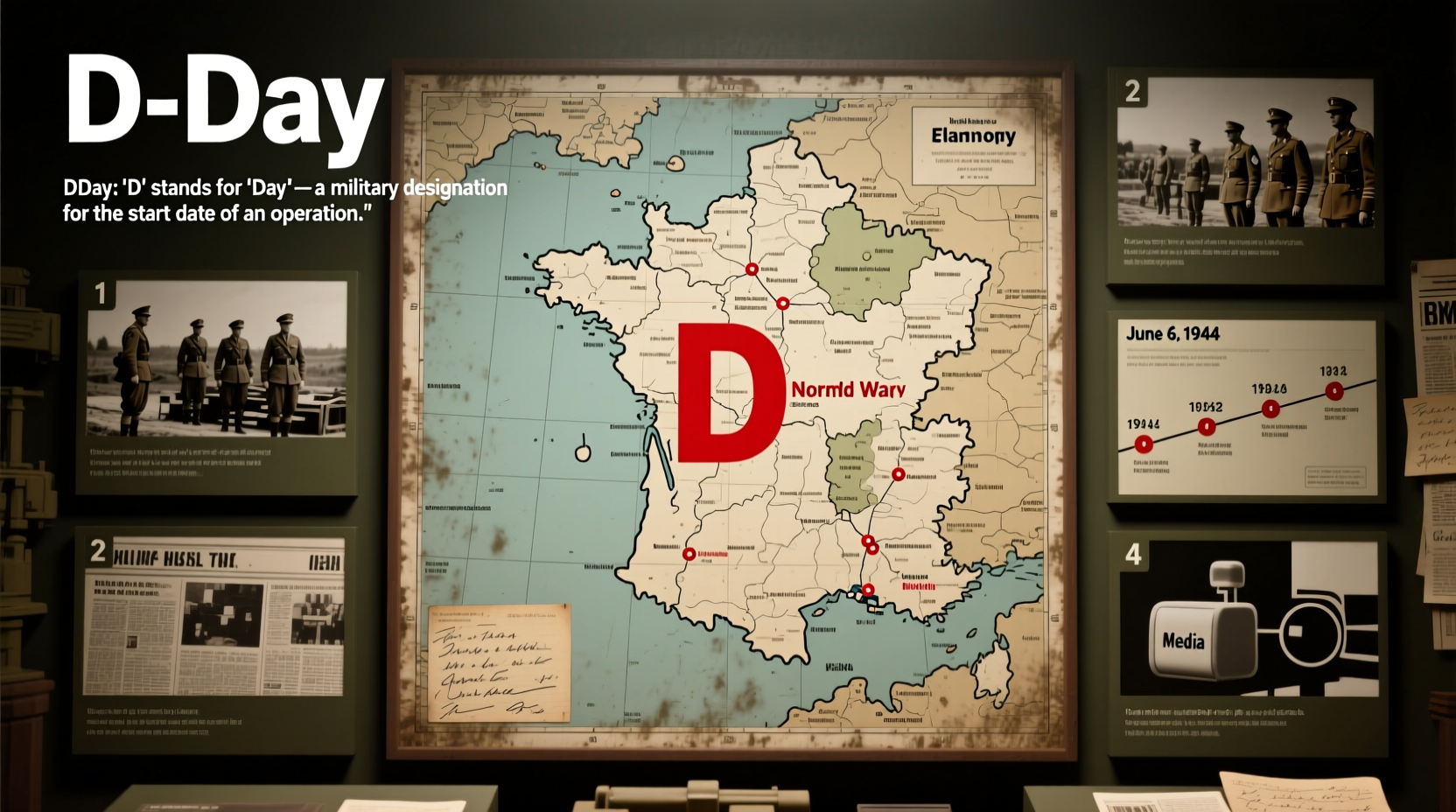
In military parlance, “D-Day” is not an abbreviation for phrases like “Decision Day,” “Do or Die,” or “Deliverance Day,” despite popular speculation. Instead, it follows a standardized notation used by armed forces to designate the day on which a combat operation begins. The “D” simply stands for “Day.” Similarly, “H-Hour” refers to the precise hour when an operation commences.
When planners don’t know the exact calendar date of an upcoming mission, they use “D-Day” as a placeholder. All other times are expressed relative to it: “D-3” means three days before the operation; “D+7” is seven days after. This system allows for flexible planning that can adapt to shifting conditions without rewriting entire schedules.
“D-Day has no meaning other than the day of an operation. It could be any day, anywhere. But history gave it one unforgettable date.” — Brigadier General James L. Collins Jr., U.S. Army (Ret.)
Historical Use Before Normandy
Long before June 6, 1944, the term was already embedded in military doctrine. Its earliest documented use dates back to World War I. In a 1918 order issued by the U.S. First Army, the phrase appeared clearly: “The First Army will attack at H-Hour on D-Day with the object of piercing the enemy’s line.”
During the interwar years, American and British military planners refined this terminology. By World War II, “D-Day” had become standard across joint operations. Every amphibious assault, airborne drop, or coordinated offensive had its designated D-Day—even if it wasn’t publicly known.
For example:
- The North Africa landings (Operation Torch) occurred on November 8, 1942—its D-Day.
- The Sicily invasion (Operation Husky) launched on July 10, 1943—another D-Day.
- The Battle of Guadalcanal began on August 7, 1942—also marked by its own D-Day.
Yet none of these captured global imagination like the Normandy invasion. Over time, “D-Day” became shorthand for Operation Overlord—the largest seaborne invasion in history.
Why Normandy’s D-Day Stands Out
What elevated the June 6, 1944, operation above others? Several factors converged to make this particular D-Day historically singular:
- Scale: More than 156,000 troops crossed the English Channel on D-Day alone, supported by over 7,000 ships and landing craft.
- Strategic Importance: Opening a Western Front forced Nazi Germany to fight on multiple fronts, accelerating the end of the war in Europe.
- Risk and Uncertainty: Weather delays, German fortifications (the Atlantic Wall), and high casualty expectations made success far from guaranteed.
- Global Attention: Extensive media coverage and postwar remembrance cemented the event in public consciousness.
General Dwight D. Eisenhower’s message to Allied forces, issued just hours before the landings, underscored the gravity of the moment:
“Soldiers, Sailors, and Airmen of the Allied Expeditionary Force! You are about to embark upon the Great Crusade... The eyes of the world are upon you.” — General Dwight D. Eisenhower, June 6, 1944
A Closer Look: Timeline of the Normandy D-Day
Understanding the sequence of events helps illustrate why the operation demanded such precise scheduling—and why the concept of D-Day was essential to its execution.
| Time | Event |
|---|---|
| D-1, ~22:00 | Allied paratroopers depart England for France |
| H-6, 00:15 (June 6) | Pathfinders land to mark drop zones |
| H-4, 00:48 | Main airborne drops begin (U.S. 82nd and 101st Airborne) |
| H-1, 03:30 | Bombardment fleet opens fire on coastal defenses |
| H-Hour, 06:30 | First wave lands on Utah and Omaha Beaches |
| H+90 min | British and Canadian forces land at Gold, Juno, and Sword Beaches |
| D+1 | Over 34,000 Allied troops ashore; bridgeheads established |
This meticulous coordination relied on synchronized timing. Had planners referred to actual dates throughout early drafts, any change would have required rewriting thousands of documents. Using D-Day and H-Hour allowed them to adjust the schedule efficiently—even delaying the invasion by 24 hours due to storms—without disrupting command flow.
Common Misconceptions About D-Day
Despite its straightforward definition, D-Day is often misunderstood. Below are some persistent myths and clarifications:
| Misconception | Reality |
|---|---|
| \"D\" stands for \"Decision,\" \"Doom,\" or \"Debarkation\" | No official expansion exists; \"D\" simply means \"Day\" |
| D-Day only refers to June 6, 1944 | It applies to any launch day of a military operation |
| D-Day ended the war | It began the liberation of Western Europe; victory came nearly a year later |
| All troops landed successfully | Utah Beach saw light resistance; Omaha Beach suffered devastating casualties |
Legacy and Cultural Impact
Today, “D-Day” transcends military jargon. It symbolizes courage, sacrifice, and the turning point of World War II. Museums, memorials, and annual commemorations honor those who fought on the beaches of Normandy. Phrases like “the longest day” (coined by Cornelius Ryan’s 1959 book) reflect both the duration and emotional weight of June 6.
Scholars emphasize the importance of preserving the term’s accuracy while recognizing its symbolic power.
“We must remember that D-Day was not just a date—it was a convergence of planning, bravery, and geopolitical necessity. But we also owe it to history to get the facts right.” — Dr. Rebecca S. Robbins, Military Historian, King’s College London
Frequently Asked Questions
Does D-Day always refer to June 6, 1944?
No. While commonly associated with the Normandy invasion, D-Day technically refers to the start date of any military operation. However, due to its prominence, the term is now culturally linked to June 6, 1944.
Were there multiple D-Days in World War II?
Yes. Each major offensive had its own D-Day. For instance, the Pacific Theater saw numerous D-Days for island-hopping campaigns, including Tarawa (November 20, 1943) and Okinawa (April 1, 1945).
Why wasn’t a more dramatic name used?
Military operations prioritize clarity and security. Code names like “Operation Overlord” were used for secrecy, but internal planning required neutral, functional terms like D-Day to avoid confusion and maintain flexibility.
How to Honor the True Meaning of D-Day
To truly understand D-Day, consider these actions:
- Visit a veterans’ museum or memorial dedicated to WWII
- Read firsthand accounts from soldiers who participated
- Educate others about the correct use of the term
- Attend a commemoration event on June 6
- Support organizations preserving wartime history and veteran stories
Conclusion
The term “D-Day” may seem enigmatic, but its origin is rooted in simplicity and function. Born from the need for clear, adaptable military planning, it became forever linked to one of humanity’s most consequential days. Understanding what D-Day really means—both literally and historically—deepens our appreciation for the precision, sacrifice, and scale of the Normandy invasion.
As time passes, the number of living witnesses dwindles. Preserving the truth behind terms like D-Day ensures that future generations remember not just the drama of battle, but the discipline, strategy, and human cost behind it.




 浙公网安备
33010002000092号
浙公网安备
33010002000092号 浙B2-20120091-4
Comments
No comments yet. Why don't you start the discussion?