
Good Friday stands as one of the most solemn days in the Christian calendar, marking the crucifixion of Jesus Christ and his death at Calvary. Yet the name itself raises a question for many: how can a day associated with suffering, betrayal, and execution be described as “good”? The term seems paradoxical, even contradictory. To understand why it’s called Good Friday, we must explore its linguistic roots, theological depth, historical development, and enduring spiritual significance across cultures and centuries.
The Paradox of \"Good\" in Good Friday
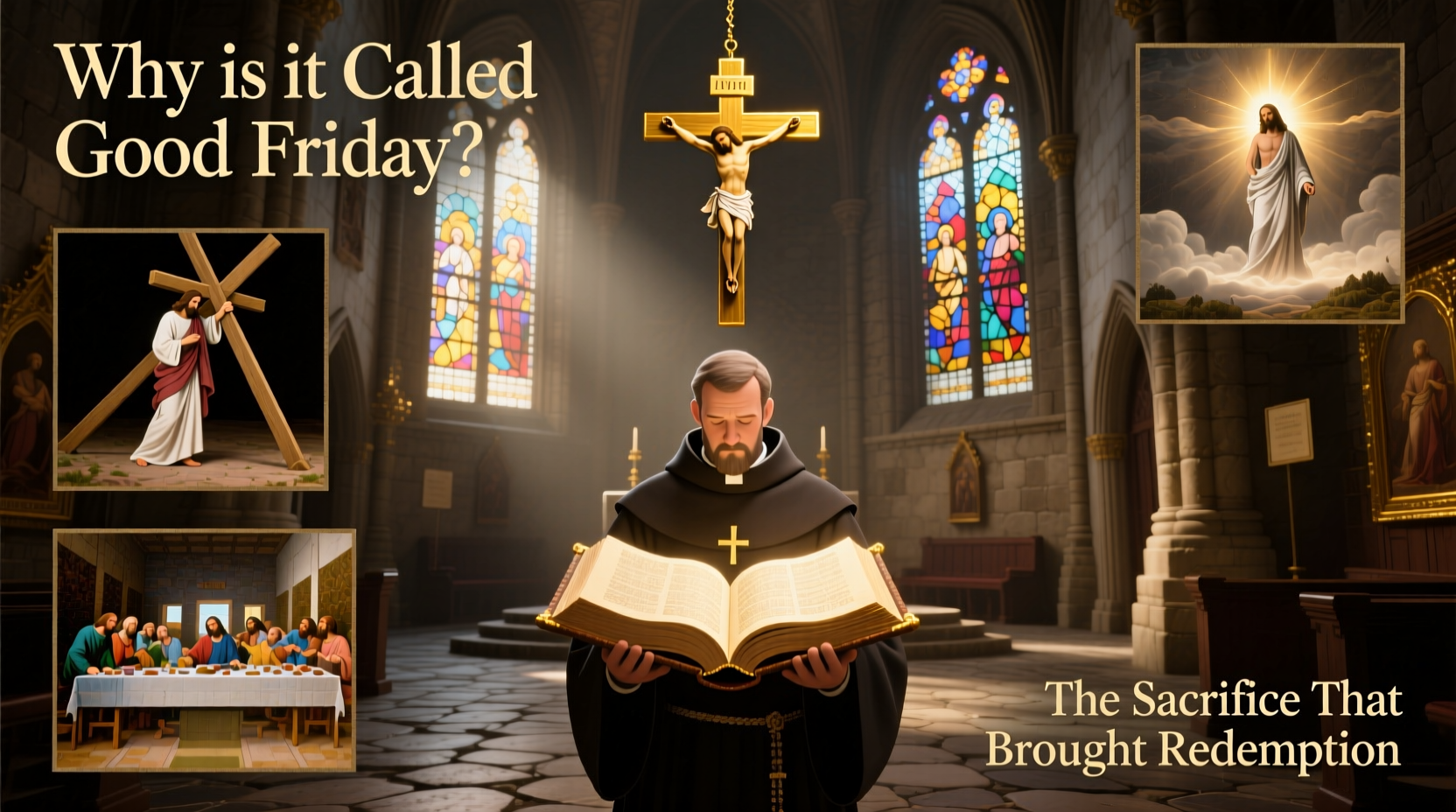
The word \"good\" in Good Friday does not imply happiness or pleasantness. Instead, it reflects an older English usage where \"good\" meant \"holy\" or \"pious.\" In this context, Good Friday is not celebrating the tragedy of Christ’s death but honoring it as a sacred event—central to the Christian belief in salvation. The day is observed with reverence, fasting, and reflection, emphasizing the profound spiritual consequence of Jesus’ sacrifice.
This paradox lies at the heart of Christian theology: that through immense suffering came redemption. The cross, once a symbol of shame and torture, became the ultimate emblem of love, forgiveness, and divine grace. As theologian Timothy Keller notes:
“The cross shows us both the horror of sin and the depth of God’s love. It is not just a historical event—it’s the turning point of history.” — Timothy Keller, Pastor and Theologian
Linguistic Origins: From \"God's Friday\" to \"Good Friday\"
One widely accepted theory traces the name to an older form of English. Scholars suggest that \"Good Friday\" may have originated from \"God’s Friday\"—a holy day set apart for divine purpose. Over time, \"God’s\" evolved phonetically into \"Good,\" especially in regional dialects and liturgical speech. This kind of linguistic shift is not uncommon; similar transformations appear in other religious terms like \"good-bye,\" originally a contraction of \"God be with ye.\"
Other languages reinforce this sacred interpretation. In German, the day is called *Karfreitag*, meaning \"Sorrowful Friday\" or \"Friday of Lamentation.\" In Latin, it's known as *Feria VI in Parasceve* (\"Friday of Preparation\"), while Romance languages often use terms like *Viernes Santo* (Spanish) or *Vendredi Saint* (French), both meaning \"Holy Friday.\" These names emphasize the solemnity rather than any positive emotion, aligning more closely with the day’s true nature.
Theological Significance: Why the Crucifixion Was Necessary
For Christians, Good Friday is not merely about remembering a tragic execution. It is the pivotal moment when, according to scripture, Jesus took upon himself the sins of humanity. This act fulfilled Old Testament prophecies and established a new covenant between God and humankind.
Central to this understanding is the concept of atonement—the reconciliation between God and people through Christ’s sacrificial death. Three key models explain this:
- Substitutionary Atonement: Jesus died in place of sinners, bearing punishment they deserved.
- Christus Victor: Jesus’ death and resurrection defeated sin, death, and evil powers.
- Moral Influence Theory: The cross demonstrates God’s love so powerfully that it transforms human hearts.
Each model underscores that the \"goodness\" of Good Friday lies not in the pain endured, but in the outcome: the possibility of forgiveness, eternal life, and restored relationship with God.
Timeline of Events on the Original Good Friday
A careful reading of the Gospels reveals a sequence of events that unfolded during the final hours of Jesus’ life. While details vary slightly among Matthew, Mark, Luke, and John, the core narrative remains consistent:
- Jesus shares the Last Supper with his disciples (Instituting the Eucharist).
- He prays in the Garden of Gethsemane, experiencing deep anguish.
- Judas betrays him with a kiss; Jesus is arrested.
- He undergoes trials before the Sanhedrin, Pontius Pilate, and Herod Antipas.
- Pilate sentences him to crucifixion despite declaring him innocent.
- Jesus carries his cross to Golgotha (Calvary).
- He is crucified between two criminals, forgiving those who crucify him.
- At noon, darkness covers the land for three hours.
- Jesus cries out, “It is finished,” and dies around 3 p.m.
- His body is taken down and placed in a tomb donated by Joseph of Arimathea.
This timeline is commemorated in many churches through services such as the Three Hours' Devotion, which runs from noon to 3 p.m., reflecting on Christ’s seven last words.
Cultural Observances Around the World
Good Friday is observed differently across global Christian communities, shaped by local traditions, denominational beliefs, and cultural expressions. Some notable practices include:
| Region | Observance | Significance |
|---|---|---|
| Rome, Italy | Papal procession at the Colosseum | Reenacts Stations of the Cross; emphasizes martyrdom and sacrifice |
| Philippines | Penitential rites, including actual crucifixions | Extreme acts of devotion expressing gratitude for answered prayers |
| Germany | Quiet day; no music, dancing, or public entertainment | Reflects mourning and respect for the sanctity of the day |
| Caribbean Nations | Consumption of hot cross buns and fish dishes | Symbols of Christ’s sacrifice and abstinence from meat |
| United States | Church services, veneration of the cross, fasting | Focused on repentance and contemplation of Christ’s suffering |
Despite diverse customs, the underlying theme remains constant: solemn remembrance of Jesus’ death as an act of divine love.
Common Misconceptions About Good Friday
Several misunderstandings persist about the meaning and purpose of Good Friday. Clarifying these helps deepen appreciation for the day:
- Misconception: Good Friday celebrates Jesus’ death.
Reality: It mourns the death while recognizing its redemptive purpose. - Misconception: Easter Sunday is more important than Good Friday.
Reality: Without the crucifixion, there would be no resurrection. Both are inseparable. - Misconception: Only Catholics observe Good Friday.
Reality: Many Protestant, Orthodox, Anglican, and other Christian traditions solemnly mark the day.
Mini Case Study: A Modern Encounter with Good Friday
Sarah Thompson, a college student raised in a non-religious household, attended her first Good Friday service at a friend’s invitation. Expecting something uplifting, she was struck by the stark emptiness of the sanctuary—no flowers, no music, only dim lighting and readings from the Gospel of John.
“I didn’t expect to feel anything,” she said later. “But when the pastor read Jesus’ words from the cross—‘Father, forgive them’—I started crying. I realized this wasn’t just about religion. It was about someone choosing love in the worst possible moment.”
Sarah now returns each year, not out of obligation, but because she finds honesty and hope in the sorrow. Her story illustrates how Good Friday continues to speak beyond tradition, touching lives in unexpected ways.
Frequently Asked Questions
Is Good Friday a public holiday?
Yes, in many countries—including the United Kingdom, Canada, Australia, Germany, and several Caribbean nations—Good Friday is a national public holiday. Businesses and schools often close to allow observance of the day.
Why do some people fast on Good Friday?
Fasting is a traditional practice to express repentance, solidarity with Christ’s suffering, and spiritual discipline. Many Christians limit themselves to one full meal and two smaller meals with no meat. The Catholic Church requires fasting for those aged 18–59 unless exempt for health reasons.
Can you say 'Happy Good Friday'?
Generally, no. Because it is a day of mourning, greetings like “Happy Good Friday” are considered inappropriate. More suitable phrases include “Blessed Good Friday” or simply acknowledging the solemnity of the day.
Conclusion: Embracing the Weight and Wonder of Good Friday
Good Friday earns its name not because it is joyful, but because it is holy. It represents the moment when divine love entered the darkest corners of human existence—betrayal, injustice, agony—and transformed them into instruments of grace. The title “Good Friday” invites us to look beyond surface meanings, to see how goodness can emerge from grief, and how sacrifice can become salvation.
Understanding the origins and meaning of Good Friday enriches not only our knowledge of Christian tradition but also our capacity to reflect on themes of sacrifice, forgiveness, and hope. Whether observed through worship, silence, or personal reflection, this day offers a powerful opportunity to confront the depth of human suffering and the greater depth of redeeming love.




 浙公网安备
33010002000092号
浙公网安备
33010002000092号 浙B2-20120091-4
Comments
No comments yet. Why don't you start the discussion?