
The term \"Great Britain\" is commonly used in everyday conversation, political discourse, and international relations, yet few pause to consider its deeper historical roots. It’s more than just a geographical label—it carries centuries of linguistic evolution, cultural identity, and geopolitical significance. Understanding why it's called \"Great Britain\" reveals layers of history stretching back to Roman times, through medieval kingdoms, and into the formation of a global empire. This article unpacks the origin, meaning, and transformation of the name, offering clarity on how a small island came to be known by a title that implies both size and stature.
The Etymology: Breaking Down \"Britain\"
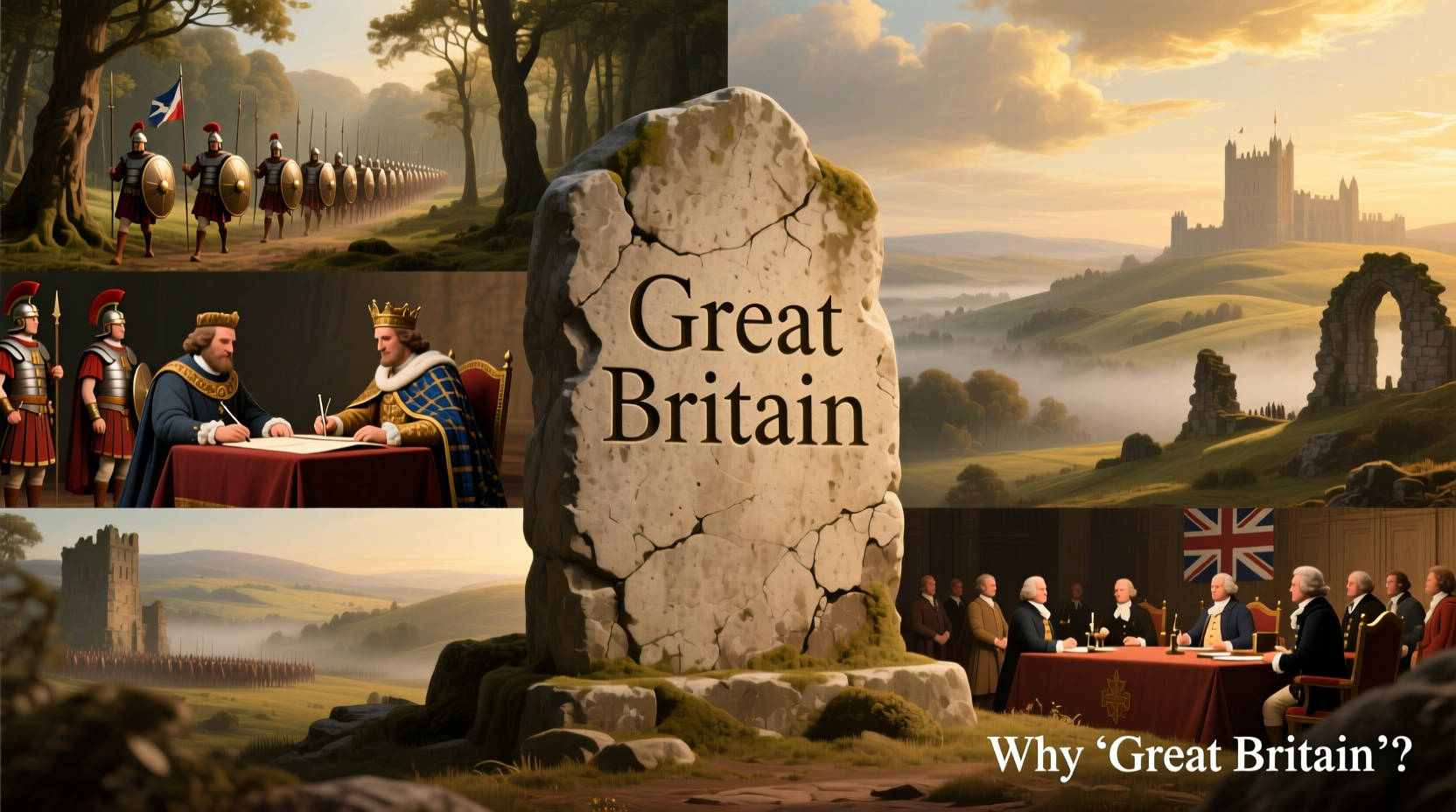
The word \"Britain\" originates from the Latin *Britannia*, the name the Romans gave to the island they conquered in 43 AD. But even earlier, Greek explorers referred to the land as *Prettanikē* or *Brettaniai*, likely derived from the Celtic-speaking people who inhabited the region—the *Pritani* or *Pretani*. These early Britons may have been named for their painted or tattooed bodies, with \"Pritani\" possibly meaning \"the painted ones\" in Brythonic Celtic.
When the Romans arrived, they Latinized the name to *Britannia*, personifying it as a warrior goddess symbolizing resistance and strength. After the fall of Roman rule in the 5th century, various Anglo-Saxon kingdoms emerged, but the broader concept of \"Britain\" persisted in ecclesiastical and literary texts.
“Names like ‘Britain’ are not static—they evolve with power, language, and perception.” — Dr. Eleanor Hart, Historian of Early Medieval Britain
So Why “Great” Britain?
The addition of \"Great\" serves a practical geographical distinction. In the late Middle Ages, European cartographers and diplomats needed a way to differentiate between the large island containing England, Scotland, and Wales, and the smaller Brittany (French: *Bretagne*) peninsula in northwestern France.
Both regions were settled by Celtic peoples, and the names were phonetically similar. To avoid confusion—especially in diplomatic correspondence and maritime navigation—the larger island became known as *Grande Bretagne* in French, which English speakers translated as \"Great Britain.\" The term does not imply superiority in status, though over time it acquired connotations of imperial power.
This naming convention follows a common pattern: \"great\" is used to distinguish larger entities from similarly named smaller ones. For example, \"New Zealand\" versus \"Zealand\" in Denmark.
Historical Timeline: How the Name Took Hold
The formal adoption of \"Great Britain\" as a unified designation coincided with political unification. Here’s a key timeline showing how the name evolved alongside governance:
- 1485: The Tudor dynasty begins; Henry VII, of Welsh descent, promotes the idea of a united British identity.
- 1603: Union of the Crowns—James VI of Scotland becomes James I of England, ruling both kingdoms under one monarch.
- 1707: Acts of Union merge England and Scotland into the single Kingdom of Great Britain.
- 1801: The Act of Union with Ireland creates the United Kingdom of Great Britain and Ireland.
- 1922: Irish Free State established; the country becomes the United Kingdom of Great Britain and Northern Ireland.
It was during the 18th century, especially after 1707, that \"Great Britain\" became entrenched in official documents, maps, and legal terminology. The name reflected not just geography, but a new political reality.
Great Britain vs. United Kingdom: Clearing the Confusion
A common misunderstanding is equating \"Great Britain\" with \"the UK.\" They are related but distinct:
| Term | Definition | Includes |
|---|---|---|
| Great Britain | Geographical term for the largest island in the British Isles | England, Scotland, Wales |
| United Kingdom (UK) | Sovereign state and political entity | England, Scotland, Wales, Northern Ireland |
| British Isles | Geographical archipelago | Great Britain, Ireland, Isle of Man, Channel Islands, and smaller islands |
| England | One constituent country | Part of both Great Britain and the UK |
Using these terms correctly matters in diplomacy, travel, and cultural recognition—especially in Scotland and Wales, where national identities remain strong.
Modern Usage and Cultural Impact
Today, \"Great Britain\" appears in contexts ranging from sports teams (e.g., Team GB at the Olympics) to international trade agreements. However, its use can spark debate. Some Scots and Welsh citizens object to being labeled simply as \"British,\" preferring to emphasize their distinct national identities.
In contrast, \"Britishness\" has also served as a unifying civic identity, particularly during times of war or national crisis. The term carries emotional weight beyond geography—it evokes shared institutions like the BBC, NHS, and monarchy, even as devolution strengthens regional governments.
Mini Case Study: Team GB and National Identity
At the 2012 London Olympics, the \"Team GB\" brand was widely celebrated. However, questions arose: Why include athletes from Northern Ireland under \"GB\" when they could choose to represent Ireland? And why weren’t separate Scottish or Welsh teams allowed?
The answer lies in the International Olympic Committee’s recognition of the United Kingdom as a single nation. Despite ongoing debates about sovereignty and identity, the team competed under the banner of Great Britain—a reminder that historical names continue to shape modern symbolism.
Frequently Asked Questions
Is Great Britain the same as the UK?
No. Great Britain is the island comprising England, Scotland, and Wales. The United Kingdom includes those three countries plus Northern Ireland. While often used interchangeably in casual speech, they are not identical.
Why isn’t Ireland part of Great Britain?
Ireland is a separate island. While most of it was part of the UK until 1922, the Republic of Ireland is now an independent nation. Only Northern Ireland remains within the UK, hence the current full name: the United Kingdom of Great Britain and Northern Ireland.
Does \"Great\" mean better or more important?
Not originally. \"Great\" was used geographically to distinguish the larger island from Brittany in France. Over time, especially during the British Empire’s peak, the word gained connotations of power and influence—but its root meaning is about size, not value.
Actionable Checklist: Using the Terms Correctly
- ✅ Use \"Great Britain\" when referring specifically to the island of England, Scotland, and Wales.
- ✅ Use \"United Kingdom\" when discussing the sovereign state, including Northern Ireland.
- ✅ Avoid using \"England\" to describe the whole country—this can offend Scots, Welsh, and Northern Irish citizens.
- ✅ In formal writing, clarify whether you mean geographical, political, or cultural context.
- ✅ Recognize that identity is personal—some identify as British, others as English, Scottish, or Welsh first.
Conclusion: A Name Shaped by History and Geography
The name \"Great Britain\" is far more than a label on a map. It reflects centuries of invasion, union, linguistic adaptation, and political change. From the Celtic tribes encountered by Rome to the Acts of Union and the modern complexities of national identity, the term has evolved alongside the people who inhabit the island.
Understanding its origins fosters greater precision in communication and deeper respect for the diverse cultures within the UK. Whether you're writing a paper, traveling, or engaging in global conversations, using the right terms matters—not just for accuracy, but for empathy.




 浙公网安备
33010002000092号
浙公网安备
33010002000092号 浙B2-20120091-4
Comments
No comments yet. Why don't you start the discussion?