
On June 6, 1944, Allied forces launched Operation Overlord—the largest amphibious invasion in history—marking the beginning of the liberation of Western Europe from Nazi occupation. One of the five designated landing zones along the Normandy coast was a stretch of shoreline that would become infamous: Omaha Beach. Today, the name evokes images of courage, sacrifice, and the brutal cost of freedom. But why was it called \"Omaha\"? The answer lies not in geography or local history, but in the meticulous, secretive planning of the Allied high command. Understanding the naming origins of Omaha Beach reveals how military strategy, deception, and coordination shaped one of the most pivotal days of World War II.
The Five Code Names of D-Day
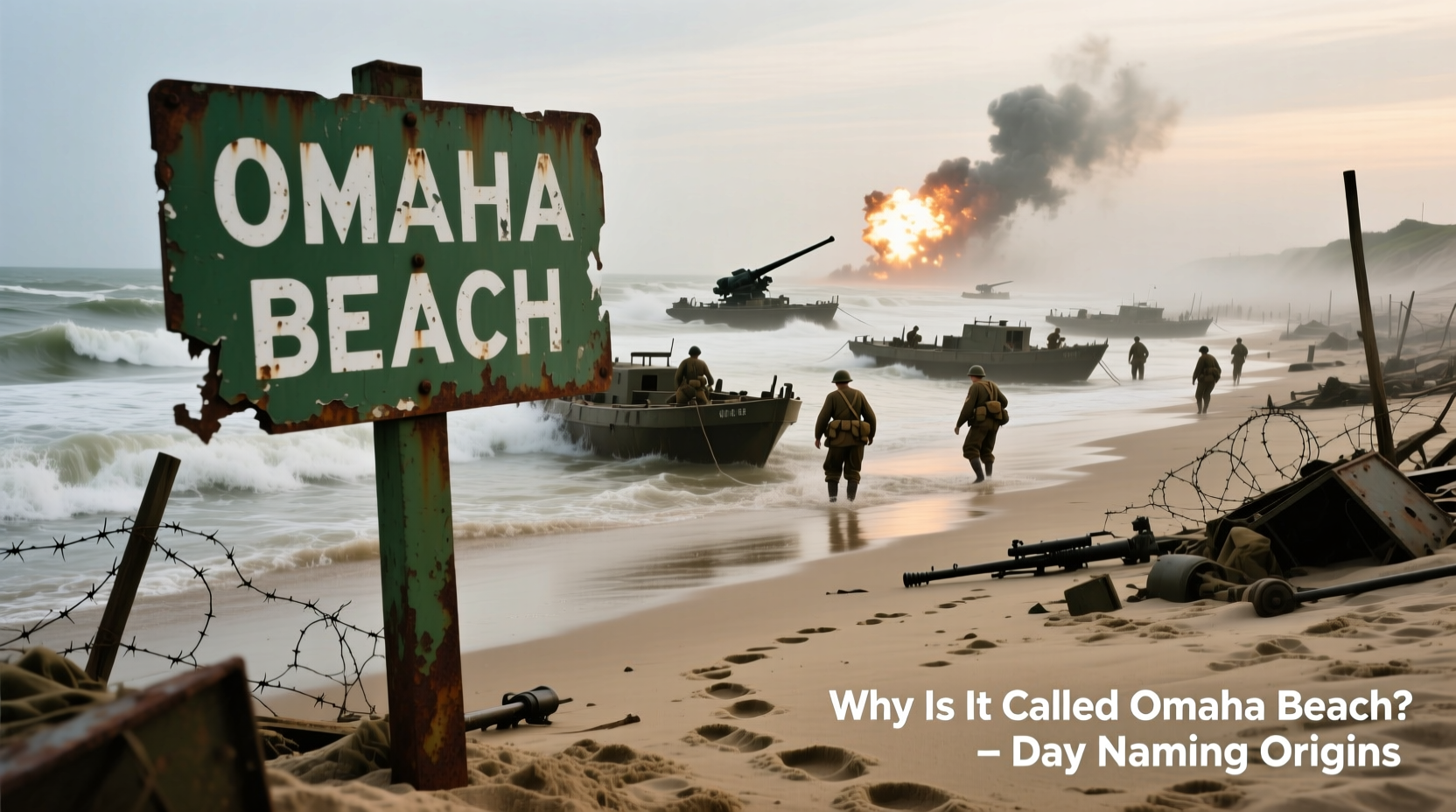
As part of the broader Operation Neptune—the naval component of Overlord—Allied planners divided the Normandy coastline into five assault sectors, each assigned a code name. These were:
- Utah – Westernmost sector, assigned to U.S. 4th Infantry Division
- Omaha – Central sector, primarily assaulted by U.S. 1st and 29th Infantry Divisions
- Gold – British sector, aimed at linking with Canadian forces at Juno
- Juno – Assigned to the Canadian 3rd Infantry Division
- Sword – Easternmost sector, targeted by British 3rd Infantry Division
These names were not chosen for sentimental or geographic reasons. Instead, they were randomly selected as part of a standardized Allied coding system designed to ensure clarity, security, and ease of communication across multinational forces.
The Origin of \"Omaha\": A Random Selection
The name \"Omaha\" has no direct connection to the French village of Saint-Laurent-sur-Mer, where the actual beach is located. It does not derive from local dialect, historical events, or terrain features. Instead, \"Omaha\" was one of a series of randomly generated code names created by the Allied staff planners in early 1944.
According to declassified documents and military records, the U.S. Joint Chiefs of Staff adopted a practice of using American city names for certain operations and locations to simplify logistics and reduce confusion. Omaha, Nebraska—a mid-sized Midwestern city—was selected purely at random from a list of potential names that met specific criteria: short, easy to pronounce, phonetically distinct, and unlikely to be confused with other military terms over radio communications.
“Code names had to be simple, memorable, and devoid of strategic hints. 'Omaha' fit perfectly—it meant nothing to the enemy and everything to our coordination.” — Colonel Richard Mendel, U.S. Army Historical Division (ret.)
Why City Names? Strategic Communication and Security
The use of American city names for D-Day beaches was not arbitrary; it followed established Allied protocols for operational security. During World War II, military planners avoided using real geographic names in internal communications to prevent leaks or intercepted messages from revealing target locations. Instead, they relied on a system of codenames that were:
- Geographically neutral
- Easy to transmit via radio
- Unlikely to appear in enemy intelligence databases
- Distinct enough to avoid confusion during high-pressure combat
This system minimized the risk of miscommunication among troops from different nations—American, British, Canadian, and others—who might pronounce place names differently. Using simple, familiar-sounding words like \"Utah\" and \"Omaha\" ensured clarity even under chaotic conditions.
A Closer Look: The Assault on Omaha Beach
Despite its innocuous name, Omaha Beach became the site of the bloodiest fighting on D-Day. Stretching approximately six miles between Vierville-sur-Mer and Colleville-Montgomery, the beach was heavily fortified with German bunkers, machine gun nests, and artillery positions perched on bluffs. Poor weather, strong currents, and navigational errors caused landing craft to miss their intended marks, concentrating troops in kill zones.
Of the roughly 34,000 troops scheduled to land at Omaha, only about 20,000 made it ashore by day’s end. Casualties exceeded 2,400, making it the costliest of the five landing zones. Yet, through extraordinary bravery and adaptability, U.S. forces eventually secured a foothold—paving the way for the breakout from Normandy weeks later.
The contrast between the mundane origin of the name \"Omaha\" and the ferocity of the battle fought there underscores how deeply symbolic such code names have become in historical memory.
Timeline of Key Events at Omaha Beach
- 05:00 AM – Naval bombardment begins offshore (lighter than planned due to concerns about cratering the beach).
- 06:30 AM – First wave lands at Easy Red, Fox Green, and other sub-sectors. Immediate heavy fire from German defenses.
- 07:30 AM – Engineers attempt to clear obstacles; many are killed or pinned down.
- 09:00 AM – Surviving officers begin organizing scattered units; small groups advance inland.
- 12:00 PM – Reinforcements arrive; momentum shifts as tanks and artillery support improve.
- 18:00 PM – A continuous Allied line is established, though far short of D-Day objectives.
- June 7–11 – Consolidation continues; link-up achieved with Utah Beach forces.
Mini Case Study: The Role of Code Names in Mission Success
In the hours before the invasion, Allied paratroopers of the 82nd and 101st Airborne Divisions were briefed using only code names. Their drop zones were labeled \"Albany,\" \"Boston,\" and \"Chicago\"—none of which corresponded to actual towns. When mis-drops occurred due to fog and anti-aircraft fire, confusion was inevitable, but the use of consistent code names allowed surviving units to regroup around known objectives.
Likewise, at Omaha Beach, the designation \"Fox Green\" or \"Easy Red\" helped medics, engineers, and follow-up waves identify sectors despite smoke, debris, and disorientation. Though the name \"Omaha\" originated in a planning office far from the front lines, it became a vital anchor point for coordination under fire.
Do’s and Don’ts of Military Naming Conventions
| Do | Don't |
|---|---|
| Use short, phonetically clear names (e.g., \"Sword,\" \"Utah\") | Use complex or regionally ambiguous names (e.g., \"Château-Landon\") |
| Select names unlikely to be associated with targets | Choose names that hint at location or mission type |
| Ensure names are distinct across languages and accents | Pick names that sound similar (e.g., \"Delta\" and \"Dakota\") |
| Standardize naming across allied forces | Allow individual units to create their own codes |
Frequently Asked Questions
Was Omaha Beach named after Omaha, Nebraska?
Yes, but not because of any strategic or symbolic connection. The name \"Omaha\" was randomly selected from a list of American city names used as code words. Omaha, Nebraska, was chosen simply because it met the criteria for brevity, clarity, and ease of use in military communications.
Did the Germans know about the name \"Omaha Beach\"?
No. The Germans referred to the area as part of \"Defensive Sector 73\" or by local village names like Vierville and Colleville. The term \"Omaha Beach\" was exclusively an Allied designation used in planning and operations. It entered public and historical discourse only after the war.
Are the other D-Day beach names also American cities?
Only Utah and Omaha are named after U.S. cities. Gold, Juno, and Sword were assigned by British and Canadian planners and do not correspond to real places in the same way. \"Juno\" may reference the Roman goddess, while \"Sword\" and \"Gold\" follow the British preference for single-syllable, weapon- or color-related terms.
Conclusion: More Than Just a Name
The name \"Omaha Beach\" began as a bureaucratic placeholder—an anonymous tag in a war room map. Yet today, it carries profound emotional and historical weight. It stands as a testament to the men who stormed the sands under fire, many never knowing why their objective bore the name of a distant American city. The origins of the name remind us that behind every strategic decision, even something as simple as a label, lies layers of planning, secrecy, and human consequence.
Understanding the naming origins of Omaha Beach does more than satisfy curiosity—it deepens appreciation for the precision and discipline that defined the D-Day operation. In war, even the smallest details can shape the course of history.




 浙公网安备
33010002000092号
浙公网安备
33010002000092号 浙B2-20120091-4
Comments
No comments yet. Why don't you start the discussion?