
The name \"The Ohio State University\" often raises eyebrows—especially for newcomers. Why \"The\"? Why not just \"Ohio State University\"? And how did a land-grant institution founded in 1870 come to carry such a formal and distinctive title? The answer lies in a blend of historical context, legislative intent, and regional identity. Understanding the full story requires stepping back into post-Civil War America, when education, agriculture, and state pride were being redefined across the Midwest.
Unlike many universities that derive their names from cities or founders, The Ohio State University reflects a deliberate effort to embody the entire state’s educational mission. Its name wasn’t chosen lightly—it was codified by law, shaped by national policy, and refined over time through tradition and branding. This article unpacks the layers behind the name, tracing its roots from federal legislation to modern-day identity.
The Land-Grant Act and the Birth of a University
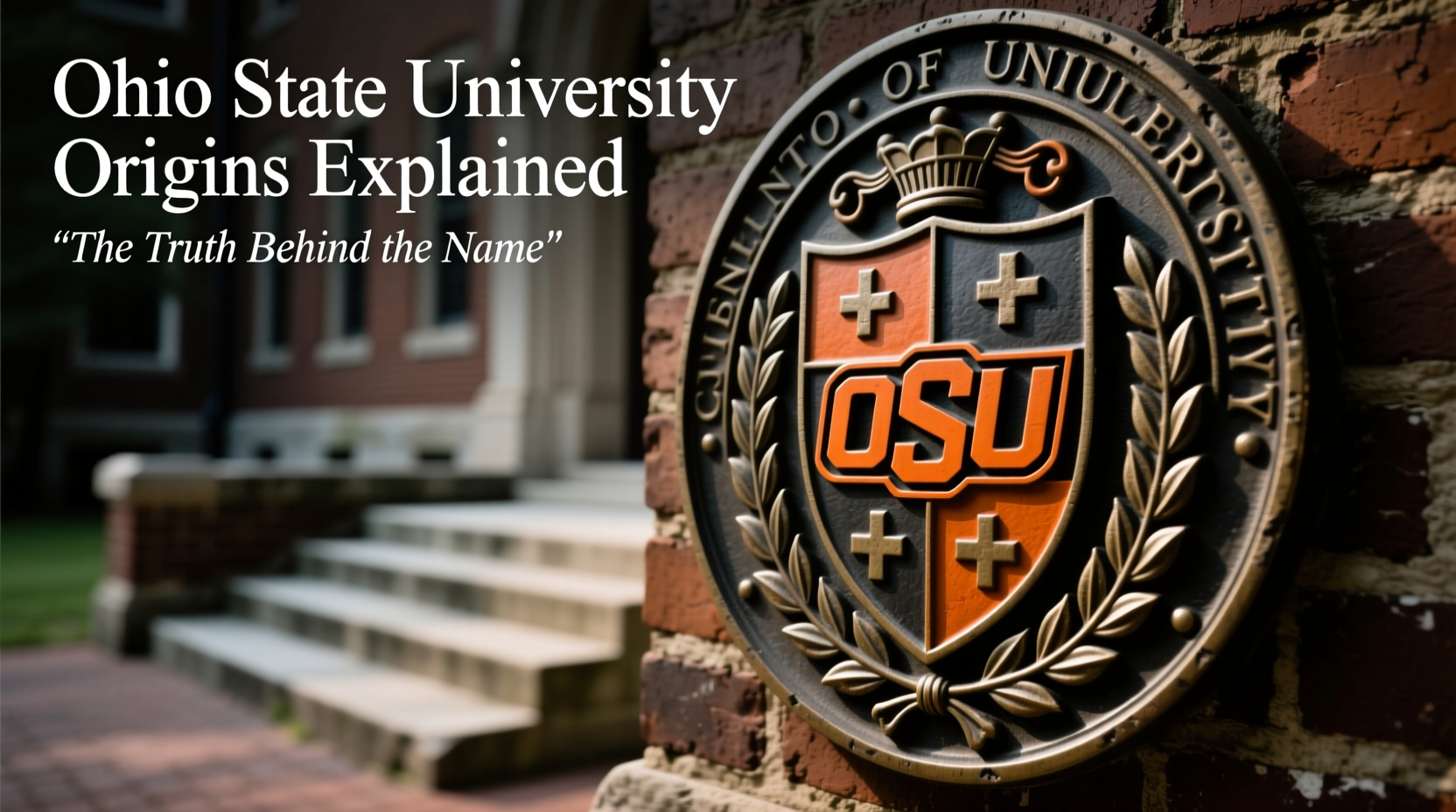
The foundation of The Ohio State University can be traced directly to the Morrill Act of 1862, signed by President Abraham Lincoln. This landmark legislation granted federal land to states to establish colleges focused on agriculture, engineering, and military science—fields considered essential to national development but underrepresented in traditional liberal arts curricula.
Ohio accepted the terms of the Morrill Act in 1867 and began planning for a new agricultural and mechanical college. After much debate over location and governance, the Ohio General Assembly officially established the institution on March 19, 1870, as the \"Ohio Agricultural and Mechanical College.\" At this stage, there was no mention of \"The\" in the name. It was a functional designation reflecting its purpose.
However, the college was always intended to serve the entire state—not just Columbus or Franklin County. From the outset, it was conceived as a public institution with statewide responsibility, which would later influence both its name and its mission.
The Addition of \"The\" in Official Naming
In 1878, eight years after its founding, the Ohio General Assembly passed legislation to expand the school’s academic scope beyond agriculture and mechanics. As part of this expansion, the institution was renamed \"The Ohio State University\". The inclusion of \"The\" was neither accidental nor stylistic—it carried legal and symbolic weight.
According to archival records from the university’s library, the definite article \"The\" was added to emphasize that this was the principal state-supported university for Ohio. While other institutions existed (such as private colleges and normal schools), this was the flagship land-grant university designated to represent the educational aspirations of the entire state.
“By adopting 'The Ohio State University,' lawmakers made a statement: this was not merely one of many colleges, but *the* central institution of higher learning supported by and accountable to all Ohioans.” — Dr. Rebecca Thompson, Historian of American Higher Education
How the Name Evolved Over Time
The transition from \"Ohio Agricultural and Mechanical College\" to \"The Ohio State University\" marked more than just a name change—it signaled a transformation in academic ambition. By the early 20th century, the university had expanded into liberal arts, medicine, law, and business, becoming a comprehensive research university.
Despite these changes, the official name remained intact. In fact, the use of \"The\" became increasingly embedded in institutional identity. Faculty, administrators, and alumni consistently used the full name in formal communications, legal documents, and publications.
Interestingly, the public and media often shortened it to \"Ohio State,\" a nickname that gained widespread popularity—especially in athletics. However, the university has maintained a clear distinction: while \"Ohio State\" is acceptable in informal contexts, the legal and formal name remains \"The Ohio State University.\"
Naming Conventions Among U.S. Public Universities
The use of \"The\" in a university’s name is relatively rare but not unique. Other examples include:
- The University of Texas at Austin
- The City University of New York
- The Pennsylvania State University
These institutions, like Ohio State, were established with broad public mandates and often serve as flagship campuses within larger systems. The inclusion of \"The\" underscores their status as primary representatives of state-funded higher education.
| University | Official Name Includes \"The\"? | Common Nickname |
|---|---|---|
| Ohio State | Yes – The Ohio State University | Ohio State |
| Pennsylvania State | Yes – The Pennsylvania State University | Penn State |
| Michigan | No – University of Michigan | Michigan |
| Texas | Yes – The University of Texas at Austin | Texas |
| Florida | No – University of Florida | Florida |
Public Perception vs. Institutional Identity
For decades, a quiet tension has existed between how the university refers to itself and how it is commonly referred to by fans, journalists, and even some faculty. Sports broadcasts, headlines, and casual conversation overwhelmingly use \"Ohio State.\" Search engine data shows that \"Ohio State\" receives over 10 times more searches than the full name.
Yet the institution continues to uphold \"The Ohio State University\" as its official designation. In 2018, the university launched a brand consistency initiative reinforcing the use of the full name in marketing materials, digital platforms, and external partnerships. The goal was not to discourage nicknames but to ensure clarity and legal accuracy in formal settings.
Mini Case Study: The 2015 Football National Championship
During Ohio State’s historic 2015 College Football Playoff National Championship run, national media outlets used \"Ohio State\" almost exclusively. Commentators said \"Ohio State wins!\" and headlines read \"Buckeyes Claim Title for Ohio State.\" While emotionally resonant, none of these references used the full legal name.
Internally, however, the university’s communications team ensured that all official press releases, banners, and commemorative merchandise bore the full name: \"The Ohio State University.\" This duality illustrates how institutions balance public familiarity with formal identity—one rooted in accessibility, the other in legacy and governance.
Why \"The\" Still Matters Today
In an era where branding and digital presence dominate, the persistence of \"The\" might seem archaic. But for administrators and historians, it serves several key functions:
- Legal Precision: Contracts, accreditation documents, and federal grants require the exact legal name.
- Statewide Representation: \"The\" reinforces the idea that the university belongs to all Ohio residents, not just those in Columbus.
- Differentiation: It distinguishes the institution from other \"state universities\" within Ohio, such as Kent State or Miami University.
- Historical Continuity: Retaining the original name honors the vision of the founders and early legislators.
Moreover, the full name appears in the university’s charter, statutes, and Board of Trustees resolutions. Changing it would require legislative action—a step no administration has seriously pursued.
Expert Insight on Institutional Naming
“Names are not just labels—they’re statements of purpose. 'The Ohio State University' tells you this isn’t just another college. It’s *the* state’s university. That ‘The’ carries authority, responsibility, and inclusivity.” — Dr. James Holloway, Professor of Educational Policy, University of Virginia
Frequently Asked Questions
Is it incorrect to say 'Ohio State University' without 'The'?
Grammatically, yes. The official name includes \"The,\" so omitting it creates an inaccuracy. Saying \"Ohio State University\" (without \"The\") is a common mistake, but it’s not the legally recognized name. The correct form is either \"The Ohio State University\" or the abbreviated \"Ohio State.\"
Why do people keep leaving out 'The'?
Linguistic efficiency plays a major role. \"Ohio State\" is shorter and easier to say, especially in sports commentary or casual speech. Media outlets often prioritize brevity over formality, contributing to the widespread use of the nickname.
Has the university ever considered dropping 'The'?
There have been informal discussions, but no official proposal has gained traction. University leadership recognizes the value of the full name in maintaining institutional gravitas and legal clarity. Any change would likely face resistance from alumni and historians.
Conclusion: A Name With Purpose
The name \"The Ohio State University\" is more than a grammatical quirk—it’s a reflection of history, policy, and collective identity. Born from a federal mandate to advance practical education, shaped by state legislation, and preserved through decades of growth, the name continues to signify a public mission that extends far beyond campus borders.
Whether you call it \"The Ohio State University\" in formal writing or \"Ohio State\" at a tailgate, understanding the origins of the name adds depth to its meaning. It reminds us that behind every institution is a story of intention, service, and belonging.




 浙公网安备
33010002000092号
浙公网安备
33010002000092号 浙B2-20120091-4
Comments
No comments yet. Why don't you start the discussion?