
Many people hesitate when choosing between \"I\" and \"me\" in everyday speech and writing. While both are first-person singular pronouns, their grammatical roles differ significantly. Misusing them can undermine clarity and credibility, especially in formal contexts. The confusion often arises because spoken English frequently favors informal constructions—like saying “Me and John went to the store”—that don’t align with standard grammar rules. Understanding when to use \"I\" versus \"me\" isn't about sounding stiff; it's about communicating precisely and effectively.
The Core Difference: Subject vs. Object Pronouns
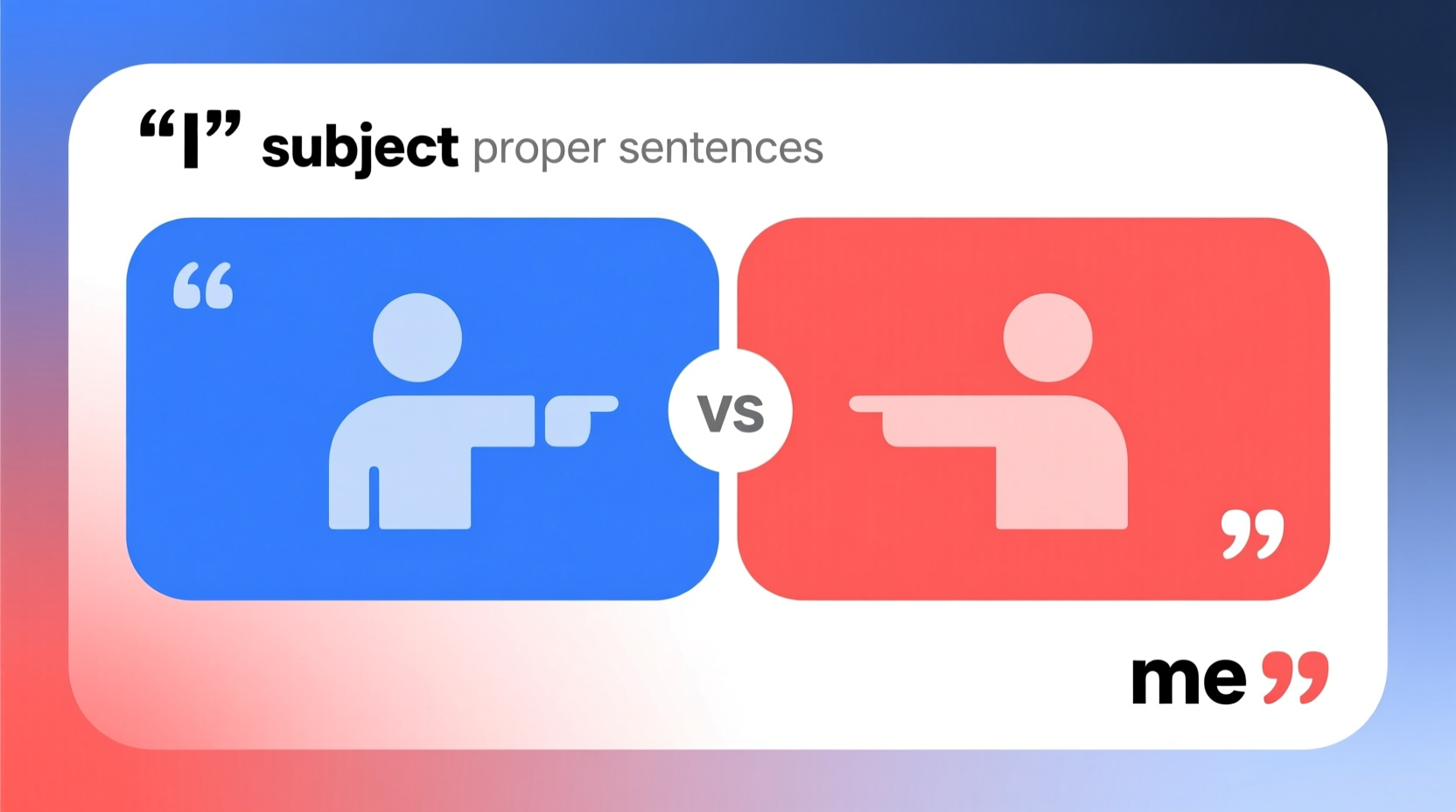
The foundation of correct usage lies in recognizing whether the pronoun functions as a subject or an object in a sentence. \"I\" is a subject pronoun, meaning it performs the action of the verb. \"Me\" is an object pronoun, used when receiving the action or following prepositions like \"to,\" \"for,\" or \"with.\"
Consider these basic examples:
- I called Sarah. (Subject performing the action)
- Sarah called me. (Object receiving the action)
- She gave the book to me. (\"Me\" follows the preposition \"to\")
- I am ready for dinner. (\"I\" is the subject of the linking verb \"am\")
A common mistake occurs when speakers instinctively avoid \"I\" due to overcorrection. For instance, hearing someone say, “The teacher spoke to John and I,” sounds formal but is actually incorrect. The phrase “John and I” cannot serve as the object of a preposition. It should be “John and me.”
Common Errors and How to Fix Them
Even native speakers struggle with compound constructions involving \"I\" and \"me.\" These errors often stem from early schooling where children are corrected for saying “Me and John went out,” leading them to overuse \"I\" later—even in wrong contexts.
Here’s a breakdown of frequent mistakes:
| Incorrect | Correct | Reason |
|---|---|---|
| They invited John and I to dinner. | They invited John and me to dinner. | \"Me\" is the object of the verb \"invited.\" |
| Between you and I, this plan won’t work. | Between you and me, this plan won’t work. | After prepositions like \"between,\" use object pronouns. |
| She gave the report to him and I. | She gave the report to him and me. | \"To\" is a preposition requiring object form. |
| My brother and me went hiking. | My brother and I went hiking. | \"I\" is needed as part of the subject. |
The key is not memorizing every rule but developing a habit of isolating the pronoun to check its function. Try removing \"John\" or \"him\" and see what sounds right: “They invited I?” No. “They invited me?” Yes.
Expert Insight on Language Evolution
While prescriptive grammar insists on strict distinctions, linguists acknowledge that language evolves through usage. Still, knowing standard rules remains essential for professional and academic communication.
“Prescriptive grammar gives us consistency in writing and formal speech. But we must also recognize that spoken English often simplifies structures. The goal isn't to shame casual usage, but to equip people with choices.” — Dr. Rebecca Langston, Linguistics Professor at Columbia University
This perspective helps explain why phrases like “It is I” sound archaic today. Though technically correct—\"I\" being the predicate nominative after a linking verb—most modern speakers say “It’s me.” In fact, even style guides now accept “It’s me” as standard in contemporary English. However, in formal writing or testing environments, “It is I” may still be expected.
Step-by-Step Guide to Choosing Between 'I' and 'Me'
Follow this simple process whenever you're unsure which pronoun to use:
- Identify the verb: Determine the main action in the sentence.
- Determine the role of the pronoun: Is it doing the action (subject) or receiving it (object)?
- Remove the other noun or pronoun: Test the sentence with just \"I\" or \"me.\"
- Check for prepositions: If the pronoun follows words like \"with,\" \"to,\" \"for,\" or \"between,\" use \"me.\"
- Reinsert the full phrase: Once confirmed, return the original construction.
Example: “The manager praised Sarah and ___.”
- Verb: \"praised\"
- Who received praise? Sarah and [blank] → object of the verb
- Test: “The manager praised I”? Incorrect. “The manager praised me”? Correct.
- Final sentence: “The manager praised Sarah and me.”
Real-Life Example: A Professional Email Mistake
Julia, a marketing associate, drafted an email stating: “Please send the final proposal to James and I by Friday.” Her supervisor gently corrected her, explaining that “to” is a preposition and requires the object form “me.” Julia revised the sentence and learned a lasting lesson about prepositional phrases.
Later, she applied the isolation trick: “Please send the proposal to I?” That clearly sounded wrong. From then on, she used the method in all her business communications, improving both accuracy and confidence.
Frequently Asked Questions
Is “It’s me” grammatically correct?
Yes, in modern English, “It’s me” is widely accepted in both spoken and written contexts. While traditional grammar would favor “It is I” (since the complement after a linking verb should match the subject case), usage has shifted. Most dictionaries and style guides now recognize “It’s me” as standard.
Can I ever use “me” as a subject?
Not in standard English. In formal writing and speech, subjects require nominative case pronouns like “I,” “he,” “she,” etc. Saying “Me going to the store” is nonstandard and typically found only in dialects or very casual speech. For clarity and professionalism, always use “I” as the subject.
What about sentences like “Let’s keep this between you and me”?
This is correct. “Between” is a preposition, so it takes object pronouns. Even though some mistakenly say “between you and I” to sound more educated, it’s grammatically flawed. Think of it this way: you wouldn’t say “between I,” so “between you and I” doesn’t follow logically.
Final Checklist for Confident Usage
Use this checklist before sending emails, writing essays, or preparing speeches:
- ✅ Did I identify whether the pronoun is a subject or object?
- ✅ Did I test the sentence with only “I” or “me”?
- ✅ Does the pronoun follow a preposition? If yes, use “me.”
- ✅ Am I using “I” only when it’s part of the subject performing the action?
- ✅ Have I avoided overcorrecting into unnatural-sounding errors like “between you and I”?
Conclusion: Master Clarity Through Practice
Understanding why it’s “I” or “me” isn’t about pedantry—it’s about precision. Whether you’re writing a cover letter, speaking in a meeting, or composing a text to a colleague, choosing the right pronoun shapes how others perceive your attention to detail and command of language. Grammar isn’t a set of arbitrary rules; it’s a tool for effective communication. With practice, the distinction becomes intuitive. Start applying these principles today, and soon, you’ll speak and write with greater confidence and correctness.




 浙公网安备
33010002000092号
浙公网安备
33010002000092号 浙B2-20120091-4
Comments
No comments yet. Why don't you start the discussion?