
Jupiter stands as a colossus in our solar system, dwarfing all other planets in both mass and volume. With a diameter more than 11 times that of Earth and a mass over two and a half times greater than all other planets combined, Jupiter’s dominance is undeniable. But what exactly makes Jupiter so large? The answer lies in a combination of cosmic timing, gravitational dynamics, and planetary formation processes that set it apart from its planetary siblings.
The Formation Advantage: Early Start, Rapid Growth
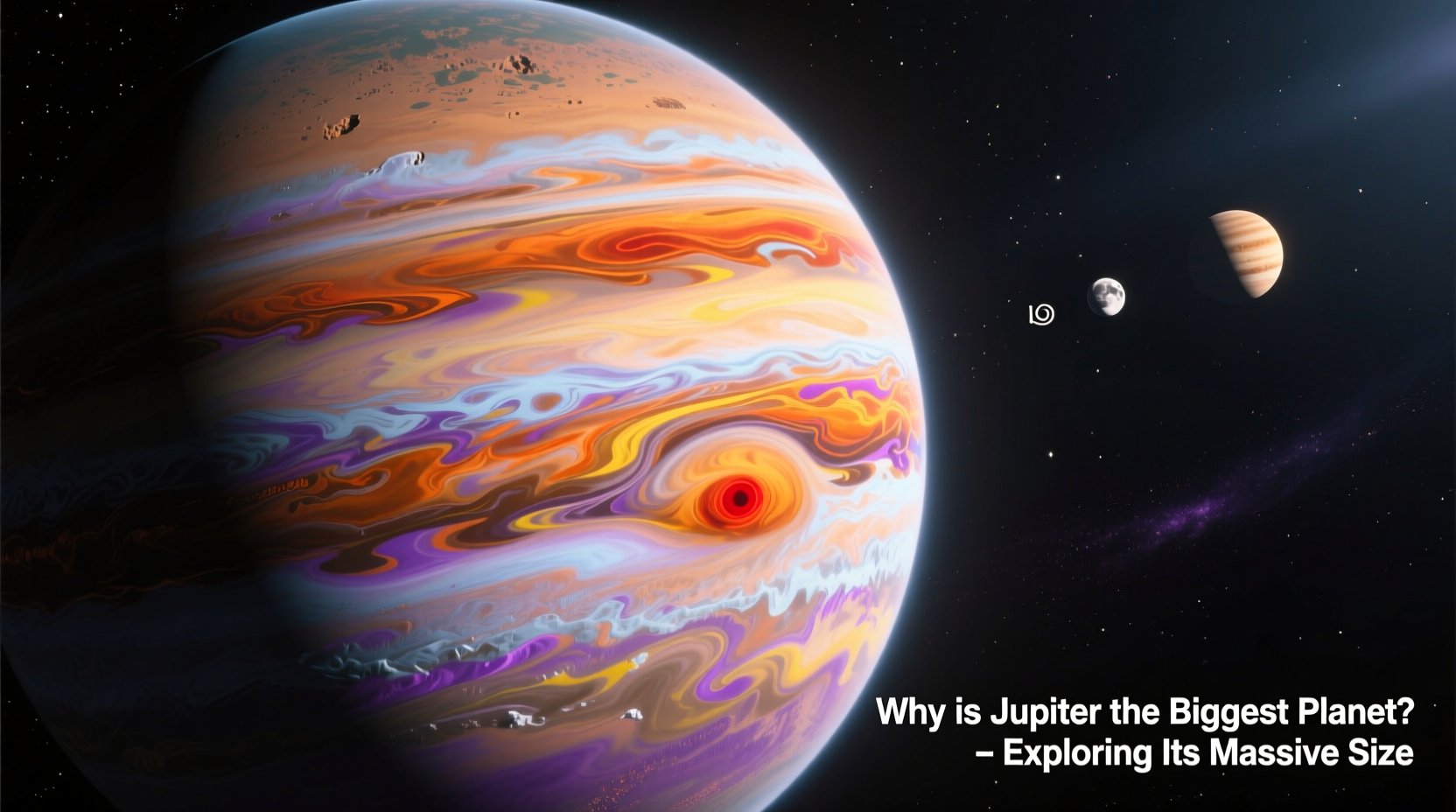
Jupiter’s immense size can be traced back to the earliest stages of the solar system’s formation, about 4.6 billion years ago. As the Sun coalesced from a collapsing cloud of gas and dust, the surrounding material began forming a protoplanetary disk. Within this disk, tiny particles collided and stuck together, gradually building larger bodies known as planetesimals.
Jupiter formed in the outer region of this disk, where temperatures were low enough for volatile compounds like water, ammonia, and methane to condense into ice. This abundance of solid material gave Jupiter’s core a critical head start. Unlike terrestrial planets that relied mostly on rock and metal, Jupiter had access to vast quantities of icy and gaseous materials.
Once Jupiter’s core reached a critical mass—estimated at around 10 to 20 times that of Earth—it began to gravitationally attract enormous amounts of hydrogen and helium from the surrounding nebula. This runaway accretion process allowed Jupiter to rapidly swell into a gas giant before the young Sun’s radiation cleared out the remaining gas in the disk.
Composition and Structure: A Planet of Gas and Pressure
Unlike rocky planets, Jupiter lacks a solid surface. Instead, it is composed primarily of hydrogen (about 90%) and helium (nearly 10%), mirroring the elemental composition of the Sun. Deep within its atmosphere, increasing pressure transforms hydrogen from a gas into a liquid metallic state—a form that conducts electricity and generates Jupiter’s powerful magnetic field.
The internal structure of Jupiter is layered but not sharply defined:
- Outer Atmosphere: Clouds of ammonia, ammonium hydrosulfide, and water vapor form colorful bands and storms.
- Inner Layers: Molecular hydrogen transitions into liquid hydrogen under extreme pressure.
- Core Region: Scientists debate whether a dense, rocky core exists, or if heavy elements are diffused throughout the interior.
This deep reservoir of light gases, compressed under immense gravity, contributes significantly to Jupiter’s bulk. Its sheer volume—over 1,300 Earths could fit inside—stems from this gaseous nature, even though its average density is only slightly greater than water.
Gravitational Dominance and Orbital Influence
Jupiter’s mass gives it extraordinary gravitational influence, shaping much of the architecture of the solar system. It acts as a cosmic vacuum cleaner, deflecting or capturing comets and asteroids that might otherwise threaten the inner planets. The Shoemaker-Levy 9 comet impact in 1994 demonstrated this role vividly, as fragments of the comet slammed into Jupiter’s atmosphere with explosive force.
“Jupiter is the solar system’s gatekeeper. Its gravity has likely prevented countless impacts on Earth.” — Dr. Amy Mainzer, NASA Planetary Scientist
Moreover, Jupiter’s presence may have influenced the formation—or lack thereof—of other planets. Some models suggest that if Jupiter had migrated closer to the Sun during its early evolution (a theory known as the Grand Tack), it could have disrupted the growth of Mars and limited the material available for planet formation in the inner solar system.
Comparative Planet Size: How Jupiter Stacks Up
To grasp Jupiter’s scale, consider how it compares to other planets. The table below illustrates key metrics across the solar system’s largest planets:
| Planet | Diameter (km) | Mass (Earth = 1) | Volume (Earth = 1) |
|---|---|---|---|
| Jupiter | 139,820 | 318 | 1,321 |
| Saturn | 116,460 | 95 | 764 |
| Uranus | 50,724 | 14.5 | 63 |
| Neptune | 49,244 | 17.1 | 58 |
| Earth | 12,742 | 1 | 1 |
Despite Saturn’s large size, it is significantly less massive than Jupiter. In fact, Saturn is so light for its volume that it would float in water—if a bathtub large enough existed. Jupiter, by contrast, packs immense mass into a slightly smaller volume, making it the undisputed heavyweight champion of the solar system.
Could a Bigger Planet Exist in Our Solar System?
A natural question arises: Could a planet even larger than Jupiter exist in our solar system? The answer is almost certainly no—due to the limited amount of material in the original protoplanetary disk. Even Jupiter consumed only a small fraction of the total mass available beyond the frost line.
There is, however, an upper limit to how large a planet can grow. Once a body reaches about 13 times the mass of Jupiter, it can begin fusing deuterium and becomes a brown dwarf—a \"failed star.\" Jupiter is nowhere near this threshold, but its size represents the practical maximum for a planet formed through core accretion in a system like ours.
Real-World Insight: The Juno Mission’s Revelations
NASA’s Juno spacecraft, which entered orbit around Jupiter in 2016, has provided unprecedented insights into the planet’s interior and origins. One of its most surprising findings was that Jupiter’s core may be “fuzzy” or diluted, suggesting that a massive collision early in its history could have disrupted a compact core and mixed heavy elements into the surrounding layers.
This scenario implies that Jupiter may have absorbed a proto-planet roughly 10 times the mass of Earth during its youth—an event that would have accelerated its growth and contributed to its current size. Such violent mergers may be common in the development of gas giants, offering a new perspective on how planets reach their final forms.
Frequently Asked Questions
Why doesn’t Jupiter become a star?
Although Jupiter is massive, it lacks the necessary mass to initiate sustained nuclear fusion. Stars require at least 80 times the mass of Jupiter to ignite hydrogen fusion in their cores. Jupiter radiates heat due to gravitational contraction, but it remains a planet—not a star.
Is Jupiter still growing?
Jupiter is no longer actively accreting significant amounts of material. However, it does collect small amounts of interplanetary dust and occasional comet fragments. These additions are negligible compared to its total mass, so Jupiter is effectively stable in size.
Can we see Jupiter’s size from Earth?
Yes. Through a small telescope, Jupiter appears as a large disk with visible cloud bands and its four largest moons (Io, Europa, Ganymede, and Callisto). Its angular diameter varies from 30 to 50 arcseconds, making it one of the largest-appearing planets in our night sky.
Conclusion: Embracing Jupiter’s Cosmic Significance
Jupiter’s status as the biggest planet is more than a fun fact—it reflects fundamental principles of planetary science, from formation dynamics to gravitational influence. Its size is the result of perfect timing, abundant resources, and powerful physics operating over billions of years. Understanding Jupiter helps us understand not only our own solar system but also the thousands of exoplanets now being discovered around other stars.
As missions like Juno continue to peel back the layers of this giant world, we gain deeper appreciation for the forces that shape planets and solar systems. Jupiter reminds us that size matters—but so does history, location, and the delicate balance of cosmic conditions.




 浙公网安备
33010002000092号
浙公网安备
33010002000092号 浙B2-20120091-4
Comments
No comments yet. Why don't you start the discussion?