
The letter “K” has become a ubiquitous shorthand for \"thousand\" across industries—from finance and technology to sports and social media. You’ve likely seen salaries listed as $75K, distances marked as 10K runs, or follower counts like 500K on YouTube. But why \"K\"? Why not \"T\" for thousand? And where did this convention originate? The answer lies at the intersection of language, scientific notation, and cultural evolution.
Unlike arbitrary abbreviations, “K” follows a logical pattern rooted in the metric system and international standards. Its adoption wasn’t sudden but evolved over decades through academic, industrial, and eventually digital communication channels. Understanding the journey of “K” reveals more than just linguistic curiosity—it sheds light on how global systems standardize symbols for clarity and efficiency.
The Metric System and the Role of “Kilo”
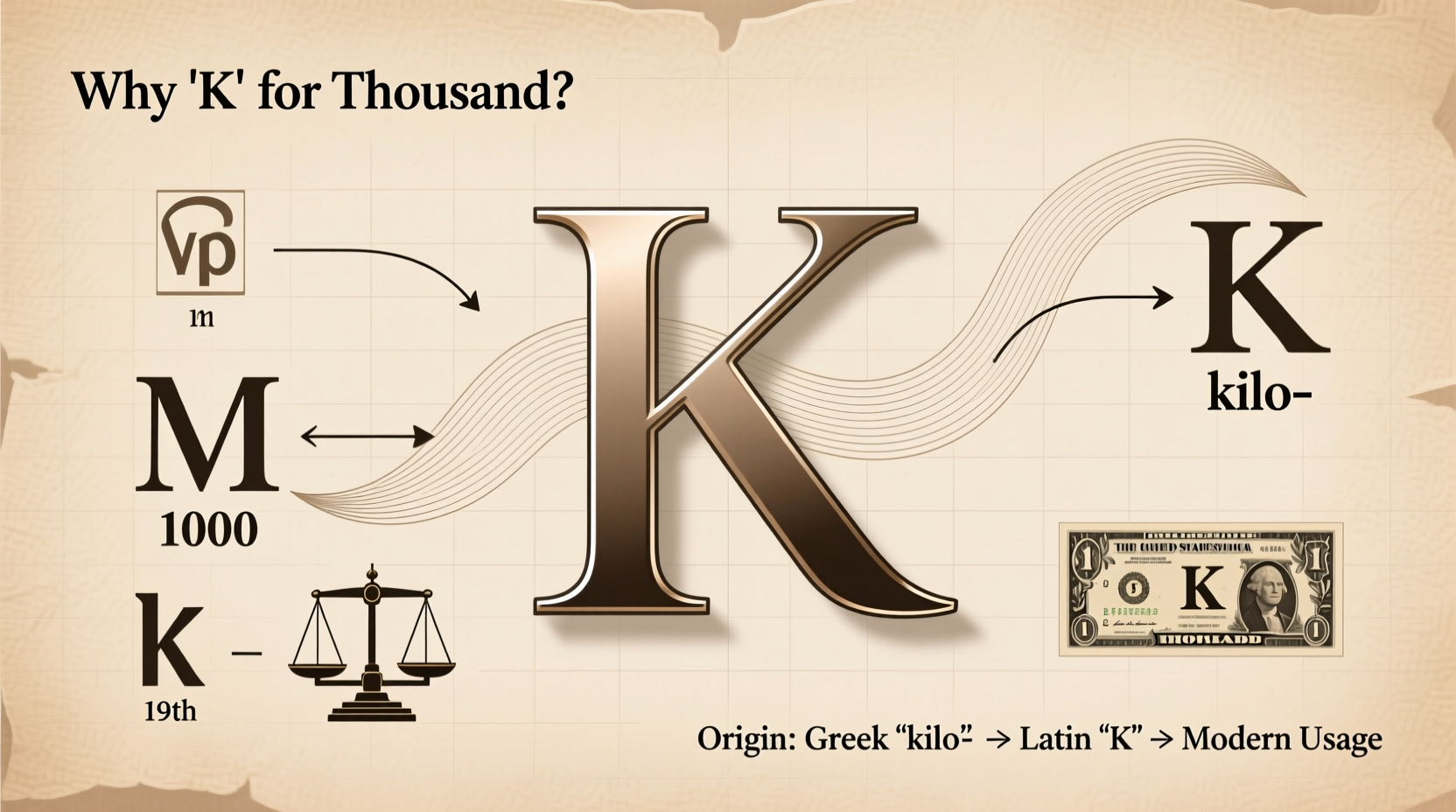
The use of “K” for thousand traces back to the prefix *kilo-*, derived from the Greek word *chilioi* (χίλιοι), meaning \"thousand.\" Although the root is Greek, the modern scientific use of *kilo-* was formalized during the development of the metric system in late 18th-century France. When the International System of Units (SI) was established in 1960, *kilo-* was officially adopted as a multiplier of 1,000, represented by the lowercase letter “k.”
For example:
- 1 kilogram = 1,000 grams
- 1 kilometer = 1,000 meters
- 1 kilowatt = 1,000 watts
In scientific and engineering contexts, precision matters. To avoid confusion with other prefixes (like *mega-* for million), standardized symbols were essential. While “k” is technically correct in SI units, in popular usage—especially in financial and informal writing—the uppercase “K” became dominant, likely for visual clarity in headlines, charts, and digital displays.
From Science to Finance: How “K” Entered Everyday Language
The migration of “K” from laboratories to boardrooms began in the mid-20th century. Economists, accountants, and financial analysts needed concise ways to express large numbers without cluttering reports with zeros. Writing “$500k” instead of “$500,000” saved space and improved readability, especially in tables and balance sheets.
This shorthand gained momentum during the rise of computing and data processing, where character limits and screen real estate favored compact notation. Programmers and database designers adopted “K” early on—such as “10K records” or “memory size: 64K”—reinforcing its presence in technical documentation.
“Standardized abbreviations like ‘K’ reduce cognitive load and improve data comprehension at scale.” — Dr. Alan Reeves, Cognitive Scientist specializing in information design
By the 1980s and 1990s, “K” had crossed into mainstream business culture. Job postings listed salaries as “$60K–$80K,” real estate ads cited prices in “hundreds of K,” and stock market tickers used “K” to denote trading volume. This normalization paved the way for broader cultural acceptance.
Digital Culture and the Rise of “K” Online
The internet accelerated the spread of “K” beyond professional circles. Platforms like Twitter, Instagram, and YouTube impose brevity, making “1M” and “500K” ideal for displaying follower counts, views, and likes. A profile showing “250K followers” communicates status instantly, without requiring users to parse five-digit numbers.
Gaming and streaming communities further normalized the term. Streamers celebrate milestones like “100K subs,” and gamers reference in-game currencies in “Ks.” Even slang evolved: “pulling a 50K heist” or “earning 10K XP” are now common phrases in online discourse.
This shift reflects a broader trend toward numerical literacy in digital spaces. Users intuitively understand that “K” means thousand, “M” means million, and “B” means billion—without needing explanations. It’s a micro-language of scale, efficient and universally recognized.
Common Contexts Where “K” Is Used Today
| Context | Example | Meaning |
|---|---|---|
| Salary | $75K per year | Seventy-five thousand dollars annually |
| Sports | 5K race | Race of 5 kilometers (~3.1 miles) |
| Social Media | 1.2M / 450K followers | 1.2 million or 450 thousand followers |
| Data Storage | File size: 256K | 256 kilobytes |
| Gaming | Score: 99K points | Ninety-nine thousand points |
Why Not “T” for Thousand?
A natural question arises: if we use “M” for million and “B” for billion, why not “T” for thousand? After all, “T” could stand for “thousand” or “grand” (slang for $1,000). However, “T” already has established meanings in various fields:
- In physics, “T” stands for tesla (unit of magnetic field).
- In finance, “T” often refers to Treasury bonds (“T-bills”).
- In time notation, “T” separates date from time in ISO formats (e.g., 2024-05-15T12:00:00).
More importantly, “K” aligns with an existing international standard (*kilo-*), giving it legitimacy and consistency. “T” lacks such a foundation and could create ambiguity. Additionally, “grand” (from American slang) is used informally for $1,000, but it doesn't scale well—no one says “five hundred grand thousand.” “K,” however, integrates seamlessly into larger numerical expressions.
Global Variations and Misunderstandings
While “K” is widely understood in English-speaking and tech-savvy communities, it’s not universal. In some countries, different conventions prevail:
- In India, “L” is sometimes used for lakh (100,000), so “5L” means 500,000.
- In parts of Europe, spaces or periods are used as thousand separators (e.g., 1.000 or 1 000), which can conflict with decimal notation elsewhere.
Misinterpretations do occur. For instance, someone unfamiliar with the convention might read “$30K” as thirty kelvins or confuse “5K” with a chemical formula. Clear context is crucial, especially in international communications.
Frequently Asked Questions
Is “K” always capitalized?
No. In scientific writing, the SI standard uses lowercase “k” (e.g., kg, km). However, in financial and informal contexts, uppercase “K” is common to enhance readability and avoid confusion with variables or units.
Can “K” mean something other than thousand?
Rarely in modern usage. Historically, “K” has stood for potassium (from Latin *kalium*) in chemistry, and in temperature, “K” denotes kelvin. But in numeric shorthand, it almost exclusively means thousand.
Why do we say “5K run” instead of “5-kilometer run”?
“5K” is shorter and has become a branded term in fitness culture. Race organizers use it for marketing—“Join our annual 5K!” sounds snappier than spelling out “five-kilometer race.” It also aligns with digital tracking apps that display distances in “K.”
Practical Tips for Using “K” Correctly
- Use “K” consistently: either always uppercase or follow industry norms (e.g., finance vs. science).
- Avoid mixing “K” and “thousands” in the same document for clarity.
- Clarify meaning when audience familiarity is uncertain (e.g., non-technical stakeholders).
- Remember that “K” represents exactly 1,000, not approximately “a lot.”
- Pair “K” with currency symbols appropriately: $65K, €40K, ¥500K.
Conclusion: Embracing Clarity Through Convention
The letter “K” as a symbol for thousand is more than a shortcut—it’s a testament to how language evolves under pressure from science, commerce, and technology. Rooted in the metric prefix *kilo-*, refined in engineering labs, and popularized by digital culture, “K” bridges precision and practicality. It allows us to communicate large numbers efficiently, whether discussing salaries, data sizes, or athletic achievements.
Understanding its origin helps prevent misuse and deepens appreciation for the subtle systems that shape modern communication. As global interaction increases and data grows ever larger, symbols like “K” will remain vital tools for clarity and connection.




 浙公网安备
33010002000092号
浙公网安备
33010002000092号 浙B2-20120091-4
Comments
No comments yet. Why don't you start the discussion?