
Kubernetes has become a cornerstone of modern cloud infrastructure, orchestrating containerized applications at scale across industries. But for newcomers and even seasoned engineers, one question often arises: why is it referred to as \"k8s\"? At first glance, \"k8s\" looks like a cryptic code or a typo. In reality, it’s a deliberate shorthand rooted in a common tech naming convention known as “numeronyms.” Understanding this term reveals not only how developers communicate efficiently but also how culture shapes language in software engineering.
The Numeronym Behind k8s: What Does It Mean?
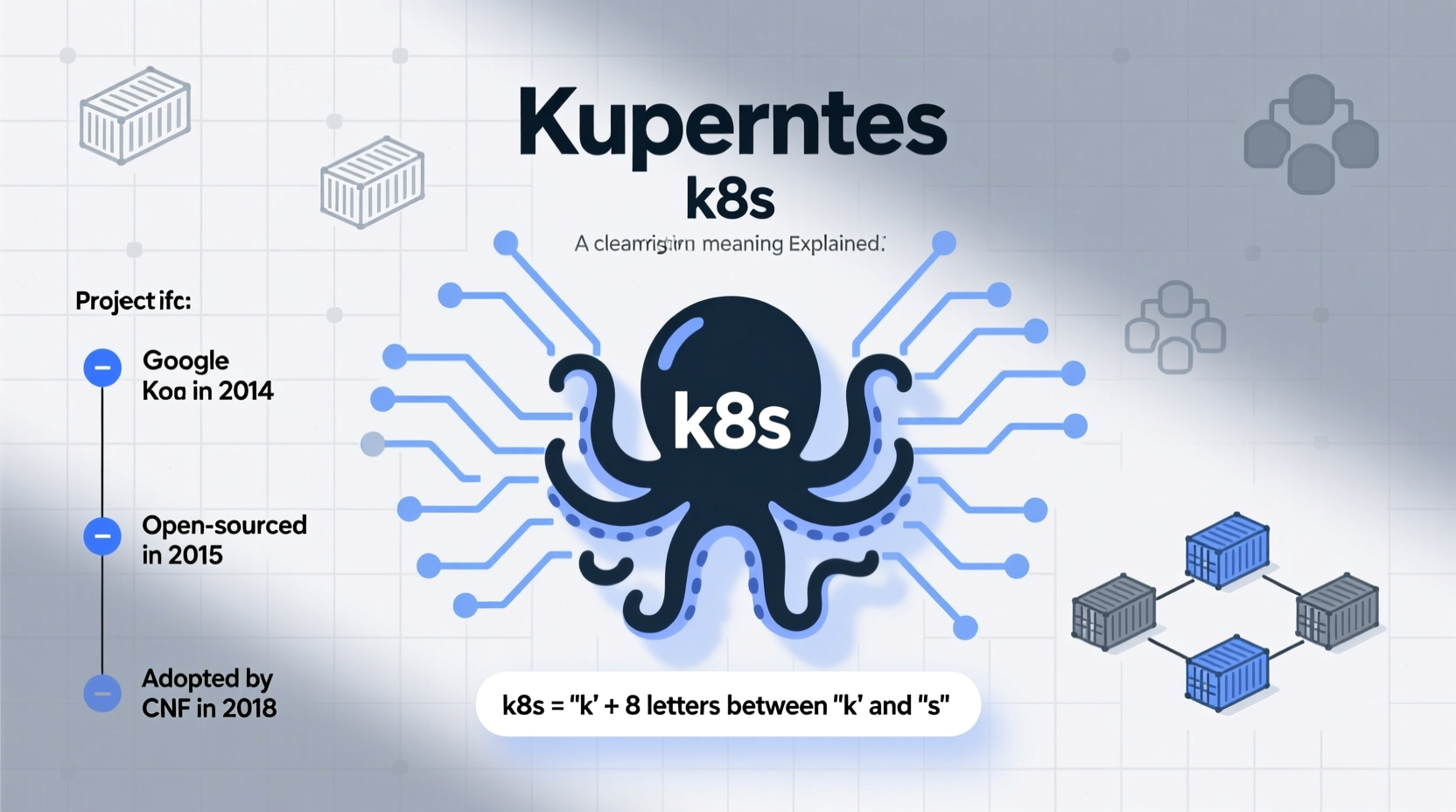
The term \"k8s\" is a numeronym—a blend of letters and numbers where digits represent the number of omitted letters between the first and last character of a word. In this case:
- K = first letter of \"Kubernetes\"
- 8 = the number of letters skipped (u-r-b-e-r-n-e-t-e)
- s = the final letter of \"Kubernetes\"
So, K + 8 letters + s = k8s. This pattern isn’t unique to Kubernetes. It follows a long-standing tradition in computing where brevity meets functionality. Just as \"i18n\" stands for \"internationalization\" (i + 18 letters + n) and \"a11y\" means \"accessibility\" (a + 11 letters + y), \"k8s\" is simply a concise way to refer to a lengthy word without losing clarity among technical audiences.
A Brief History of Numeronyms in Tech
Numeronyms have been part of computing culture since at least the 1980s. One of the earliest documented uses was within Digital Equipment Corporation (DEC), where engineers used \"i18n\" during discussions about software internationalization. The goal was efficiency—engineers needed quick, unambiguous ways to reference complex terms in emails, code comments, and internal documentation.
As open-source communities grew and collaboration moved online via mailing lists, IRC channels, and later Slack and GitHub, these abbreviations gained traction. They reduced typing time, minimized character counts in constrained environments, and fostered a sense of shared understanding among professionals.
When Google open-sourced Kubernetes in 2014, the project quickly adopted \"k8s\" in its domain names, documentation, and community channels. Today, the official website is k8s.io, and major tools like kubectl (pronounced \"kube control\") are universally recognized under the k8s umbrella.
“Abbreviations like k8s aren’t just shortcuts—they’re cultural markers of belonging in the developer world.” — Dr. Lena Torres, Software Linguistics Researcher at MIT
Why Use k8s Instead of Spelling Out Kubernetes?
There are several practical and cultural reasons why \"k8s\" prevails over the full spelling:
- Efficiency in Communication: In fast-paced development environments, writing or saying \"k8s\" saves time without sacrificing clarity.
- Consistency Across Platforms: From CLI commands to YAML manifests, the ecosystem consistently uses k8s-based terminology.
- Branding and Identity: The Kubernetes community embraces k8s as part of its identity. Conferences like KubeCon promote the term widely.
- URL and Namespace Constraints: Short forms are essential for domain names, Docker images, Helm charts, and API endpoints.
This shorthand doesn’t hinder learning; rather, it becomes a rite of passage. Newcomers who begin using \"k8s\" confidently signal their integration into the DevOps and cloud-native ecosystem.
Real-World Example: How k8s Is Used in Practice
Consider a mid-sized SaaS company migrating from monolithic architecture to microservices. Their engineering team decides to adopt Kubernetes for orchestration. During stand-up meetings, they frequently use \"k8s\" in conversation:
“Did you deploy the new service to the staging k8s cluster?” “I’m debugging a pod issue in k8s using kubectl logs.” “The CI/CD pipeline now pushes images directly to our k8s environment.”
In documentation, the team creates folders labeled k8s-manifests/ and scripts named apply-k8s-config.sh. Even ticketing systems reflect the usage: “Fix ingress timeout in production k8s.”
Over time, \"k8s\" becomes second nature. Engineers don’t think twice about the abbreviation—it’s embedded in workflows, tooling, and daily communication. This seamless adoption illustrates how functional language evolves organically in technical fields.
Common Misconceptions About k8s
Despite its widespread use, some misunderstandings persist:
| Misconception | Reality |
|---|---|
| k8s is an unofficial or slang term | No—k8s is officially endorsed by the Cloud Native Computing Foundation (CNCF) and used in all core project domains and repositories. |
| k8s refers to a different technology than Kubernetes | False—k8s is strictly a shorthand; there is no functional difference between Kubernetes and k8s. |
| New developers should avoid using k8s until they're experienced | Untrue—using k8s early helps integrate learners into the community faster. |
How to Embrace k8s in Your Workflow: A Quick Checklist
To align with industry standards and enhance your fluency in cloud-native technologies, follow this actionable checklist:
- Start using “k8s” in notes, diagrams, and internal communications when referring to Kubernetes.
- Familiarize yourself with key tools:
kubectl,kubeadm, andminikube. - Bookmark official resources at k8s.io and explore the documentation.
- Join k8s-focused communities on Slack, Reddit, or GitHub Discussions.
- Use k8s in version-controlled folder names (e.g.,
/infrastructure/k8s/prod) for consistency.
Frequently Asked Questions
Is k8s pronounced “kates” or “kube”?
No—k8s is typically pronounced “kay-eight-es” to distinguish it from “kube,” which usually refers to command-line tools like kubectl. However, in casual conversation, many say “running on kube” as shorthand, though technically imprecise.
Are there other numeronyms I should know in DevOps?
Yes. Common ones include:
- i18n – internationalization
- a11y – accessibility
- l10n – localization
- SRE – Site Reliability Engineering (not a numeronym, but often grouped due to brevity culture)
Can I use k8s in formal documentation or presentations?
In internal or technical documents, yes—especially if your audience is familiar with Kubernetes. In external-facing or beginner-level materials, introduce the term first: “Kubernetes (commonly abbreviated as k8s).” After initial clarification, switch to k8s for brevity.
Conclusion: Language Evolves With Technology
The name \"k8s\" is more than a typographical shortcut—it reflects how language adapts to meet the demands of innovation. In a world where speed, precision, and scalability define success, efficient communication becomes a competitive advantage. By embracing terms like k8s, engineers streamline collaboration, reduce cognitive load, and participate in a global culture of shared knowledge.
Understanding why Kubernetes is called k8s offers insight not just into a naming quirk, but into the very fabric of developer culture. Whether you're managing clusters or just starting your journey, using k8s correctly marks your entry into the cloud-native community.




 浙公网安备
33010002000092号
浙公网安备
33010002000092号 浙B2-20120091-4
Comments
No comments yet. Why don't you start the discussion?