
Los Angeles International Airport, commonly known as LAX, is one of the busiest and most recognizable airports in the world. Its name appears on luggage tags, flight trackers, and departure boards across the globe. But have you ever stopped to wonder: Why is it called LAX? What does the “X” mean? And how did a major international gateway end up with such an unusual suffix? The answer lies in the early days of American aviation, when airport codes were simpler, more localized, and shaped by postal abbreviations and radio call signs.
The Evolution of Airport Codes
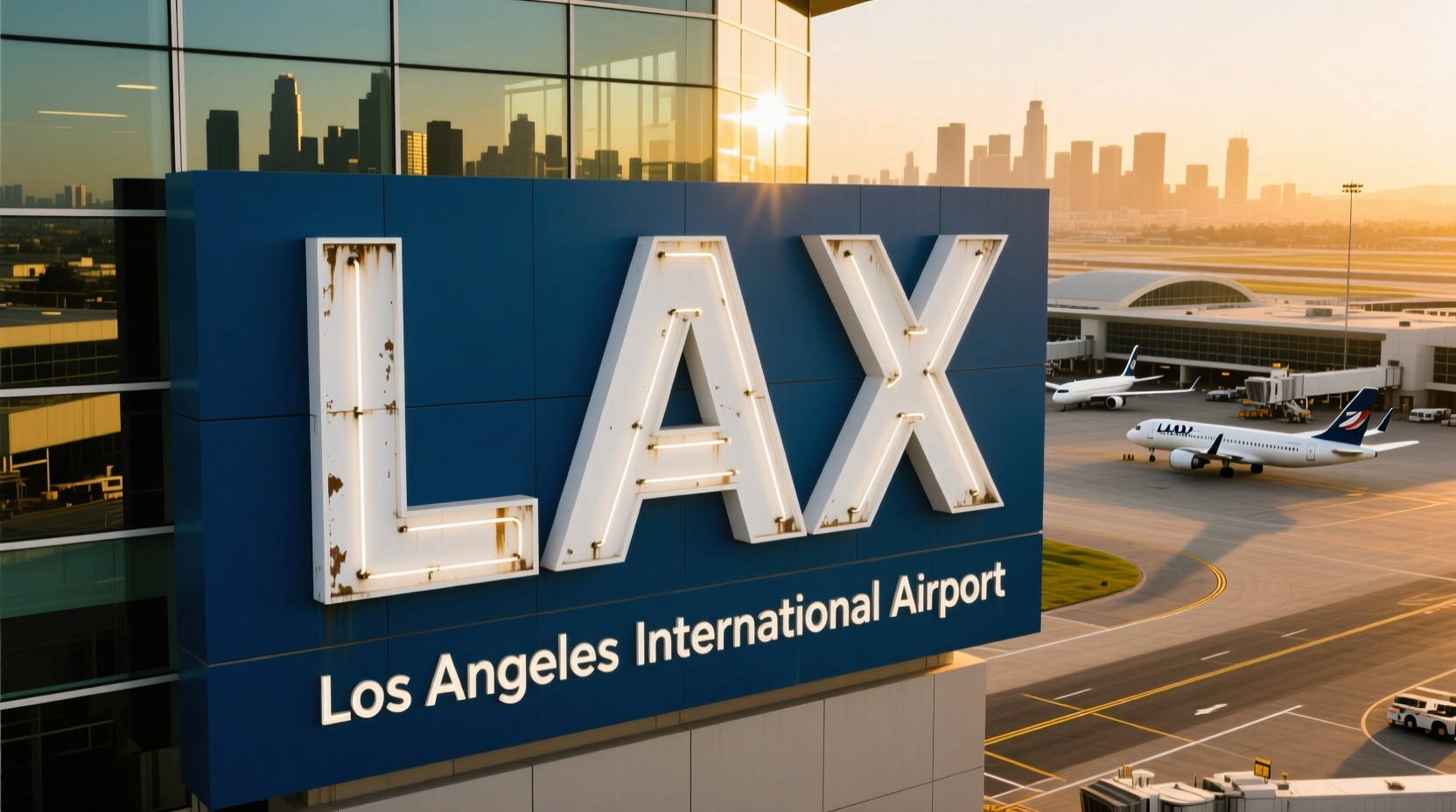
In the early 20th century, before air travel became widespread, cities used two-letter codes to identify locations for weather reporting and air traffic coordination. These codes were assigned by the National Weather Service (NWS) and later adopted by the emerging aviation industry. Los Angeles was originally designated \"LA\" — a straightforward abbreviation based on its name.
As commercial aviation expanded in the 1930s and 1940s, the number of airports grew rapidly, and the two-letter system quickly became insufficient. To prevent duplication and streamline communication, the International Air Transport Association (IATA) introduced a standardized three-letter coding system. Existing two-letter codes were typically expanded by adding a third letter, often derived from the city’s name, a nearby landmark, or sometimes simply to avoid conflicts with other airports.
For Los Angeles, this meant transforming \"LA\" into a three-character identifier. Instead of changing the root, officials appended an \"X\" — resulting in \"LAX.\" At first glance, this may seem arbitrary, but the use of \"X\" wasn’t random; it followed a common pattern in early U.S. airport code development.
Why the “X”? Decoding the Suffix
The addition of \"X\" to LAX might appear cryptic, but it reflects historical conventions in radio communication and geographic identifiers. In early aviation, many U.S. cities added \"X\" as a placeholder or suffix when expanding their two-letter codes. This practice originated from the use of radio call signs, where \"X\" denoted stations in the western United States.
For example:
- Dallas-Fort Worth became DFW
- Phoenix became PHX
- Honolulu became HNL
- Salt Lake City became SLC (though not ending in X, same era)
In this context, \"X\" didn't stand for anything literal like \"crossroads\" or \"experimental.\" It was simply a conventional way to extend existing codes while maintaining regional consistency. So when LA needed a third letter, \"X\" was a natural fit — preserving the original identifier while conforming to the new three-letter standard.
“Many early airport codes were adaptations of weather station or radio call sign identifiers. The 'X' in LAX isn’t symbolic — it’s structural, a product of bureaucratic standardization.” — Dr. Alan Reed, Aviation Historian, Smithsonian National Air and Space Museum
A Timeline of LAX: From Municipal Airfield to Global Hub
The story of LAX extends beyond its name. Understanding its evolution helps explain why the code stuck and became globally recognized.
- 1928: The city of Los Angeles purchases 640 acres of land in Westchester for an airfield. It’s initially named Mines Field, after a local landowner.
- 1930: The airport is renamed Los Angeles Metropolitan Airport. It begins scheduled passenger service.
- 1937: The airport adopts the two-letter code \"LA\" for weather and flight operations.
- 1947: With the introduction of three-letter IATA codes, \"LA\" becomes \"LAX\" to comply with new standards.
- 1949: The airport is officially rebranded as Los Angeles International Airport.
- 1961: The iconic Theme Building opens, cementing LAX as a symbol of mid-century modern design and the Jet Age.
- Today: LAX serves over 80 million passengers annually and remains one of the primary gateways to the Pacific Rim.
Despite multiple renovations, expansions, and rebranding efforts, the name LAX has endured — not because of marketing, but because of consistency in global aviation systems.
Common Misconceptions About the Name LAX
Over the years, several myths have emerged about what \"LAX\" stands for. While creative, they are historically inaccurate.
| Misconception | Reality |
|---|---|
| LAX stands for \"Los Angeles X\" — with X meaning \"crossroads of the world\" | No official documentation supports this. The \"X\" is a structural addition, not symbolic. |
| \"X\" refers to experimental flights or secret government projects at the airport | Fringe theory with no basis in aviation records. LAX has never been a classified facility. |
| The name changed to LAX only after international flights began | LAX was adopted in 1947; the airport was renamed \"International\" in 1949. The code predates the formal title. |
How LAX Compares to Other Major U.S. Airport Codes
LAX is not unique in its naming logic. Many major American airports follow similar patterns of expansion from two-letter to three-letter codes. Here’s how LAX fits into the broader system:
| Airport | Original Code | Final Code | Reason for Third Letter |
|---|---|---|---|
| New York (LaGuardia) | NY | LGA | Named after Mayor Fiorello La Guardia; \"NYC\" already taken |
| Chicago | CH | ORD | From Orchard Field, the airport’s original name |
| San Francisco | SF | SFO | \"O\" added to distinguish from other SF-named locations |
| Las Vegas | LV | LAS | Expanded using first three letters of city name |
| Los Angeles | LA | LAX | \"X\" added as a standard suffix during code expansion |
This comparison shows that LAX follows a consistent national pattern — even if the result feels less intuitive than others.
Mini Case Study: Traveler Confusion at LAX
Jessica, a first-time international traveler from Germany, arrived at LAX expecting to see signs spelling out \"Los Angeles.\" Instead, she was greeted by massive \"LAX\" emblems on terminals, shuttles, and baggage carousels. Initially confused, she assumed \"LAX\" was a brand or nickname, not realizing it was the official airport code.
After asking an information officer, she learned the history behind the name. “It made so much sense once I understood it wasn’t a marketing gimmick,” she said. “Now I notice airport codes everywhere — and I actually enjoy decoding them.”
Her experience highlights how unfamiliar naming conventions can confuse travelers — especially those from countries where airport names are spelled out fully (like Frankfurt am Main or Charles de Gaulle). Yet, once explained, these codes become part of the global language of travel.
Frequently Asked Questions
Does the \"X\" in LAX stand for anything?
No, the \"X\" does not stand for a specific word. It was added as a standard practice when transitioning from two-letter to three-letter airport codes in the 1940s. It has no symbolic meaning.
Are there other airports that end in \"X\"?
Yes. Examples include PHX (Phoenix), PDX (Portland), and SDF (Louisville, though not ending in X, same era). The \"X\" suffix was common in western U.S. cities during the code expansion period.
Could LAX have been named something else?
Possibly. If the airport had been developed later, it might have received a code like \"LAC\" or \"LAN.\" But because it inherited the \"LA\" designation from its early weather station code, \"LAX\" was the logical extension under IATA rules.
Conclusion: More Than Just Letters
LAX is far more than a set of letters on a departure board. It’s a historical artifact embedded in the infrastructure of modern aviation. The name reflects a time when air travel was transitioning from novelty to necessity, and when standardized systems had to be created overnight to manage growing complexity.
Understanding why LAX is called LAX offers more than trivia — it provides insight into how language, logistics, and legacy shape our everyday experiences. The next time you pass through Terminal B or wait for a flight at Gate 45A, remember: that \"X\" isn’t mysterious. It’s a quiet nod to the engineers, meteorologists, and pilots who built the skies we travel today.




 浙公网安备
33010002000092号
浙公网安备
33010002000092号 浙B2-20120091-4
Comments
No comments yet. Why don't you start the discussion?