
Experiencing a vibration or shake through the steering wheel or brake pedal when slowing down can be unsettling—and sometimes dangerous. Many drivers immediately assume their wheels are out of alignment, but the truth is more complex. While alignment plays a role in vehicle handling, it's rarely the direct cause of brake-related shaking. More often, the culprit lies within the braking system itself, particularly warped or worn brake rotors. Understanding the difference between rotor issues and alignment problems is essential for accurate diagnosis, cost-effective repairs, and long-term vehicle safety.
Understanding Brake Shaking: The Mechanics Behind the Vibration
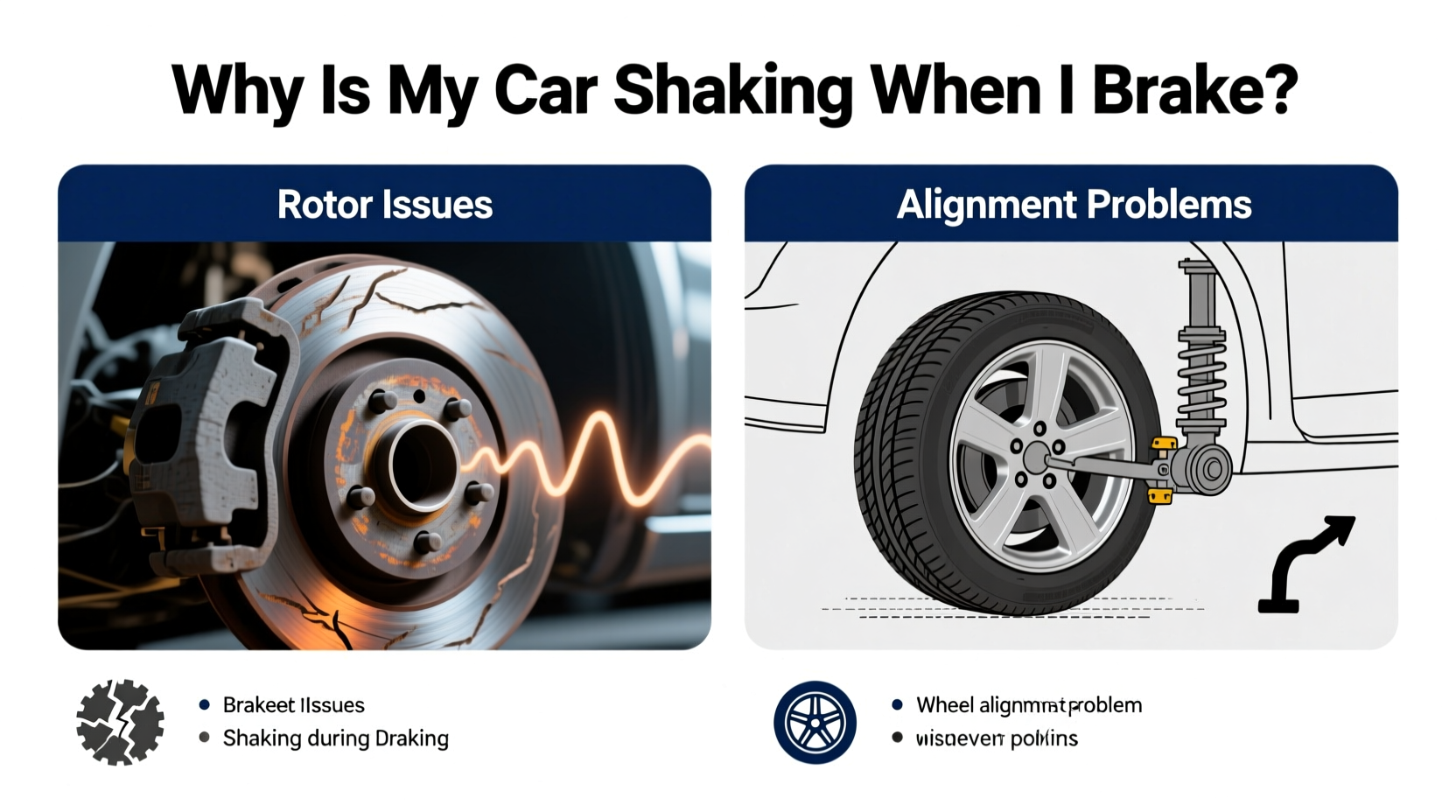
When you press the brake pedal, hydraulic pressure forces brake pads against the rotors—metal discs attached to each wheel. This friction slows the vehicle. If the surface of a rotor is uneven, excessively worn, or damaged, the pads don’t make consistent contact. Instead, they skip over high and low spots, creating a pulsing sensation transmitted through the brake pedal and steering column.
This phenomenon is often mistaken for poor alignment because both conditions can affect how the car feels while driving. However, alignment refers to the angles at which your wheels are set relative to each other and the road. It influences tire wear, directional stability, and straight-line tracking—but not the physical interaction between brake pads and rotors.
Brake-induced shaking typically worsens as speed increases and becomes most noticeable during deceleration. In contrast, misalignment usually causes pulling to one side, uneven tire wear, or a crooked steering wheel when driving straight—symptoms that persist regardless of whether you're braking.
Common Causes of Brake Shaking: Rotors vs. Other Factors
While warped rotors are the most frequent cause of brake vibration, several mechanical issues can mimic similar symptoms. Identifying the root cause requires careful observation and professional inspection.
1. Warped or Worn Brake Rotors
Rotors can warp due to excessive heat buildup from aggressive braking, poor-quality materials, or improper torque on lug nuts. Over time, repeated heating and cooling cycles cause metal fatigue, leading to distortion. Even slight warping—sometimes less than 0.001 inches—can produce noticeable vibrations.
Worn rotors may also develop grooves or become too thin to dissipate heat effectively, reducing braking performance and increasing the likelihood of pulsation.
2. Uneven Brake Pad Deposits
Glazing or uneven transfer of pad material onto the rotor surface (known as \"pad taper\" or \"disc thickness variation\") can create high spots. This condition mimics warping and often occurs after hard stops or using incompatible brake pads.
3. Stuck Calipers or Slide Pins
If a brake caliper doesn’t retract properly due to corrosion or dried lubricant, the pad remains in partial contact with the rotor. This constant friction generates excess heat, potentially warping the rotor over time.
4. Tire and Wheel Issues
Unbalanced tires, bent rims, or separated tire tread can also cause shaking, though these usually present as vibrations during acceleration or cruising—not just under braking.
5. Suspension Component Wear
Worn control arms, bushings, ball joints, or tie rods can allow excessive movement in the front end, amplifying any minor inconsistencies in the braking system. These components should be inspected alongside the brakes.
“Over 70% of brake shudder complaints we see are due to rotor runout or thickness variation—not alignment.” — Carlos Mendez, ASE-Certified Master Technician
Alignment Problems: When They Matter and When They Don’t
Wheel alignment adjusts camber, caster, and toe angles to ensure optimal tire contact with the road. Proper alignment improves fuel efficiency, extends tire life, and enhances handling. But here’s the key point: **alignment does not affect what happens between the brake pad and rotor**.
You might need an alignment if:
- Your car pulls strongly to one side while driving
- The steering wheel is off-center when going straight
- Tires show irregular wear patterns (e.g., feathering, inner/outer edge wear)
However, none of these directly cause shaking during braking. That said, severe suspension misalignment—especially if caused by impact damage like hitting a curb—could indirectly contribute to rotor warping by altering stress distribution across the hub assembly.
In rare cases, incorrect camber angle could lead to uneven rotor wear over many thousands of miles, but this would be a secondary, long-term effect rather than an immediate cause of pulsation.
Key Differences Between Rotor Issues and Alignment Problems
| Symptom | Rotor Issue | Alignment Problem |
|---|---|---|
| Shaking felt when braking | Yes – especially at higher speeds | No – unrelated to braking |
| Vibration during normal driving | Rare unless severe | Possible if tires affected |
| Steering wheel pull | Only during braking (if front rotors) | Constant, even without braking |
| Tire wear pattern | Usually even | Uneven (inner/outer shoulder wear) |
| Repair focus | Brakes, rotors, calipers | Suspension geometry adjustment |
Step-by-Step Diagnostic Process for Brake Shaking
Diagnosing the source of brake vibration doesn’t require expensive tools, but it does demand attention to detail. Follow this logical sequence to identify the issue accurately:
- Observe when the shaking occurs: Does it happen only when braking? At specific speeds? Only under heavy braking?
- Check for consistency: Is the pulsation rhythmic and tied to wheel rotation? This suggests a mechanical defect like rotor warpage.
- Inspect the front-end visually: Look for rusted caliper slides, leaking brake fluid, or obvious damage to wheels.
- Test drive with caution: Note whether the steering wheel shakes (front rotors) or the seat/floorboard vibrates (rear rotors).
- Have a technician measure rotor runout: Using a dial indicator, they can detect deviations greater than 0.001 inches, which warrant resurfacing or replacement.
- Verify lug nut torque: Improperly tightened lug nuts can distort the rotor over time. Always use a torque wrench during tire changes.
- Assess suspension components: Check for play in ball joints, control arm bushings, and tie rod ends.
- Perform alignment check: Only after ruling out brake and suspension faults—don’t assume misalignment is the cause.
Mini Case Study: Sarah’s SUV Shaking Mystery
Sarah, a commuter in Denver, began noticing her 2018 Honda Pilot shuddered when braking above 50 mph. She assumed her recent pothole encounter had thrown the alignment off and scheduled an alignment service. After the adjustment, the shake remained unchanged.
She then visited a trusted mechanic who performed a full brake inspection. The technician found that the front rotors had developed significant thickness variation—0.003 inches beyond acceptable limits—due to overheating from frequent mountain descents. The brake pads were glazed but still functional.
The solution? Resurfacing the rotors (they were thick enough) and installing new ceramic pads. Post-repair, the vibration disappeared completely. An alignment recheck confirmed it was within spec all along.
This case illustrates how easily misdiagnosis can occur without proper testing. Focusing on symptoms alone led Sarah down the wrong repair path initially.
Do’s and Don’ts: Managing Brake Shaking Effectively
| Action | Do | Don't |
|---|---|---|
| After noticing shaking | Get brakes inspected promptly | Delay repairs hoping it resolves itself |
| Lug nut installation | Use a torque wrench in star pattern | Use an impact gun without final torque check |
| Choosing repair shop | Select one with dial indicators for runout checks | Accept “just replace the pads” without rotor assessment |
| Driving habits | Allow cool-down after highway driving | Ride the brakes downhill |
| Preventive maintenance | Inspect brakes every 12,000 miles | Wait until squealing before checking |
Frequently Asked Questions
Can bad alignment cause my car to shake when I brake?
No, misalignment affects how your car tracks and handles but does not interfere with the contact between brake pads and rotors. If shaking only occurs during braking, the issue is almost certainly in the brake system—not alignment.
How much does it cost to fix warped rotors?
Resurfacing rotors costs $15–$25 per rotor if done in-house. Replacement ranges from $100–$300 per axle including parts and labor. Prices vary based on vehicle make and brake quality.
Is it safe to drive with brake shaking?
Short-term driving is generally safe, but prolonged neglect can damage calipers, reduce braking efficiency, and compromise ABS functionality. Address the issue within a few hundred miles to prevent further damage.
Final Recommendations and Preventive Care
To avoid recurring brake vibrations, adopt proactive maintenance habits. Use high-quality brake pads suited to your driving style—ceramic for daily commuting, semi-metallic for towing or hilly terrain. Avoid aggressive braking whenever possible, and let your brakes cool after extended highway use.
Whenever tires are removed, insist on proper lug nut torque using a calibrated wrench. Skipping this step is one of the top causes of post-service rotor warping.
Finally, remember: brake shaking is a symptom, not a diagnosis. Don’t accept vague explanations or unnecessary services. Ask for a runout measurement and a clear explanation of findings before approving repairs.




 浙公网安备
33010002000092号
浙公网安备
33010002000092号 浙B2-20120091-4
Comments
No comments yet. Why don't you start the discussion?