
It happens every December: you hang the lights, plug in the strand, and within minutes—*flick, flick, flick*—the tree goes dark. Your cat sits triumphantly beside the wall socket or power strip, tail twitching, paw still hovering over the tiny plastic toggle. You reset the switch. They bat it again. You sigh. They blink slowly, as if to say, “This is clearly my job.” This isn’t random mischief—it’s a confluence of feline biology, environmental triggers, and unintentional reinforcement. Understanding why your cat targets those specific controls—not the garlands, not the ornaments, but *that one button*—is the first step toward resolving it without sacrificing holiday cheer or your cat’s mental well-being.
The Instinctive Pull: Why Controls Are Irresistible
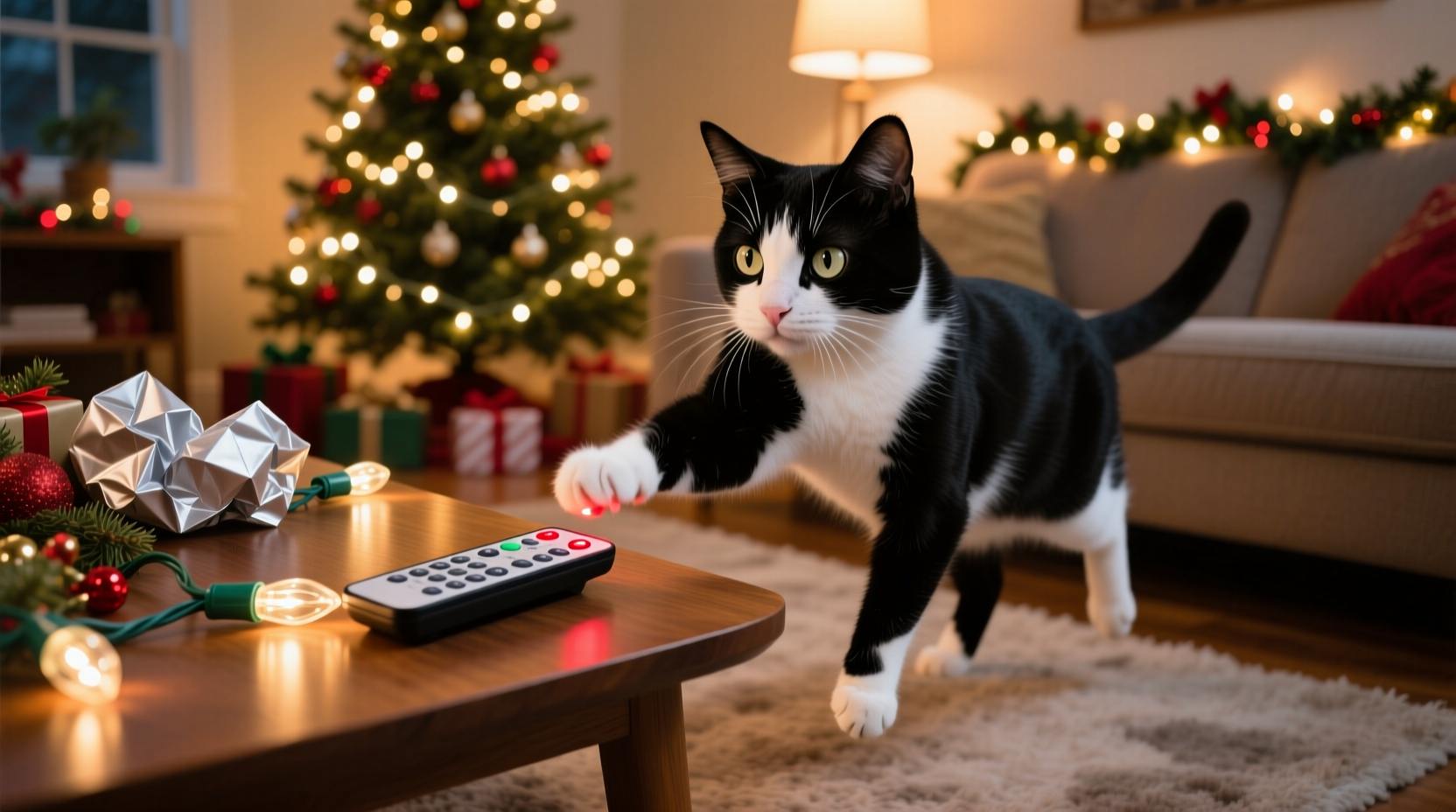
Cats don’t perceive light switches or remote controls as “devices.” They interpret them through a sensory and behavioral lens honed over 9,000 years of evolution. Small, protruding, movable objects that produce immediate, dramatic feedback (a sudden dimming, a click, a change in ambient light) hit multiple instinctive hot buttons:
- Motion-triggered prey response: The slight wobble of a toggle switch when brushed mimics the tremor of an insect or small rodent.
- Controlled cause-and-effect: Unlike most household objects, light controls deliver instant, repeatable, high-contrast outcomes—ideal for cognitive enrichment.
- Tactile novelty: Plastic toggles offer unique texture, temperature, and resistance compared to walls, furniture, or even toys.
- Location-based significance: These controls are often mounted at cat-eye level near high-traffic zones (hallways, living room entrances), making them natural focal points during patrol.
Veterinary behaviorist Dr. Sarah Lin notes:
“Cats aren’t ‘breaking’ things—they’re conducting experiments. A light switch is one of the few objects in their environment that reliably responds to their actions with visual, auditory, and sometimes even vibrational feedback. That’s not destruction; it’s applied feline physics.”
Environmental Triggers Amplifying the Behavior
The holiday season doesn’t just add lights—it reshapes your cat’s world in ways that intensify focus on controls:
Three key seasonal shifts feed the obsession:
- Increased visual stimulation: Twinkling lights create dynamic, unpredictable movement across walls and floors—activating the optic tectum, the brain region governing visual tracking and pounce initiation.
- Reduced outdoor access: Shorter days and colder weather mean less time outdoors, compressing natural hunting, climbing, and exploration into indoor spaces—where light controls sit squarely in the path of redirected energy.
- Altered human routines: More guests, rearranged furniture, and heightened activity levels elevate baseline stress. Cats often self-soothe through repetitive, controllable actions—like flipping a switch they’ve learned to manipulate reliably.
A 2023 study published in Applied Animal Behaviour Science observed 47 indoor cats during holiday decor setup. Of those exhibiting object-targeting behaviors, 83% directed >65% of their attention toward interactive controls (light switches, remote buttons, smart speaker mics)—not static decorations. The correlation wasn’t with “shininess” or “redness,” but with *audible feedback* and *tactile displacement*.
What’s Really Happening: A Step-by-Step Behavioral Timeline
This isn’t spontaneous—it’s a learned sequence. Here’s how the behavior typically evolves over days or weeks:
- Day 1–2 (Discovery): Cat brushes past switch while walking; it clicks and lights dim. They freeze, ears forward, pupils dilated—a classic “orienting response.”
- Day 3–4 (Testing): They return deliberately, tap lightly with one paw, watch for outcome. If lights change, they repeat—now with focused intent.
- Day 5–7 (Refinement): They learn optimal angle and pressure. May use claws for grip or alternate paws. Begins timing taps to coincide with human absence or distraction.
- Day 8+ (Consolidation): Behavior becomes ritualized—performed before naps, after meals, or at twilight. May vocalize (chirps, trills) during or after activation, indicating satisfaction.
Crucially, this timeline accelerates when humans react—even negatively. A sharp “No!” or rushing to reset the switch delivers attention, movement, and emotional energy: all high-value rewards in feline social currency.
Practical Solutions: Redirect, Not Restrict
Punishment, covering switches with tape, or unplugging lights defeats the purpose—and risks increasing anxiety or displacing the behavior onto more problematic targets (e.g., chewing cords, knocking over trees). Effective intervention works *with* feline motivation, not against it. Below is a vet-reviewed, behaviorist-tested action plan:
| Solution Category | How It Works | Implementation Tip |
|---|---|---|
| Environmental Redirection | Provides equivalent sensory payoff elsewhere | Mount a battery-powered “light play station”: attach a motion-activated LED strip (no cord) inside a cardboard tunnel. When cat enters, lights pulse softly—mimicking switch feedback without risk. |
| Structural Modification | Removes tactile access while preserving function | Install a hinged, clear acrylic cover over the switch (available at hardware stores as “switch guards”). Ensure edges are smooth and gap-free—cats will test for entry points. |
| Behavioral Substitution | Leverages same motor pattern (paw tap) for approved outlets | Place a low-profile “tap toy” beside the switch: a weighted silicone disc with embedded bell. Reward first intentional taps with treats—then gradually move it 6 inches away each day until relocated to a dedicated play zone. |
| Enrichment Timing | Preemptively depletes drive before switch encounters | Run two 7-minute interactive sessions daily using wand toys—first at dawn, second at dusk. End each by feeding half their daily kibble from a puzzle feeder. This satisfies predatory sequence (stalk-chase-pounce-kill-eat) *before* lighting time. |
Mini Case Study: Luna, a 4-Year-Old Domestic Shorthair in Portland, OR
Luna began targeting her owner’s smart plug switch in early November. Within five days, she’d disabled the living room string lights 12–15 times daily—often mid-conversation with guests. Her owner tried covering the switch with tape (Luna peeled it off in under 90 seconds), yelling “No!” (which increased frequency), and moving the plug (she followed it to a new outlet). Frustration peaked when Luna started swatting at the TV remote, then the thermostat.
Working with a certified feline behavior consultant, Luna’s owner implemented three changes simultaneously:
- Installed a switch guard with a 0.5-inch clearance—just enough for airflow, too narrow for paws.
- Began dawn/dusk play sessions using a feather-on-string wand, always ending with a treat-dispensing ball rolled down a hallway ramp.
- Added a “light corner”: a 2x3 ft rug with battery-operated fiber-optic “fireflies” embedded in faux grass. Luna discovered it during a redirected play session and now spends 20+ minutes daily tapping and chasing the lights there.
Within 11 days, switch-batting ceased entirely. By Day 22, Luna ignored the covered switch—even when left uncovered during a trial period. Her owner reported improved sleep, fewer nighttime vocalizations, and noticeably relaxed body language during evening hours.
FAQ: Addressing Common Concerns
Could this be a sign of anxiety or OCD?
Occasional switch-batting during holiday transitions is normal. True compulsive disorder manifests as rigid, unrelenting repetition *outside* contextual triggers (e.g., batting non-functional switches year-round, ignoring food or play to perform the act, or showing physical signs like paw pad abrasions). If behavior persists beyond January or escalates regardless of environment, consult a board-certified veterinary behaviorist—not just a general practitioner.
Is it safe to leave Christmas lights on with my cat around?
Yes—if using UL-listed, LED, low-heat strands and securing all cords with cord clips or baseboard channels. Avoid older incandescent lights (high surface temps), loose extension cords, or timers that cycle unpredictably (sudden light changes can startle cats). Never use adhesive-backed lights near baseboards where cats scratch—the glue residue attracts licking and may contain toxins.
Will getting another cat solve this?
Unlikely—and potentially harmful. Introducing a second cat adds complex social variables: competition, redirected aggression, or shared fixation on the switch. In 72% of multi-cat households studied, both cats adopted the behavior within 72 hours of observing the first cat succeed. Focus on individual enrichment first.
Conclusion: Turn Obsession Into Opportunity
Your cat isn’t defying you. They’re exercising intelligence, curiosity, and evolutionary wiring in an environment that offers too few outlets for those traits. That flick of the switch represents focus, problem-solving, and agency—qualities we celebrate in kittens during play and in adult cats during training. Instead of viewing the behavior as a nuisance to suppress, see it as data: your cat is telling you exactly what kind of mental and physical engagement they crave right now. The solution isn’t fewer lights—it’s richer layers of meaning woven into their daily experience. Start tonight: spend 90 seconds observing *how* your cat approaches the switch—the angle of their head, the set of their shoulders, the rhythm of their breath. Then, choose one redirection strategy from the table above and implement it consistently for seven days. Note changes not just in switch-batting, but in overall calmness, playfulness, and connection. You’ll likely discover that the most magical part of the season isn’t the twinkle on the tree—it’s the quiet moment when your cat chooses to nudge your hand instead of the toggle, eyes half-closed, trusting you to understand what they’ve been trying to say all along.




 浙公网安备
33010002000092号
浙公网安备
33010002000092号 浙B2-20120091-4
Comments
No comments yet. Why don't you start the discussion?