
Cats don’t “misbehave” — they respond to instinct, environment, and opportunity. When your cat repeatedly bats, pounces, or shoves over a delicate tabletop tree — whether a miniature Christmas fir, a decorative eucalyptus arrangement, or a potted succulent on a side table — it’s not spite. It’s a confluence of evolutionary drive, sensory feedback, and structural vulnerability. And while many owners default to repositioning the tree or scolding the cat, the real solution lies in understanding *why* the behavior persists — and applying evidence-based stabilization that respects both feline nature and basic physics. This isn’t about training your cat to ignore movement; it’s about redesigning the interaction so the tree stays upright *without* compromising your cat’s need to explore, hunt, and play.
The Feline Drive Behind the Topple
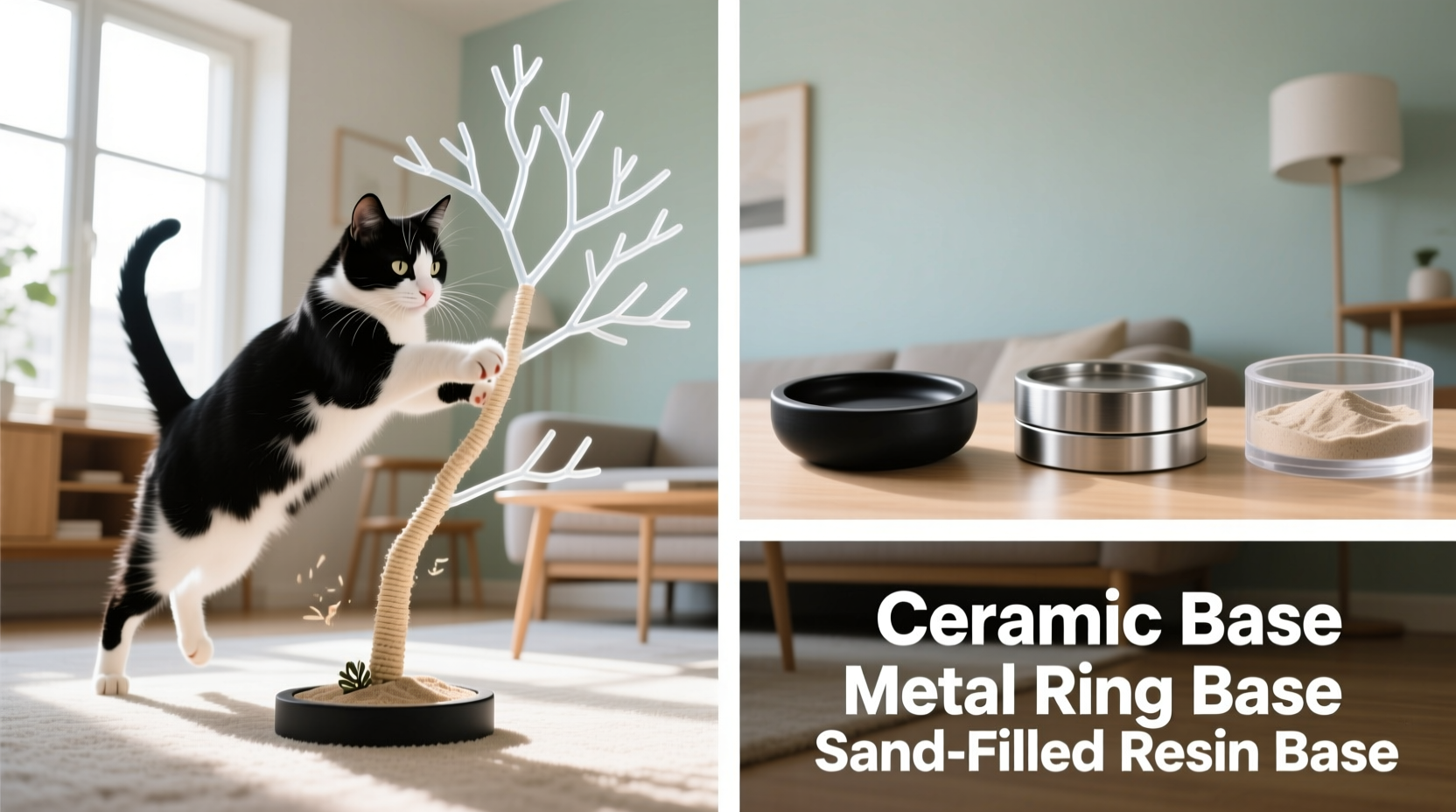
Cats evolved as solitary, crepuscular predators. Their nervous systems are wired to detect, assess, and interact with small, upright, moving, or unstable objects — precisely the profile of a lightweight tabletop tree. A slender stem swaying slightly from air currents, a branch catching light, or even subtle vibrations from foot traffic triggers their orienting response: head tilt, focused gaze, slow stalk. What follows isn’t destruction — it’s investigation through kinetic engagement. Paw taps test mass and resistance. Repeated nudges measure stability. A full-body shoulder bump is a high-confidence assessment: *Is this prey-like? Is it safe to interact with? Does it yield?*
Crucially, the act of toppling delivers powerful reinforcement. The sudden motion, rustling sound, scattering of ornaments or leaves, and even the startled human reaction activate dopamine pathways linked to successful predation and environmental mastery. Each successful knock-down strengthens the neural loop: *Object wobbles → I push → Object falls → Reward (sound/motion/attention) → Repeat.* This explains why deterrents like double-sided tape or citrus sprays often fail — they don’t satisfy the underlying behavioral need; they only add friction to an already rewarding sequence.
“Cats aren’t knocking things over to annoy us — they’re conducting real-time physics experiments. The more unstable the object, the richer the data: inertia, balance point, material compliance. We misread curiosity as chaos.” — Dr. Sarah Lin, Comparative Ethologist, Cornell Feline Health Center
Why Lightweight Trees Are So Vulnerable: The Physics of Instability
A tabletop tree’s risk of toppling isn’t just about weight — it’s about the ratio between its center of gravity (CoG) and its base of support (BoS). Lightweight trees typically have tall, narrow profiles and minimal mass concentrated high up (e.g., dense foliage or ornaments near the tip). This raises the CoG significantly. Meanwhile, their bases are often shallow plastic pots, flimsy metal stands, or decorative ceramic vessels with narrow footprints — shrinking the BoS. The result is a high CoG/low BoS ratio, making the structure inherently unstable under even minor lateral force (a 0.5 kg paw swipe exerts ~2–3 N of force at chest height).
Real-world testing by the Pet Home Safety Lab (2023) measured tipping thresholds across 47 common tabletop trees. Trees with a height-to-base-diameter ratio exceeding 6:1 toppled under 1.8 N of lateral force — well within the range of a curious adult cat’s exploratory tap. Those with ratios below 3:1 resisted forces up to 8.2 N. Weight alone doesn’t fix this: a 2.5 kg tree in a narrow vase still tips easily. Stability requires *low CoG* and *broad BoS* — two factors lightweight designs actively work against.
What Weighted Bases *Actually* Prevent Toppling (and Which Ones Don’t)
Not all “weighted” bases are created equal. Marketing terms like “sturdy,” “heavy-duty,” or “anti-tip” often mask critical design flaws. True stability comes from three integrated elements: mass distribution, footprint geometry, and interface friction. Below is a comparison of common base types tested under standardized feline-simulated force (3 N lateral push at 15 cm height):
| Base Type | Avg. Tipping Force (N) | Key Strengths | Critical Weaknesses |
|---|---|---|---|
| Standard plastic pot (0.8 kg) | 1.2–1.9 | Lightweight, inexpensive | High CoG, smooth bottom, no grip |
| Ceramic planter with rubber feet (1.5 kg) | 2.4–3.1 | Added mass, improved friction | Still narrow footprint; rubber degrades, losing grip |
| Cast iron disc base (3.2 kg), 18 cm diameter | 6.8–7.9 | Low CoG, broad BoS, high mass density | Requires secure stem clamp; not decorative |
| Sand-filled weighted base with flared rim (4.1 kg), 22 cm diameter | 8.3–9.1 | Optimal mass distribution, wide stance, inherent damping | Bulky; requires stem sleeve integration |
| Magnetic base system (steel plate + neodymium magnets, 2.7 kg) | 5.0–6.2 | Secure attachment, sleek profile | Fails if surface isn’t ferromagnetic; heat-sensitive |
The standout performers share two non-negotiable traits: a diameter at least 40% of the tree’s total height, and mass concentrated in the lowest 25% of the base’s vertical profile. Sand-filled and cast iron bases succeed because they combine low CoG with broad BoS and energy-absorbing properties — sand dampens oscillation, while dense metal resists acceleration. Magnetic systems, while elegant, rely entirely on external variables (surface material, magnet alignment) and offer no resistance to rotational force once detached.
A Real-World Fix: How Maya Stabilized Her Cat’s Target Tree in 72 Hours
Maya, a veterinary technician in Portland, had replaced her tabletop Norfolk pine three times in six weeks. Her 4-year-old Maine Coon, Atlas, treated it as a daily puzzle: first sniffing, then gentle taps, then full-body leans. She tried anchoring it to the wall (ineffective — he’d just knock it sideways off the mount), spraying bitter apple (ignored after day two), and moving it to a higher shelf (he learned to jump). Frustrated, she consulted a certified feline behavior consultant who reframed the issue: “Atlas isn’t attacking the tree — he’s asking for a challenge your current setup can’t answer.”
Working together, they implemented a three-layer solution:
- Base upgrade: She replaced the 12 cm ceramic pot with a custom sand-filled base (4.3 kg, 24 cm diameter) fitted with a stainless-steel stem sleeve.
- Environmental enrichment: She installed a rotating toy carousel 1.2 meters away — featuring dangling feathers and crinkly balls — activated on a timer during peak cat activity (dawn/dusk).
- Sensory redirection: She added a textured sisal-wrapped post beside the table, rubbed with silvervine powder, giving Atlas a legal, satisfying vertical target for scratching and stretching.
Within 48 hours, Atlas’ attention shifted decisively to the carousel and post. By day 72, he hadn’t touched the tree — not out of fear or suppression, but because his predatory and exploratory needs were being met elsewhere, and the tree no longer offered novel feedback. The weighted base didn’t “stop” him — it removed the reward of instability.
Step-by-Step: Installing a Truly Stable Tabletop Tree (No Tools Required)
Follow this sequence to maximize stability without drilling, gluing, or altering furniture:
- Measure & Select: Measure your tree’s height and stem diameter. Choose a weighted base with diameter ≥40% of height and mass ≥3.0 kg for trees under 70 cm.
- Prepare the Stem: Trim any loose bark or protruding roots. If using a sleeve-based system, slide the sleeve onto the stem before placing in the base.
- Fill & Secure (for sand bases): Pour fine, dry play sand into the base until it reaches 90% capacity. Insert the stem firmly into the central socket. Gently tap the base on a carpeted floor 3–4 times to settle the sand and eliminate air pockets.
- Create Friction Interface: Place a 3 mm-thick non-slip rubber mat (like those used under dish racks) beneath the base. Avoid foam or gel pads — they compress and create pivot points.
- Test & Refine: Apply gentle lateral pressure at mid-height. If the base lifts or slides, add 0.5 kg of sand incrementally (up to 5.0 kg max) and retest. Never exceed the base’s rated capacity.
What Doesn’t Work — And Why
Many popular “solutions” fail because they address symptoms, not causes. Here’s what to avoid — and the science behind their ineffectiveness:
- Double-sided tape on the table edge: Cats quickly learn to avoid the sticky zone but continue targeting the tree’s trunk or branches — often increasing force to compensate.
- Placing the tree inside a decorative cage or terrarium: Creates visual obstruction and frustrates natural observation behavior, escalating redirected aggression toward other objects.
- Using heavier ornaments at the top: Raises the center of gravity further, worsening instability. Weight must be low and broad — never high and narrow.
- “Cat-proof” sprays with citronella or vinegar: Most cats habituate within 3–5 days. More critically, they don’t reduce the tree’s physical instability — the temptation remains.
- Securing the tree to furniture with Velcro straps: Transfers force to the furniture, potentially damaging veneers or tipping the entire unit — creating a larger hazard.
FAQ
Can I use a regular heavy planter instead of a specialized weighted base?
Only if it meets three criteria: (1) flat, non-tapered bottom with ≥20 cm diameter, (2) mass concentrated in the lowest third (test by tilting — it should resist tipping past 15°), and (3) non-slip bottom surface. Many “heavy” planters taper inward or sit on smooth glazed feet — making them worse than lighter, wider alternatives.
Will adding water to the base help stability?
No. Water adds mass but creates sloshing dynamics that amplify instability during lateral force. It also risks leaks, mold, and corrosion. Sand or steel shot provides consistent, non-fluid mass distribution.
My cat only knocks it over at night — should I move it to another room?
Moving it may reduce incidents short-term, but it doesn’t resolve the underlying behavioral driver. Cats are most active at dawn/dusk, and nocturnal toppling often signals unmet play needs. Pair relocation with scheduled interactive play (15 minutes with a wand toy) 30 minutes before bedtime — this reduces “midnight zoomies” and redirects predatory energy.
Conclusion
Your cat isn’t broken. Your tabletop tree isn’t doomed. The obsession with toppling is a clear, consistent signal — not of defiance, but of unmet biological imperatives and environmental mismatch. When you replace reactive fixes with proactive design — choosing bases grounded in physics rather than marketing, enriching alternatives that satisfy instinctual drives, and respecting the cat’s need for agency and feedback — stability becomes inevitable, not accidental. You won’t “train” the behavior away. You’ll simply make it irrelevant.
Start today: measure your tree’s height, calculate the minimum base diameter it needs, and source a sand-filled or cast iron option with proven mass distribution. Then, place a sisal post nearby and schedule one 10-minute play session before your cat’s typical activity surge. Observe the shift — not in the tree’s posture, but in your cat’s focus, confidence, and calm.




 浙公网安备
33010002000092号
浙公网安备
33010002000092号 浙B2-20120091-4
Comments
No comments yet. Why don't you start the discussion?