
The check engine light (CEL) is one of the most misunderstood dashboard warnings in modern vehicles. When it appears, many drivers react with confusion or panic—especially when they notice it's not just on, but flashing. The behavior of this small yellow or orange engine-shaped icon carries vital information about your car’s health. A solid glow might signal a minor issue, while a rapid flash could mean serious damage is occurring in real time. Understanding the difference between a flashing and steady check engine light isn’t just useful—it can save you thousands in repairs, prevent roadside breakdowns, and even protect your safety.
What Triggers the Check Engine Light?
The check engine light is part of your vehicle’s onboard diagnostics system (OBD-II), which monitors hundreds of sensors across the engine, transmission, emissions controls, and fuel systems. When the engine control unit (ECU) detects a parameter outside acceptable limits, it logs a diagnostic trouble code (DTC) and activates the CEL.
These triggers range from something as simple as a loose gas cap to major mechanical failures like misfiring cylinders or failing catalytic converters. But how the light behaves—steady or flashing—is the ECU’s way of communicating urgency.
Flashing vs. Solid: Key Differences in Meaning
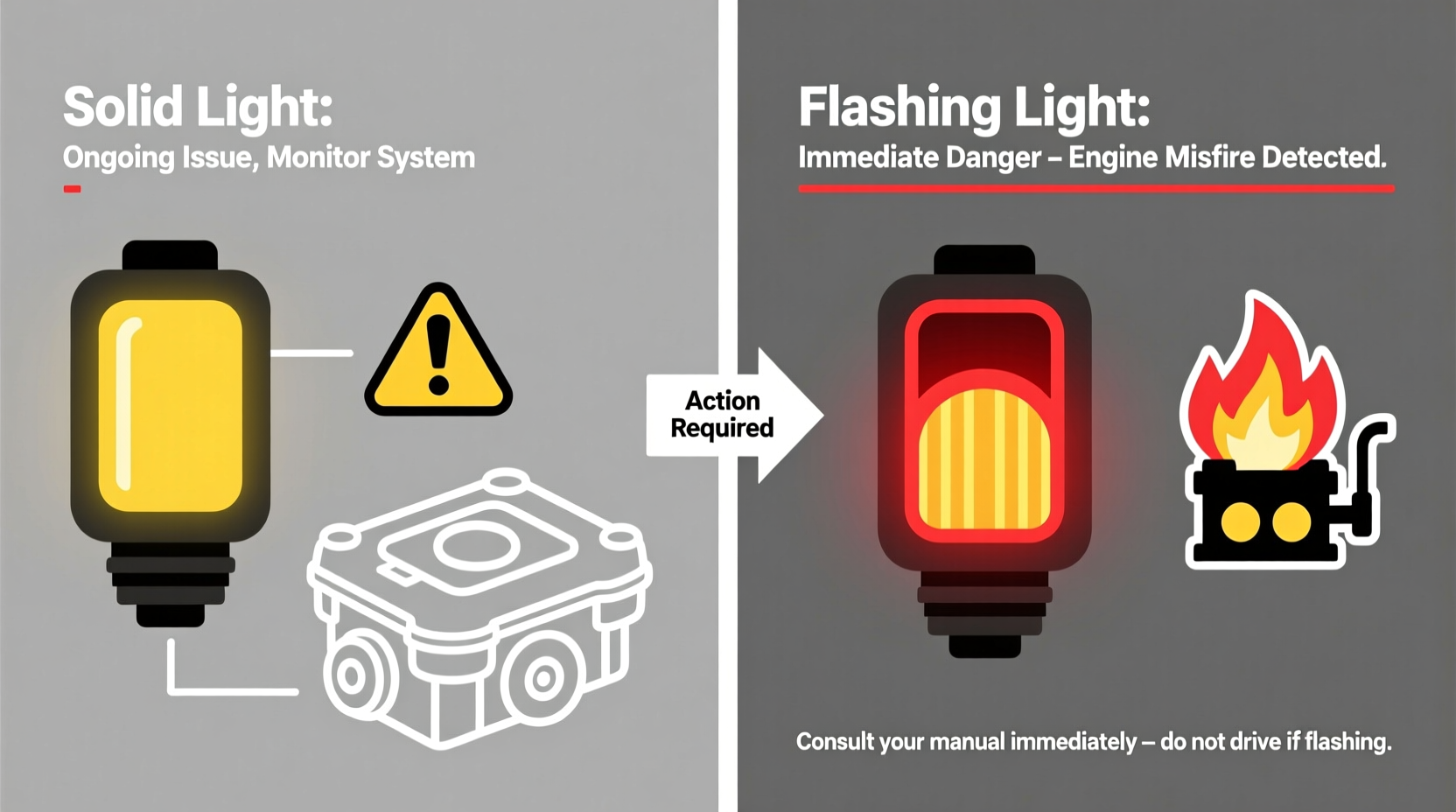
The distinction between a flashing and a solid check engine light lies in severity and immediacy:
- Flashing Check Engine Light: This means there is a severe engine misfire happening right now. Unburned fuel is entering the exhaust system, risking catastrophic damage to the catalytic converter—a costly component to replace.
- Solid Check Engine Light: This indicates a non-critical fault has been detected. While attention is needed, the issue typically doesn’t require immediate action unless accompanied by performance problems (e.g., rough idle, poor acceleration).
Think of the flashing light as a red alert: “Stop driving soon and get help.” A solid light is more like a yellow caution sign: “Schedule service within a few days.”
Why a Flashing Light Demands Immediate Action
A flashing CEL almost always points to a cylinder misfire. When one or more cylinders fail to ignite properly, raw fuel passes into the exhaust. The catalytic converter, designed to handle controlled amounts of heat and chemical reactions, becomes overwhelmed. Excess fuel ignites inside the converter, causing temperatures to spike beyond 2,000°F—hot enough to melt internal components.
Once damaged, the catalytic converter loses efficiency, increases emissions, reduces fuel economy, and may eventually clog, leading to engine stalling. Replacement costs average $900–$2,500 depending on the vehicle.
“Driving with a flashing check engine light is like running a fever and ignoring it—only here, the ‘fever’ is destroying expensive parts in real time.” — Marcus Tran, ASE-Certified Master Technician
Common Causes Behind Each Type of Warning
Different underlying issues trigger each type of warning. Knowing these helps assess risk and respond appropriately.
| Warning Type | Common Causes | Risk Level |
|---|---|---|
| Flashing CEL | Engine misfire (due to bad spark plugs, coils, or fuel injectors), severe vacuum leak, timing issues, damaged sensors causing rich fuel mixture | High – Risk of catalytic converter damage within minutes |
| Solid CEL | Loose gas cap, oxygen sensor failure, mass airflow sensor contamination, minor exhaust leak, evaporative emissions (EVAP) system fault | Low to Moderate – No immediate danger, but affects efficiency and emissions |
Real Example: Ignoring the Flash Can Cost Thousands
Consider Sarah, a commuter in Denver who noticed her check engine light flashing during her morning drive. She assumed it was similar to past solid-light incidents and planned to visit a mechanic “when convenient.” Over the next 40 miles, she continued driving despite a rough idle and reduced power.
When she finally brought the car in, diagnostics revealed a failed ignition coil causing repeated misfires. More critically, the catalytic converter was melted internally due to excessive heat from unburned fuel. Total repair cost: $1,850—$350 for the coil, $1,500 for the converter. Her technician emphasized that pulling over after the first few flashes could have saved over $1,000.
This case illustrates how misunderstanding the urgency of a flashing light leads to avoidable expenses.
Step-by-Step: What to Do When the Light Behaves Differently
If the Light Is Flashing
- Reduce Speed and Load: If safe, ease off the accelerator. Avoid towing, uphill driving, or rapid acceleration.
- Find a Safe Place to Stop: Pull over within a few minutes. Continuing risks permanent damage.
- Turn Off Accessories: Reduce electrical load (A/C, heated seats) to minimize strain.
- Do Not Restart if Engine Feels Rough: If the car stalls or shakes violently, don’t keep trying to start it.
- Call for Tow Service: Have the vehicle towed to a trusted repair shop. Driving further is not worth the risk.
If the Light Is Solid
- Check Dashboard for Other Warnings: Look for overheating, oil pressure, or battery lights that suggest broader issues.
- Inspect Gas Cap: Turn off the engine and ensure the cap clicks securely. A loose cap is a common false trigger.
- Monitor Performance: Note any changes in fuel economy, idling smoothness, or power delivery.
- Use an OBD-II Scanner: Affordable code readers (like Fixd or Autel AL319) can retrieve the DTC and give insight into the problem.
- Schedule Service Within 3–7 Days: Even minor faults can escalate if left unresolved.
Diagnostic Trouble Codes: Decoding the Message
Every check engine light activation corresponds to one or more DTCs. These alphanumeric codes begin with a letter followed by four digits:
- P = Powertrain (engine, transmission)
- B = Body (climate control, airbags)
- C = Chassis (ABS, suspension)
- U = Network (communication between modules)
For example:
- P0300: Random/Multiple Cylinder Misfire Detected → Often causes flashing CEL
- P0420: Catalyst System Efficiency Below Threshold → Usually solid light
- P0171: System Too Lean (Bank 1) → May start solid, worsen to flash if ignored
While generic code definitions are widely available, accurate interpretation requires considering vehicle make, model, mileage, and symptoms. A P0300 on a high-mileage sedan might point to worn spark plugs; on a newer turbocharged SUV, it could indicate a failing direct injector.
Preventive Checklist: Reduce CEL Occurrences
Regular maintenance and awareness reduce the likelihood of unexpected warnings. Follow this checklist to stay ahead:
- ✅ Replace spark plugs and ignition coils per manufacturer schedule
- ✅ Use quality fuel with detergent additives (Top Tier gasoline recommended)
- ✅ Inspect vacuum hoses annually for cracks or disconnections
- ✅ Clean or replace the mass airflow (MAF) sensor every 30,000 miles
- ✅ Tighten the gas cap until it clicks (typically 3–4 turns after initial seal)
- ✅ Change engine oil and filter on time—sludge buildup affects sensor readings
- ✅ Address small issues early (e.g., rough idle, hesitation) before they trigger CEL
“The best way to avoid a flashing check engine light is consistent maintenance. Most misfires stem from neglected wear items like plugs and coils.” — Lena Patel, Automotive Diagnostics Instructor at UTI
Frequently Asked Questions
Can I drive with a solid check engine light?
Yes, in most cases—but cautiously. If the car runs normally, you can continue driving short distances while planning a service appointment within a week. However, if you notice performance issues (hesitation, stalling, poor fuel economy), limit driving and seek diagnosis sooner.
Will the check engine light reset itself if the problem goes away?
Yes. Modern vehicles use a \"drive cycle\" logic. If the issue doesn’t reoccur over several trips under various conditions (idle, acceleration, cruising), the light may turn off automatically. However, the code often remains stored for emission testing purposes. Use a scanner to confirm resolution.
Is a flashing check engine light an emergency?
It’s not a medical emergency, but it is a mechanical emergency. You should treat it with the same urgency as low oil pressure or overheating. Continued operation risks thousands in repair bills. Safely stop and arrange towing.
Conclusion: Listen to Your Car’s Warning System
Your vehicle communicates through sounds, vibrations, and dashboard lights. The check engine light—especially when flashing—isn’t meant to scare, but to protect. Recognizing the critical difference between a solid and flashing indicator empowers you to make smart decisions that preserve your engine, safeguard your wallet, and maintain reliability.
Don’t wait for a minor issue to become a major failure. Invest in a simple code reader, stay attentive to changes in performance, and respect the urgency of a flashing light. Whether you're commuting across town or embarking on a road trip, understanding this key warning system keeps you moving safely and confidently.




 浙公网安备
33010002000092号
浙公网安备
33010002000092号 浙B2-20120091-4
Comments
No comments yet. Why don't you start the discussion?