
One moment your tree glows warmly—full, vibrant, evenly lit. The next, the bottom third is dark while the top stays bright. Or worse: only the first 25 bulbs shine, then nothing beyond the midpoint. This isn’t random failure—it’s a signature symptom of a broken circuit in a series-wired light strand. Unlike household wiring, most traditional mini-light strings use a series configuration: current flows through each bulb in sequence. One break—or even one faulty bulb—halts the path for the entire downstream section. Understanding *why* this happens—and knowing which troubleshooting steps actually work (and which waste time)—is the difference between a functional display and a frustrating holiday scramble.
How Series Circuits Work (and Why Half-Out Is So Common)
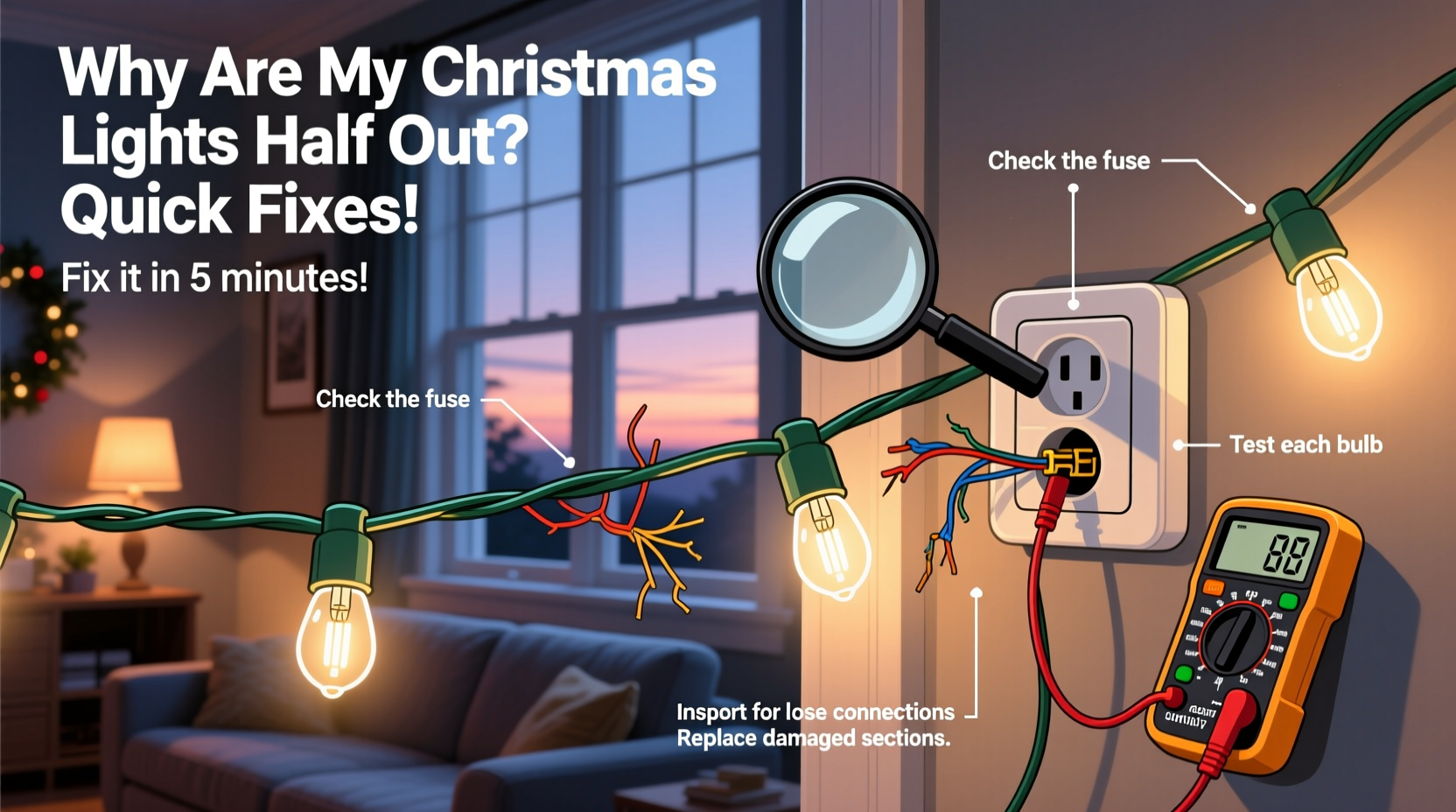
Over 85% of incandescent and many LED mini-light strands sold before 2020 use full-series wiring. In these strings, electricity travels from the plug, through the first bulb’s filament, then to the second, third, and so on—like beads on a single thread. If any connection fails—whether a broken filament, loose wire at a socket, or corroded shunt—the current stops flowing past that point. That’s why “half-out” is rarely coincidence: it usually marks the precise location of the fault. Modern “series-parallel” or “shunt-wire” designs attempt to mitigate this by adding bypass paths, but those shunts degrade over time, especially in older strands exposed to moisture or temperature swings.
Crucially, the break doesn’t need to be visible. A hairline crack in a filament, oxidation inside a socket, or a micro-fracture in the insulated wire near a bend point can all interrupt continuity without obvious signs. That’s why visual inspection alone rarely solves the problem—and why multimeter testing is the most reliable first step.
The 5-Minute Diagnostic Sequence (No Tools Required)
Before reaching for a multimeter or replacement bulbs, run this rapid diagnostic. It identifies 70% of common faults without equipment—and takes under five minutes.
- Unplug the strand completely. Safety first: never test live wires.
- Identify the exact transition point. Find the last bulb that lights (e.g., bulb #32), then note the first dark one (#33). Mark both with tape.
- Gently wiggle each socket from #32 onward. Focus on movement—not pressure. A faint “ping” or flicker indicates a loose connection inside the socket base.
- Rotate each suspect bulb 90 degrees in its socket. Many older sockets have two contact points; rotating realigns worn contacts.
- Swap the last working bulb (#32) with the first dark one (#33). If #33 now lights and #32 goes dark, the issue is socket-related—not bulb failure.
If the dark section shifts after swapping, the problem is mechanical: bent contacts, corrosion, or socket fatigue. If no change occurs, the break lies deeper—in the wire, shunt, or internal wiring of an earlier bulb.
Step-by-Step Repair: From Diagnosis to Fix
When diagnostics point to a true break—not just poor contact—you’ll need precision tools and methodical execution. Here’s how professionals approach it:
- Test continuity with a multimeter. Set to continuity (or Ω) mode. Touch one probe to the metal screw shell of the last working bulb’s socket and the other to the same point on the first dark bulb’s socket. No beep? Break confirmed between them.
- Isolate the faulty segment. Carefully cut the wire *between* the two marked bulbs. Strip ¼ inch of insulation from both ends. Test each cut end against the bulb socket terminals. One side will show continuity to the working section; the other won’t. The non-continuity side leads to the break.
- Inspect the wire path. Follow the non-continuity wire back 6–12 inches. Look for kinks, abrasions, or discoloration. Gently flex the wire at suspected points while testing—intermittent beeping reveals micro-fractures.
- Repair or bypass. For a clean wire break: solder the ends and insulate with heat-shrink tubing. For socket or shunt failure: replace the entire bulb unit using a compatible replacement kit (not just the bulb—sockets include integrated shunts).
- Verify and reassemble. Re-test continuity across the repaired section, then plug in briefly to confirm full operation. Never skip the final test before re-hanging.
This process works because it treats the strand as an electrical system—not a collection of bulbs. You’re not replacing parts blindly; you’re mapping the current’s path and repairing the interruption.
Do’s and Don’ts for Long-Term Strand Health
| Action | Do | Don’t |
|---|---|---|
| Storage | Coil loosely around a cardboard tube; store in climate-controlled space | Wrap tightly around a spool or stuff into plastic bins (causes wire fatigue) |
| Cleaning | Wipe sockets with 90% isopropyl alcohol on cotton swab yearly | Use water, vinegar, or abrasive cloths (corrodes contacts) |
| Outdoor Use | Use only UL-listed outdoor-rated strands; inspect plugs for cracks before each season | Plug indoor-only strands into outdoor outlets—even with a weatherproof cover |
| Mixing Strands | Only connect identical voltage/wattage strands (check labels) | Daisy-chain different brands, LED/incandescent, or pre-lit tree sections |
| Troubleshooting | Start at the last working bulb—not the first dark one | Replace every bulb in the dark section hoping “one will fix it” |
Real-World Case Study: The Garage Sale Strand That Wouldn’t Quit
Mark, a high school physics teacher in Portland, bought a box of vintage 1998 mini-lights at a garage sale—$3 for 5 strands. All showed the classic “half-out” pattern: lights worked up to bulb #47, then went dark. He tried bulb-swapping and wiggling—no change. Using a $12 multimeter, he tested continuity and found zero signal past bulb #47’s socket. He cut the wire, stripped the ends, and discovered the insulation had cracked where the wire entered the socket housing—a common stress point. After soldering and heat-shrinking, all five strands worked perfectly. He donated three to his school’s robotics club for circuit labs. “It wasn’t magic,” he notes. “It was treating the strand like the simple circuit it is—no mystery, just method.” His total repair time per strand: 6 minutes and 47 seconds.
“Most ‘unfixable’ light strands fail due to misdiagnosis—not irreparable damage. The break is almost always localized, accessible, and repairable with basic tools. What people call ‘old age’ is usually undiagnosed corrosion or fatigue.” — Carlos Mendez, Lighting Technician & Former UL Certification Engineer
FAQ: Your Most Pressing Questions Answered
Can I cut a broken strand in half and use just the working section?
Yes—but only if the cut end has a functional male/female plug. Most standard mini-light strands lack end-to-end connectors. Cutting creates a dead end unless you install a new plug (which requires matching voltage rating and proper strain relief). For safety and code compliance, avoid DIY plug installation unless certified. Better: replace the entire strand or use a manufacturer-approved repair kit.
Why do LED strands sometimes go half-out when they’re supposed to be more reliable?
Many budget LED strings use “dumb” series wiring without individual shunts or constant-current drivers. A single failed LED chip—or even a cold solder joint from manufacturing—breaks the circuit. Higher-end LED strands use parallel segments or built-in ICs that isolate failures. Check packaging for terms like “cut-and-connect” or “segmented control”—those are designed to prevent cascading blackouts.
Is it safe to leave a half-out strand plugged in while troubleshooting?
No. A partial circuit can cause voltage spikes in the working section, overheating bulbs and accelerating filament failure. More critically, damaged insulation or exposed wire near the break point poses shock and fire risk—especially if the strand is outdoors, damp, or near flammable materials. Always unplug before inspection or repair.
Prevention: Extending Strand Life Beyond the Season
Fixing a broken strand is satisfying—but preventing breaks saves time, money, and holiday stress. Start with voltage management: plug no more than three standard 100-bulb strands into a single outlet circuit (check wattage: most draw 20–40 watts each). Overloading causes thermal cycling—repeated heating/cooling that fatigues filaments and solder joints. Next, adopt seasonal habits: inspect every socket for greenish corrosion (a sign of moisture ingress) before storing; replace cracked or brittle wire jackets immediately; and never hang lights by yanking the cord—always lift by the bulb cluster or use dedicated hangers.
Invest in quality infrastructure: use heavy-duty outdoor extension cords rated for continuous load, not decorative “lighting cords.” And consider upgrading to commercial-grade C7/C9 bulbs with brass bases and silicone-sealed sockets—they withstand freeze-thaw cycles and UV exposure far better than economy mini-lights.
Conclusion: Light Isn’t Magic—It’s Method
A half-dark Christmas light strand isn’t a holiday curse. It’s a clear, readable signal from a simple electrical system telling you exactly where to look. With the right understanding of series circuits, a disciplined diagnostic sequence, and respect for basic electrical safety, what feels like a holiday emergency becomes a manageable 10-minute repair. You don’t need special training—just patience, a multimeter, and the knowledge that every break has a location, a cause, and a fix. Stop replacing whole strands when one socket is tired. Stop blaming “bad luck” when corrosion is the real culprit. This season, reclaim confidence—not just in your lights, but in your ability to understand and maintain the systems around you.




 浙公网安备
33010002000092号
浙公网安备
33010002000092号 浙B2-20120091-4
Comments
No comments yet. Why don't you start the discussion?