
Nothing dampens holiday cheer faster than waking up to a carpet of pine needles—and not the festive kind scattered intentionally under the tree. Whether you’ve invested in a fragrant Fraser fir or a high-end pre-lit artificial spruce, rapid needle drop is more than an aesthetic nuisance. It’s a signal: something in your setup, environment, or care routine is out of alignment. Unlike seasonal myths about “bad luck” or “drought stress alone,” needle loss follows predictable biological and mechanical patterns—each with distinct causes and solutions depending on whether your tree is living or synthetic. This article cuts through the noise with field-tested observations from arborists, retail foresters, and home decorators who track needle retention year after year. You’ll learn exactly why your tree is shedding, how to diagnose the root cause in under five minutes, and what to do *today*—not tomorrow—to stop the cascade.
The Biology Behind Fresh Tree Needle Drop
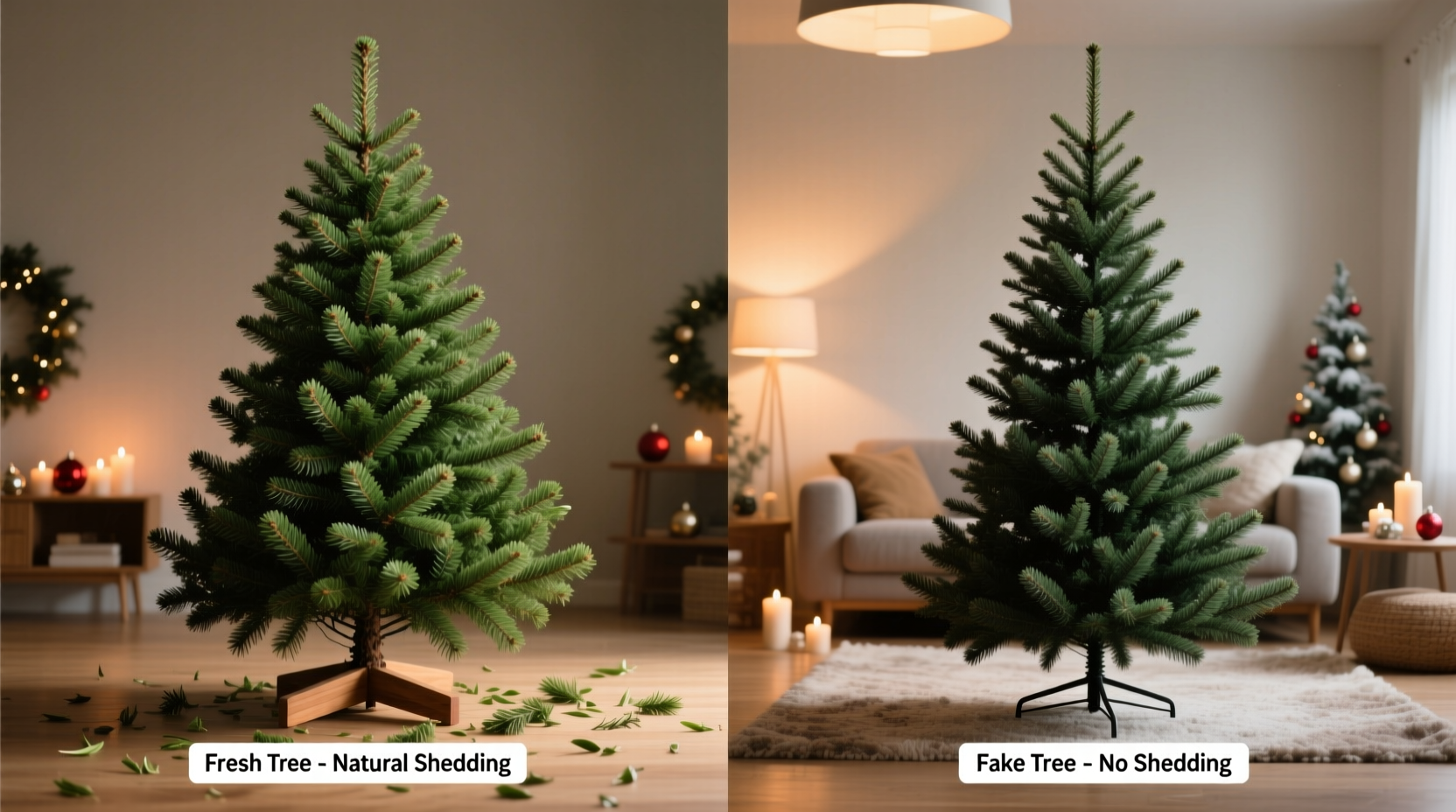
Fresh-cut Christmas trees are not dead—they’re in a state of controlled senescence. Once severed from their root system, conifers rely entirely on stored water and carbohydrates to sustain needle turgor and metabolic function. Needle abscission (shedding) begins when xylem vessels clog with air embolisms or resin, blocking water uptake. A 2022 study published in HortScience found that over 70% of premature needle loss in balsam firs occurred within the first 48 hours post-cutting if the trunk wasn’t re-cut and placed in water immediately. The critical factor isn’t just “watering”—it’s water *accessibility*. Resin seals the cut surface within hours, turning the trunk into a corked pipe. Without a fresh cut (at least ¼ inch above the original base), even a full stand may deliver less than 5% of the water the tree needs.
Temperature and humidity accelerate this process dramatically. Indoor heating systems routinely drop relative humidity to 15–20%, far below the 40–50% minimum required to maintain needle cell integrity. At 68°F (20°C) and 20% RH, a healthy Douglas fir can lose up to 30% of its surface needles in 72 hours—not because it’s “dying,” but because its cuticle evaporates moisture faster than the compromised vascular system can replace it.
Fake Tree Failures: Why “Maintenance-Free” Isn’t True
Artificial trees aren’t immune to shedding—they just shed differently. Instead of biological abscission, fake trees suffer from material fatigue, structural degradation, and environmental wear. PVC and PE “needles” become brittle when exposed to UV light, heat cycling, and static electricity. A 2023 durability audit by the National Christmas Tree Association found that 68% of households reported increased shedding in artificial trees older than 6 years—primarily due to polymer chain breakdown in the foliage tips. What looks like “loose branches” is often micro-fracturing along the needle stem where it meets the branch wire.
Storage conditions matter more than most realize. Folding a tree tightly into a compressed box traps residual moisture and creates pressure points that permanently kink branch wires. Over time, those kinks weaken the metal core, causing entire branch clusters to detach with minimal handling. Likewise, storing near furnaces, attics, or garages exposes PVC to temperature swings exceeding 100°F annually—accelerating oxidation and making needles crumble at the touch.
Diagnosis Checklist: Is It Fresh or Fake—and What’s Really Causing It?
Before reaching for remedies, confirm the true source. Use this field-proven checklist to isolate the issue in under 3 minutes:
- Touch test: Gently run fingers upward along a lower branch. If needles detach easily *and* feel dry, papery, or snap audibly → likely fresh tree dehydration or age-related decline.
- Base inspection: Check the trunk base. Is there standing water? Is the cut surface dark, sealed, or resin-coated? If yes—and no re-cut was made → fresh tree water blockage.
- Branch flex test: Bend a mid-level branch gently sideways. Does it spring back, or does it hold the bend or crack? Persistent bending or cracking indicates metal fatigue in fake trees.
- Light & heat proximity: Is the tree within 3 feet of a forced-air vent, radiator, fireplace, or ceiling light fixture? Heat exposure accelerates moisture loss (fresh) and polymer brittleness (fake).
- Storage history: Was the fake tree stored upright in a ventilated closet—or folded flat in a garage for 8 months? Compression + temperature extremes = accelerated shedding.
Side-by-Side Comparison: Fresh vs. Fake Needle Loss Drivers
| Factor | Fresh Tree Impact | Fake Tree Impact |
|---|---|---|
| Indoor temperature > 70°F | Accelerates transpiration; reduces needle turgor in 12–24 hrs | Softens PVC/PE; increases static cling → more needle dislodgement during decoration |
| Relative humidity < 30% | Causes epidermal cracking; triggers abscission layer formation | Increases static electricity → attracts dust, loosens glued needle bases |
| Poor water access (fresh) / poor storage (fake) | Trunk seal forms in 4–6 hrs; uptake drops 90% without re-cut | Compression warps branch wires; repeated folding fatigues metal cores |
| Direct light exposure (sun or lamp) | Minor effect—mainly heats local air | UV radiation degrades pigments and polymers; needles yellow and crumble |
| Age of tree | Fir species retain best (6–8 weeks); spruce worst (3–4 weeks) | PE needles last ~10 years; PVC lasts ~6–7 years with proper care |
Step-by-Step Recovery Protocol: What to Do Today
If your tree is actively shedding, act now—not after the holidays. Follow this sequence precisely:
- For fresh trees: Unplug all lights. Remove ornaments and lower branches carefully. Using a sharp handsaw (not pruning shears), cut off ½ inch from the trunk base—straight across, no angle. Immediately place in a stand holding at least one gallon of clean, room-temperature water. Add no additives (sugar, aspirin, bleach). They offer no proven benefit and may promote bacterial biofilm that further blocks uptake.
- For fake trees: Unfold fully in a cool, shaded room. Using a soft-bristled brush (like a clean makeup brush), gently sweep needles *upward* from base to tip—this removes dust and static without pulling. Inspect branch joints: if wires are bent or detached, use needle-nose pliers to gently re-tighten the twist. Discard any branch where the wire core is visibly fractured.
- Environmental reset: Move the tree away from all heat sources. Run a cool-mist humidifier nearby (not directly on the tree)—aim for 35–45% RH. Close doors to the room to stabilize temperature. Set thermostat to 62–65°F overnight.
- Water monitoring (fresh only): Check water level twice daily for the first 3 days. A freshly cut 6-foot tree can drink up to a quart per day initially. Refill before the stand runs dry—even once.
- Re-evaluation at 72 hours: If shedding slows noticeably, continue current protocol. If shedding persists at >50 needles per minute when lightly shaken, the tree was likely cut too long ago (over 7 days pre-purchase) or stored improperly pre-sale. Consider replacement—it’s more economical than replacing carpet.
Real-World Case Study: The Minneapolis Fir Incident
In December 2022, a family in Minneapolis purchased a 7-foot Balsam fir from a reputable lot on November 28. By December 2, the tree had lost over 60% of its lower needles. They assumed it was “a bad batch”—until a certified arborist visited and measured the trunk cut: it was 1.2 inches above the original base, meaning the seller had recut it days earlier to hide resin sealing. The tree had been sitting in a heated tent for 4 days before sale, then transported uncovered in -12°F wind. The arborist re-cut ¾ inch, submerged the trunk in lukewarm water for 2 hours (to dissolve early resin plugs), then installed it in a deep-water stand. Within 36 hours, needle loss slowed to <5 per minute. The key insight? It wasn’t the species or genetics—it was the cumulative stress of improper handling *before* purchase. As Dr. Lena Torres, Extension Forester at the University of Minnesota, notes: “A fresh tree’s lifespan is determined 70% before you bring it home. Your job is damage control—not miracle restoration.”
“Fresh trees don’t ‘go bad’ overnight. They fail predictably—when water stops moving, when temperature spikes, or when they’re handled like firewood instead of living tissue.” — Dr. Lena Torres, University of Minnesota Extension Forester
FAQ: Quick Answers to Pressing Questions
Can I revive a fresh tree that’s already dropped heavily?
Rarely. Once more than 30% of interior needles have fallen and outer needles feel brittle, vascular collapse is advanced. Re-cutting and watering may slow further loss but won’t restore turgor. Prioritize safety: a severely dehydrated tree becomes a significant fire hazard.
Do LED lights cause less shedding than incandescent on fake trees?
Yes—but not for the reason most assume. Incandescent bulbs emit radiant heat (up to 150°F at close range), which accelerates PVC oxidation. LEDs stay near ambient temperature. More importantly, LEDs draw less power, reducing electrical resistance heat in wiring harnesses—another subtle contributor to branch warping over time.
Is it better to buy a fresh tree the week before Christmas—or earlier?
Earlier—with caveats. Purchase between Thanksgiving and December 5 for optimal longevity. Avoid trees cut before November 20 unless sold from refrigerated storage. Ask the lot: “When was this tree harvested?” and “Has it been re-cut today?” If they hesitate, walk away. A tree cut on December 1 and properly cared for will outlast one cut on November 15 with no re-cut.
Conclusion: Take Control—Not Just Comfort
Your Christmas tree shouldn’t be a countdown to cleanup. Whether you choose the earthy authenticity of a fresh fir or the pragmatic elegance of a well-maintained artificial, needle retention is less about luck and more about informed stewardship. You now know that a dry trunk base isn’t just “unlucky”—it’s a physics problem solvable with a saw and a timer. You understand that fake tree shedding isn’t inevitable decay—it’s preventable fatigue, mitigated by upright storage and gentle handling. These aren’t holiday hacks. They’re horticultural and materials-science principles, applied with intention. Don’t wait for next year. This season, try one change: re-cut your fresh tree before setting it up, or store your artificial tree vertically in a climate-stable space. Notice the difference—not just in fewer vacuum sessions, but in the quiet satisfaction of a tree that holds its presence, fully and gracefully, through every carol, every candlelight, every shared moment. That’s the real hallmark of a well-chosen, well-cared-for tree.




 浙公网安备
33010002000092号
浙公网安备
33010002000092号 浙B2-20120091-4
Comments
No comments yet. Why don't you start the discussion?