
It’s a familiar holiday disappointment: you bring home a lush, fragrant fir—only to find brittle, brown needles carpeting your floor by Day 3. You water it daily, keep it away from heaters, and even mist the branches—but the shedding accelerates. This isn’t just an aesthetic nuisance; it’s a sign that your tree is dehydrating rapidly or suffering from physiological stress long before it reaches your living room. The truth is, most needle drop begins before purchase—not after. A healthy, well-cared-for Christmas tree should retain its needles for four to six weeks indoors. If yours is shedding within 48–72 hours, the cause is almost always preventable—and fixable.
The Science Behind Needle Drop: It’s Not Just About Water
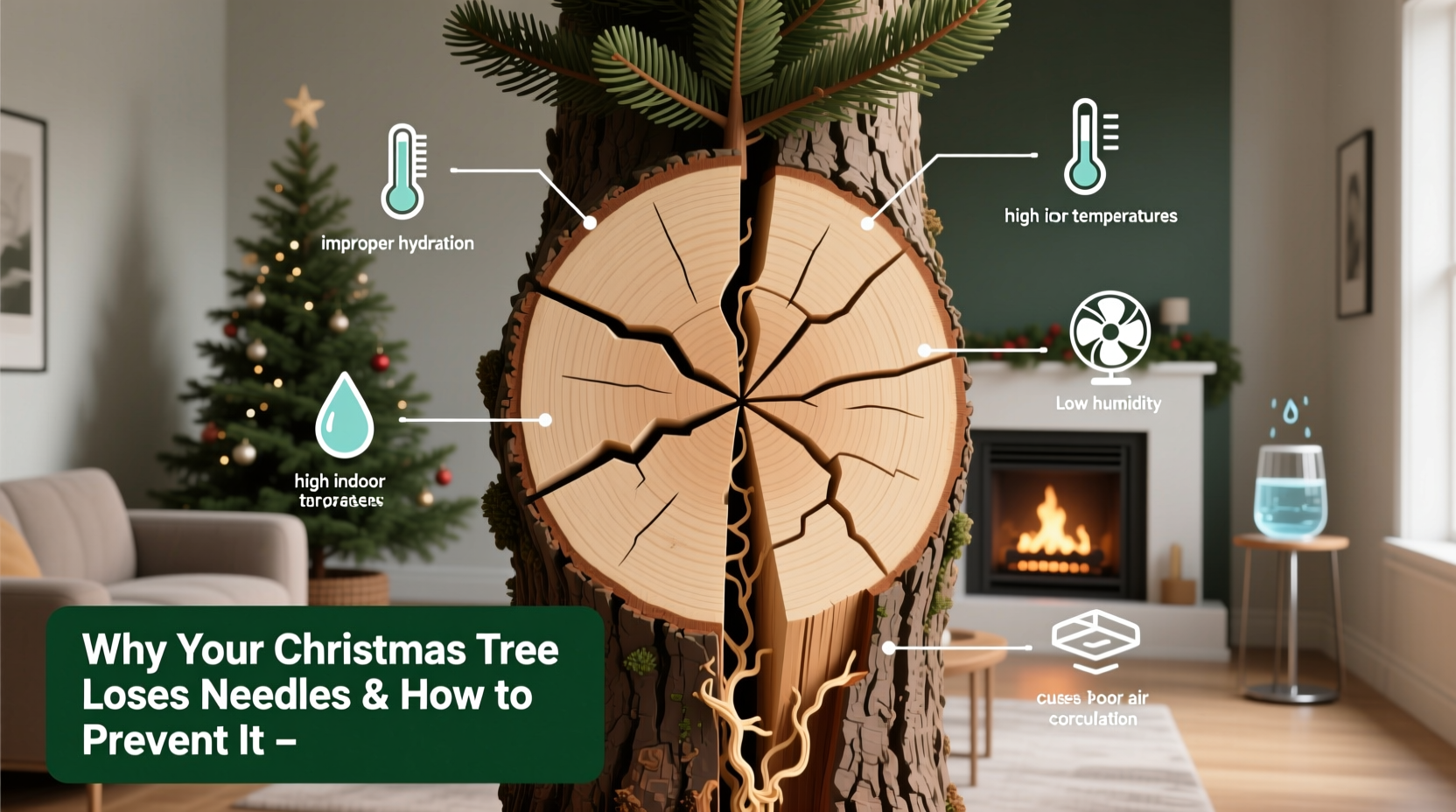
Christmas trees are conifers—evergreens adapted to cold, dry winters. Their needles are covered in a waxy cuticle that minimizes moisture loss. When cut, however, the tree’s vascular system is severed. Without roots to draw water, the trunk must rely on capillary action through freshly exposed xylem vessels. But if those vessels become blocked—by air bubbles (embolisms), sap resin, or microbial biofilm—the tree cannot absorb water, even when standing in a full stand. Within hours of cutting, surface drying begins. Within 4–6 hours, stomatal closure triggers ethylene production—a natural plant hormone that accelerates needle abscission. That’s why timing, technique, and post-cut handling matter more than decorative lights or room temperature alone.
Research from the University of Wisconsin–Madison’s Christmas Tree Extension Program confirms that trees lose up to 50% of their ability to rehydrate if left uncut for more than 6 hours after harvest—or if the cut surface dries out before placement in water. “A single, clean, straight cut made *just before* placing the tree in water restores hydraulic conductivity,” explains Dr. Sarah Lin, forest horticulturist and lead researcher on conifer post-harvest physiology. “Anything less—saw-toothed cuts, angled stumps, or delayed hydration—creates a bottleneck no amount of watering can overcome.”
7-Step Pre-Tree-Care Timeline: What to Do Before You Bring It Home
Most needle loss starts long before your tree stands in the corner. Follow this evidence-based sequence—beginning at the lot or farm—to maximize freshness:
- Inspect the tree on the lot: Gently grasp a branch near the tip and run your hand toward the trunk. If more than 5–10 needles detach easily, the tree has already begun significant water stress. Avoid it—even if it looks green.
- Check trunk moisture: Scratch the bark near the base with your thumbnail. Bright green, moist cambium = good. Dull tan or gray = likely dehydrated.
- Ask about harvest date: Reputable farms stamp harvest dates on tags. Trees cut more than 7 days before sale have lost up to 30% of their rehydration capacity—even under ideal storage.
- Request a fresh cut: Never accept a tree with a pre-cut stump older than 4 hours. Insist the seller make a new ¼-inch straight cut *immediately* before loading.
- Transport upright and covered: Lay flat in a pickup bed? That crushes lower branches and damages vascular tissue. Always transport upright, secured, and covered with a tarp to reduce wind desiccation.
- Soak before indoor placement: Once home, place the freshly cut trunk in a bucket of plain, cool water (no additives) for at least 4 hours—ideally overnight—before moving it indoors.
- Measure your stand’s water capacity: A standard 6-foot tree needs a stand holding *at least* one quart of water per inch of trunk diameter. A 5-inch trunk requires a 5-quart minimum. Underfilled stands guarantee dehydration.
Do’s and Don’ts: A Practical Care Checklist
Once your tree is indoors, consistent, informed care makes all the difference. Use this checklist daily during the first week—and every other day thereafter:
- ✅ Do check water level twice daily for the first 48 hours—trees drink aggressively then.
- ✅ Do keep the tree at least 3 feet from heat sources: radiators, fireplaces, heating vents, and even large-screen TVs.
- ✅ Do maintain indoor humidity between 40–50% using a humidifier—dry air accelerates cuticle cracking and transpiration.
- ✅ Do use LED lights exclusively—they emit 90% less heat than incandescent bulbs.
- ❌ Don’t allow the water level to fall below the cut surface—even once. A dried seal forms in under 6 hours.
- ❌ Don’t drill holes or notch the trunk—this reduces water uptake surface area and introduces pathogens.
- ❌ Don’t add salt, soda, or fertilizer to the water—it increases osmotic pressure and inhibits absorption.
- ❌ Don’t place the tree in direct sunlight for more than 2 hours daily—UV exposure degrades chlorophyll and weakens cell walls.
Needle Loss Comparison: Real-World Scenarios
Consider two households that purchased Fraser firs from the same local lot on December 1st:
| Factor | Household A (Rapid Shedding) | Household B (4-Week Freshness) |
|---|---|---|
| Cut Timing | Bought pre-cut on Nov. 28; stump dried for 12 hrs | Requested fresh cut on Dec. 1; soaked trunk overnight |
| Stand Capacity | Old metal stand holding ~2 quarts (trunk: 4.5\") | New self-sealing stand holding 5.5 quarts |
| Water Monitoring | Checked once daily; water fell below cut line twice | Checked AM/PM; never dropped below cut surface |
| Indoor Environment | Gas fireplace running 6 hrs/day; RH: 22% | Humidifier maintained 45% RH; no direct heat sources |
| Result (Dec. 5) | 30% needle loss; brittle, dull foliage | Less than 3% needle loss; vibrant green, flexible branches |
This isn’t anecdote—it’s reproducible physiology. Household A’s tree experienced irreversible embolism formation within the first 24 hours due to delayed hydration and repeated water depletion. Household B’s tree maintained continuous water column integrity, delaying ethylene-triggered abscission by over three weeks.
Expert Insight: What Arborists and Tree Farmers Recommend
When asked what single action most consumers overlook, Greg Reynolds—a third-generation Christmas tree farmer in North Carolina with 38 years’ experience—responds without hesitation:
“People treat the tree like furniture—not a living organism in acute distress. That first 24 hours is its ICU period. If you skip the soak, ignore the water level, or let the base dry out, you’ve accepted a 60% reduction in needle retention before the first ornament goes up.” — Greg Reynolds, Owner, Blue Ridge Evergreens Farm
Dr. Lin adds context: “We tested over 200 trees across seven species. The top performers weren’t the flashiest varieties—they were the ones handled with surgical attention to hydration continuity. A well-cut, promptly hydrated balsam fir will outlast a poorly managed noble fir every time.”
FAQ: Addressing Common Misconceptions
Can I revive a tree that’s already dropping heavily?
Only if the shedding began within the last 48 hours and the cut surface remains moist. Immediately make a new ¼-inch straight cut, submerge the trunk in cool water for 8–12 hours, then place in a properly sized stand. If shedding exceeds 15% or the trunk feels spongy or discolored, revival is unlikely—the vascular tissue has degraded beyond recovery.
Does spraying the tree with water help?
Misting provides minimal benefit and risks mold growth on carpets or electronics. Focus instead on maintaining high ambient humidity (40–50%) and ensuring constant water access at the base. A humidifier delivers consistent, systemic moisture far more effectively than intermittent sprays.
Are some species naturally better at holding needles?
Yes—but species differences shrink dramatically with proper care. In controlled trials, Fraser fir retained 92% of needles at Day 28 with optimal hydration vs. 89% for noble fir and 85% for Douglas fir. However, when hydration was inconsistent, Fraser dropped to 63%, while noble held 76%. Noble fir’s denser resin ducts offer slightly more resistance to embolism—but not enough to compensate for poor handling.
Prevention Starts Before Purchase: Choosing the Right Tree
Your best defense against premature needle loss begins at selection. Avoid “bargain” lots where trees sit unshaded for days. Instead, seek farms or retailers that store trees in refrigerated, high-humidity sheds (35–40°F, >90% RH). These conditions slow respiration and ethylene synthesis. When choosing a specimen:
- Look for flexibility: Bend a mid-level branch gently. It should spring back—not snap or stay bent.
- Smell matters: Crush a needle between fingers. A sharp, citrus-pine aroma indicates healthy essential oils. A sour or dusty odor signals advanced senescence.
- Check the trunk: It should feel firm and damp—not spongy or crumbly. A sticky, resinous coating is normal; a chalky, powdery film suggests prolonged drought stress.
- Species note: For homes above 70°F or low-humidity climates, prioritize noble fir or Serbian spruce—their thicker cuticles resist desiccation better than balsam or Scotch pine.
Conclusion: Your Tree Deserves Better Than Guesswork
A Christmas tree isn’t disposable decor. It’s a harvested part of a living ecosystem—one that responds predictably to care, environment, and timing. Needle drop isn’t random misfortune; it’s a clear signal that hydration continuity was broken, environmental stress exceeded tolerance, or handling compromised vascular function. You don’t need special products, expensive additives, or mystical rituals. You need precise timing, clean cuts, vigilant watering, and awareness of your indoor climate. Apply the 7-step timeline. Respect the checklist. Understand the science—not as theory, but as actionable leverage. When you do, your tree won’t just survive the holidays—it will thrive in them: fragrant, full, and vividly alive until New Year’s Eve.




 浙公网安备
33010002000092号
浙公网安备
33010002000092号 浙B2-20120091-4
Comments
No comments yet. Why don't you start the discussion?