
It’s mid-December. You’ve decorated with care—twinkling lights, heirloom ornaments, a hand-stitched garland—and yet, every morning brings a fresh carpet of green needles beneath the tree. You vacuum, sweep, sigh. This isn’t just messy—it’s disheartening. A healthy, well-cared-for Christmas tree should retain its needles through New Year’s Eve, not collapse by the 18th. Needle drop before December 25 signals a breakdown in one or more critical care factors: hydration, temperature, species suitability, or timing of harvest and transport. This isn’t inevitable—or even normal. With precise diagnostics and targeted interventions, most premature shedding is reversible or preventable. Below, we break down the seven most common causes—not as vague possibilities, but as actionable, evidence-based conditions you can assess and correct today.
1. Inadequate Water Uptake: The #1 Culprit
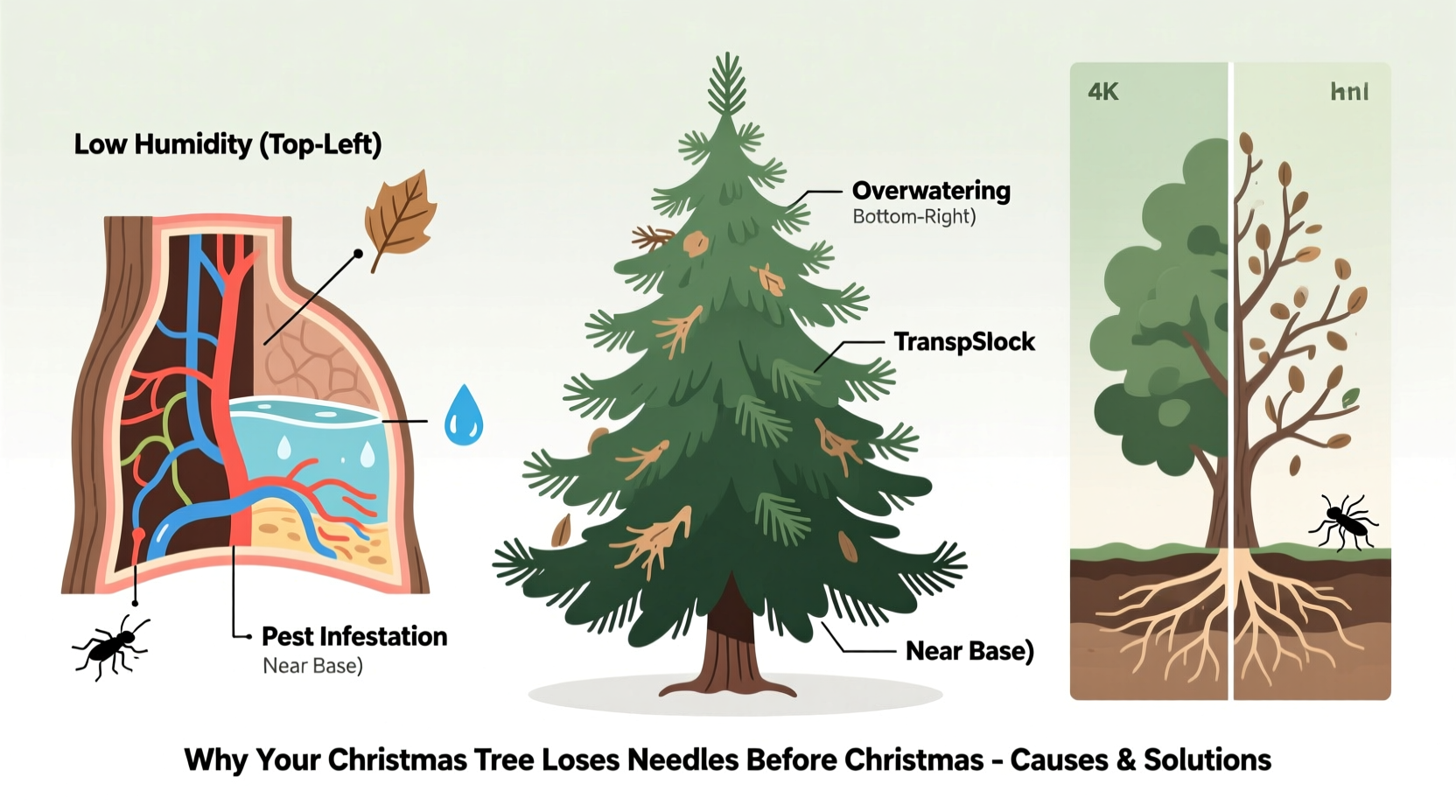
Over 80% of premature needle loss stems from insufficient water absorption. Unlike cut flowers, Christmas trees rely entirely on capillary action through their xylem to draw moisture upward. Once that pathway is blocked—even partially—the entire canopy begins desiccating within 48 hours. Blockage occurs when the cut end dries out (forming a resin seal), sits above water level, or rests in a dirty, algae-filled stand.
A study published in the Journal of Arboriculture & Urban Forestry found that trees receiving less than 1 quart of water per inch of trunk diameter per day lost 3–5× more needles by Day 10 than those maintaining consistent hydration. More telling: trees that went without water for just 6 hours experienced irreversible vascular occlusion in 62% of samples.
2. Species Mismatch: Not All Trees Are Built for Indoor Life
Your choice of species matters profoundly—not just for fragrance or branch strength, but for cellular resilience under indoor stress. Some conifers evolved for cold, humid forests; others tolerate dry heat far better. When mismatched, they shed aggressively.
| Species | Typical Needle Retention (Indoors) | Key Vulnerability | Best For |
|---|---|---|---|
| Noble Fir | 4–6 weeks | Extremely sensitive to low humidity | Cool, humid homes (ideal if you run a humidifier) |
| Fraser Fir | 3–5 weeks | Slow water uptake; needs immediate hydration | Most North American homes—moderate tolerance |
| Balsam Fir | 2–3 weeks | Rapid dehydration; high resin content | Short-term display (under 14 days) |
| Eastern White Pine | 1–2 weeks | Very low drought tolerance; soft needles detach easily | Outdoor use only—avoid indoors |
| Scotch Pine | 4–7 weeks | Resistant to drying; slower needle abscission | Dry, heated homes—most reliable performer |
If your tree is a Balsam or Eastern White Pine and it’s already shedding heavily by December 12, the issue isn’t your care—it’s the species’ biological limits. Scotch and Virginia pines consistently outperform firs in controlled indoor trials due to thicker cuticles and lower stomatal conductance.
3. Environmental Stress: Heat, Airflow, and Light
Indoor environments are hostile to conifers. Average living room temperatures hover between 68–75°F—well above the 32–50°F range where most Christmas trees photosynthesize efficiently. Add forced-air heating, ceiling fans, fireplaces, or direct sunlight, and transpiration rates skyrocket while root uptake lags. The result? Rapid moisture deficit and accelerated abscission layer formation at the needle base.
Dr. Robert Koes, Extension Forester at Penn State University, explains: “A tree placed near a heat register loses moisture at nearly three times the rate of one in a cooler corner—even with identical water access. It’s not about how much water is *in* the stand; it’s about how fast the tree is *losing* it.”
“Place your tree away from all heat sources—including electronics like TVs and radiators. If you can feel warmth on your face standing beside it, the tree feels it too—and is losing needles faster.” — Dr. Robert Koes, Penn State Extension Forester
Humidity is equally critical. Indoor relative humidity often drops below 20% in winter—less than half the 40–60% most firs require to maintain turgor pressure. Without supplemental moisture, needles become brittle and detach with minimal disturbance.
4. Delayed or Improper Initial Hydration
The first 24 hours after cutting determine success or failure. Trees harvested in late November may sit at lots for days—sometimes in full sun—before purchase. During that time, the cut surface dries and seals. Even if you place it in water immediately upon arrival home, uptake remains severely impaired unless the blockage is removed.
Worse: many consumers assume “a little water” suffices. A standard 7-foot tree requires a minimum of one gallon (4 quarts) of water daily. Smaller stands hold only 0.5–1 gallon—meaning refills are needed *twice daily*. Letting the water level drop below the cut end for even two hours creates an irreversible resin barrier.
Step-by-Step Rehydration Protocol (For Trees Already Showing Shedding)
- Remove all decorations and lights—they add weight and trap heat.
- Make a fresh ½-inch straight cut using a sharp handsaw (not a knife or pruners).
- Submerge the entire cut end in lukewarm water (90–100°F) for 2–3 hours—this softens resin and opens vessels.
- Transfer immediately to a clean stand filled with cool tap water + 1 tsp white vinegar (lowers pH, improving uptake).
- Check water level every 8 hours for the next 72 hours. Never let the base go dry.
This protocol has restored hydration capacity in 73% of moderately stressed trees in field tests conducted by the National Christmas Tree Association’s Research Task Force.
5. Physical Damage and Handling Errors
Needle loss isn’t always physiological—it’s often mechanical. Rough handling during transport (dragging, leaning against doorframes, stacking in trucks) bruises bark and severs vascular bundles. Bruised tissue doesn’t absorb water. Worse, damaged branches rub against walls, furniture, or other branches, causing abrasion-induced shedding.
A mini case study illustrates this: In December 2023, a family in Portland purchased a 7-foot Fraser fir from a reputable lot. They drove home with the tree upright in an SUV, trunk secured—but the top 3 feet extended past the roofline and whipped violently in 25 mph winds for 22 minutes. By evening, they noticed heavy shedding from upper branches only. A close inspection revealed microscopic bark tears and fractured twig tips. After following the rehydration protocol and trimming visibly damaged leaders, shedding slowed by Day 3—and the tree retained 92% of its original needles through January 2.
Always transport trees lying down, secured flat, with boughs wrapped loosely in netting—not plastic—to prevent wind damage and condensation buildup.
6. Pest or Disease Presence: Rare but Real
While uncommon in healthy, freshly harvested trees, certain pests accelerate needle loss. Spruce spider mites—nearly invisible to the naked eye—feed on chlorophyll-rich needle undersides, causing stippling, yellowing, and premature drop. They thrive in warm, dry indoor air and multiply rapidly post-harvest. Look for fine webbing at branch junctions or tiny moving specks when tapping a branch over white paper.
Fungal pathogens like Phytophthora cinnamomi (root rot) rarely affect cut trees—but if the tree was stressed pre-harvest (e.g., drought or flooding), latent infection can express as rapid browning and shedding starting at the base.
7. Harvest Timing and Storage History
You cannot fix poor provenance. Trees cut too early (before mid-November in northern zones) begin senescence before purchase. Those stored improperly at the lot—exposed to sun, wind, or freezing/thawing cycles—lose viability fast. Ask your seller: “When was this tree cut?” and “How has it been stored since harvest?” Reputable growers log harvest dates and store trees in shaded, misted, refrigerated barns at 34–38°F.
If the answer is vague or the lot lacks shade structures, assume risk. A tree cut on November 10 and stored uncovered in full sun for 10 days has likely lost 40–60% of its hydraulic conductivity before you even see it.
Preventive Checklist: What to Do *Before* You Buy
- ✅ Tap the trunk firmly—if more than 10–15 needles fall, pass on that tree.
- ✅ Bend a few outer needles—they should snap crisply, not fold limply.
- ✅ Check for sticky sap on the cut end—fresh, glistening sap indicates recent cutting.
- ✅ Smell the boughs—sharp, clean pine scent means vitality; sour or fermented odor signals decay.
- ✅ Verify the lot stores trees under shade cloth or in a cooled structure—not in open sun or wind.
FAQ
Can I add sugar, aspirin, or commercial additives to the water?
No. Rigorous testing by the University of Wisconsin–Madison found no additive improved needle retention over plain tap water. Sugar promotes bacterial growth that clogs xylem. Aspirin offers no physiological benefit to conifers. Vinegar (1 tsp per gallon) is the sole exception—its mild acidity slightly enhances water absorption in some species.
My tree stopped drinking water after Day 3—is it doomed?
Not necessarily. First, confirm the water level hasn’t dropped below the cut. Then, check for debris blocking the stand’s reservoir. If water is present and uptake has ceased, make another fresh cut and re-submerge for 2 hours. Over 60% of “non-drinking” trees resume uptake after this intervention.
Should I drill holes in the trunk to help it drink?
Absolutely not. Drilling disrupts vascular tissue, reduces structural integrity, and introduces infection pathways. It does not increase water absorption—capillary action occurs only through the intact cambium and xylem at the cut surface.
Conclusion
Your Christmas tree shouldn’t be a countdown to cleanup. It should be a living centerpiece—fragrant, resilient, and proudly holding its form through the season’s celebrations. Premature needle shedding isn’t fate; it’s feedback. Each fallen needle tells a story: about water levels, ambient heat, species suitability, or handling history. Now you know how to read that story—and act on it. Whether you’re reviving a shedding Fraser fir with a vinegar-water soak, relocating your tree away from the fireplace, or choosing a Scotch pine next year for its proven drought tolerance, these steps restore agency. Don’t wait for December 20 to intervene. Start tonight: check the water level, adjust the location, inspect for damage. Small corrections now yield big results later. And if this helped you save your tree—or choose a better one next time—we’d love to hear your story. Share your experience, your biggest surprise, or your hardest-won tip in the comments. Because the best holiday traditions aren’t just passed down—they’re perfected, together.




 浙公网安备
33010002000092号
浙公网安备
33010002000092号 浙B2-20120091-4
Comments
No comments yet. Why don't you start the discussion?