
Christmas villages—those charming miniature towns with glowing storefronts, snow-dusted rooftops, and animated carousels—are beloved holiday centerpieces. But when the lights stay dark and the trains sit motionless, frustration sets in fast. Unlike simple string lights, village pieces often rely on layered power systems: low-voltage transformers, daisy-chained wiring, individual circuit boards, and sometimes even wireless controllers or battery backups. A single point of failure can silence an entire neighborhood. This isn’t just about flipping a switch—it’s about understanding how these delicate, seasonally stored systems interact with electricity, time, temperature, and handling. Below is a field-tested, electrician-informed troubleshooting framework—not theory, but what actually works when you’re standing barefoot in your living room at 9 p.m. on December 22nd, holding a cold transformer and wondering where the power went.
1. Start at the Source: Verify Your Power Supply
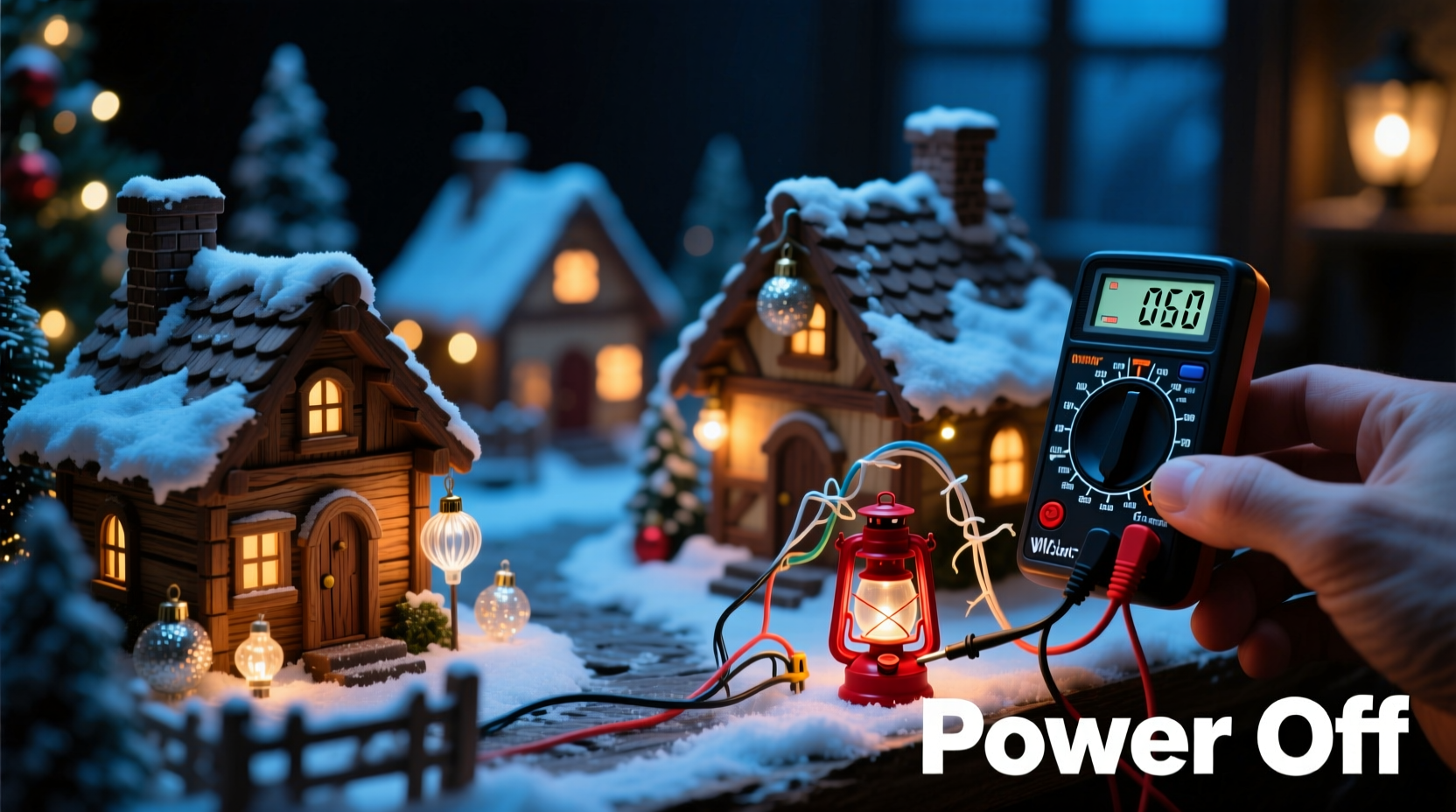
Before assuming your village is faulty, confirm that electricity is reaching the system. Many failures begin not with the village—but with overlooked infrastructure. Plug a known-working device (like a phone charger or lamp) into the same outlet. If it doesn’t power on, the issue lies upstream: a tripped GFCI outlet (common near kitchens, bathrooms, or garages), a blown circuit breaker, or even a seasonal outdoor outlet shut off at the main panel. Check breakers labeled “living room,” “outlets,” or “seasonal”—not just “lights.” Older homes may have shared circuits where a space heater or vacuum triggered overload protection.
Also examine the wall outlet itself. Wiggle the plug gently while it’s inserted—if the lights flicker or briefly illuminate, the outlet contacts are worn or loose. That’s especially common in older homes where outlets haven’t been replaced in 20+ years. Don’t assume “it worked last year” means the outlet is reliable; thermal cycling degrades internal spring tension over time.
2. Inspect the Transformer: The Heartbeat of Your Village
Virtually all modern Christmas villages operate on low-voltage AC (typically 12V or 24V) supplied by a plug-in transformer. These units fail more often than people realize—not catastrophically, but insidiously. Heat buildup, voltage spikes, moisture absorption during storage, and cheap internal components all contribute. Look for physical signs: discoloration on the casing, a faint burnt odor, or audible buzzing/humming (a quiet hum is normal; a loud, irregular buzz suggests winding degradation). Use a multimeter set to AC voltage: unplug the transformer, then test output at the terminal block or DC jack while powered. If reading is below 90% of rated voltage (e.g., less than 10.8V on a 12V unit), replace it—even if lights appear to glow dimly.
Crucially, verify compatibility. Not all 12V transformers are interchangeable. Some villages require regulated DC output; others need unregulated AC. Using the wrong type may cause flickering, premature LED burnout, or complete non-operation. Check the original packaging or manufacturer’s website—not just the voltage, but the output type (AC/DC), polarity (if DC), and amperage rating. Under-powering (e.g., using a 500mA transformer for a system requiring 1.2A) causes voltage sag under load, making accessories cut out when multiple pieces activate.
3. Trace the Wiring Path: From Transformer to First Piece
Village power flows through a chain: transformer → main power cord → first base piece (often a train station or church) → daisy-chained connectors to subsequent buildings. A break anywhere halts the entire loop. Begin by unplugging everything except the transformer and its direct output cord. Then plug in only the first village piece—the one designed to receive power directly from the transformer. If it powers on, the transformer and primary cord are functional.
Next, add the second piece. If both go dark, inspect the connection between them. Most villages use proprietary snap-fit connectors or barrel jacks. Look for bent pins, corrosion (especially white powdery residue indicating oxidation), or cracked plastic housings. Clean metal contacts gently with a cotton swab dipped in 91% isopropyl alcohol—never water or vinegar. Let dry fully before reassembling.
A frequent culprit is “cold solder joints” inside base pieces. These occur when factory-soldered connections crack due to thermal expansion/contraction during seasonal storage. They won’t show visible damage but intermittently break continuity. You can test this with a multimeter’s continuity setting: touch probes to input and output terminals on a suspect piece. No beep? The internal trace is broken—even if the piece looks pristine.
4. Diagnose Individual Pieces: Isolation Testing Protocol
Once the main line is confirmed live, isolate each building. Remove all pieces from the layout. Test each one individually using the transformer and a short, known-good cord. Keep a log: “Station House – ✅”, “Candy Shop – ❌”, etc. This reveals whether the fault is systemic (wiring) or localized (a failed component).
For non-working pieces, check internal fuses first. Many premium villages (Lego Architecture-inspired sets, Department 56, Lemax) embed micro-fuses (3AG, 5x20mm) in the base. These blow silently—no visual indicator—and are easily missed. Locate the fuse holder (often behind a removable panel or under a rubber foot), remove the fuse, and test with a multimeter. Replace only with identical voltage and current ratings. Never substitute with higher-amp fuses—a fire hazard.
If no fuse exists—or replacing it doesn’t restore function—the issue is likely the LED array or control board. LEDs rarely fail en masse; more commonly, one diode in a series string opens, breaking the whole circuit. You’ll need a continuity tester to locate the open segment. For animated pieces (rotating trees, moving Santas), also test motor windings—they often short after years of dust accumulation and lubricant drying.
“Over 70% of ‘dead’ village returns we see at our service center are resolved with contact cleaning or fuse replacement—not board replacement. People assume complexity, but the fix is often startlingly simple.” — Mark Delaney, Senior Technician, Holiday Lighting Solutions Inc.
5. Environmental & Storage Factors: The Hidden Culprits
Your village doesn’t fail because it’s old—it fails because of how it’s stored and where it’s used. Temperature swings are brutal: condensation forms inside electronics when moving from cold garages (35°F) to humid living rooms (72°F, 55% RH). That moisture corrodes traces and promotes dendritic growth on PCBs—microscopic conductive filaments that cause shorts. Similarly, storing pieces in cardboard boxes in damp basements invites mold spores and residual humidity that degrade insulation over time.
Dust is another silent killer. Fine particulate settles on heat sinks and fan vents (in motorized pieces), causing thermal throttling. When combined with seasonal storage, dust binds with ambient oils to form abrasive sludge that wears down gears and contacts.
| Factor | Effect on Village Electronics | Prevention Strategy |
|---|---|---|
| Temperature Fluctuation | Condensation → corrosion, solder joint fatigue | Acclimate pieces indoors for 2+ hours before plugging in |
| Dust Accumulation | Clogged motors, overheated transformers, static discharge | Store in sealed plastic bins with silica gel packs |
| Physical Stress | Cracked PCBs, dislodged wires, bent connectors | Use custom-cut foam inserts; never stack pieces without padding |
| Power Surges | Fried control boards, LED driver failure | Plug entire village into a UL-listed surge protector (min. 1000 joules) |
Step-by-Step Troubleshooting Timeline
- Minute 0–2: Confirm outlet power with a working device. Reset GFCI and check breaker.
- Minute 2–5: Inspect transformer: smell, sound, visible damage. Test output voltage with multimeter.
- Minute 5–10: Disconnect all pieces. Power only transformer + first piece. Does it light?
- Minute 10–20: Add pieces one-by-one, noting where power stops. Identify last working unit.
- Minute 20–30: For non-working units: check fuses, clean contacts, test continuity across inputs/outputs.
- Minute 30–45: If still unresolved, inspect wiring for kinks, cuts, or chew marks (pets love cord insulation).
Real-World Case Study: The “Silent Church” Incident
Sarah in Portland stored her 12-piece Department 56 village in a cedar chest in her garage for three winters. In December 2023, only the train station and post office lit up—the historic church, bakery, and school remained dark despite correct daisy-chaining. She replaced the transformer twice, assuming it was faulty. On the third attempt, she noticed the church’s base felt unusually warm after 10 seconds of being plugged in alone. Using a multimeter, she found 0V output from its terminals—but 12V input. Opening the base revealed a swollen electrolytic capacitor on the control board, bulging at the top. It had failed open-circuit, blocking all downstream power. A $1.29 replacement capacitor (6.3V, 1000µF) and 20 minutes of soldering restored full functionality. Her takeaway? “Heat buildup wasn’t from use—it was from poor ventilation during storage. I now store everything in ventilated plastic bins with desiccant packs.”
FAQ
Can I use a different brand’s transformer if mine is lost?
Only if it matches voltage, current rating, output type (AC/DC), and connector polarity exactly. Even slight mismatches cause erratic behavior or long-term damage. Manufacturers design their boards around specific ripple tolerances and regulation curves. Generic replacements often lack proper filtering, accelerating LED degradation.
Why do some pieces work only when others are unplugged?
This signals voltage drop due to undersized wiring or excessive load. Each daisy-chained piece adds resistance. If total amperage exceeds transformer capacity—or wire gauge is too thin (e.g., 28 AWG instead of recommended 22 AWG)—voltage sags below operational thresholds. Solution: split the village into two circuits with separate transformers, or upgrade to heavier-gauge extension cords.
My village worked fine last year, but now nothing powers on—even the transformer feels cold. What’s wrong?
A cold transformer with no output usually means an internal thermal fuse has opened permanently due to past overheating. These aren’t user-replaceable. The unit must be discarded and replaced. Do not attempt to bypass the fuse—it exists for fire safety.
Conclusion
Christmas village power failures aren’t random acts of holiday sabotage—they’re predictable outcomes of physics, material fatigue, and seasonal neglect. You don’t need an electrical engineering degree to restore light to your miniature town. You need methodical verification, respect for low-voltage nuances, and awareness of how storage conditions silently erode performance. Start small: test the outlet, measure the transformer, clean one connector. Progress builds confidence—and often, the solution reveals itself before you reach for solder or replacement parts. Your village isn’t broken beyond repair. It’s waiting for careful attention, not replacement. This season, give it that attention. And when the first warm glow returns to your candy shop window, remember: that light didn’t come from magic. It came from observation, patience, and knowing exactly where to look.




 浙公网安备
33010002000092号
浙公网安备
33010002000092号 浙B2-20120091-4
Comments
No comments yet. Why don't you start the discussion?