
Christmas villages bring warmth, nostalgia, and quiet magic to holiday displays—but nothing disrupts the season’s charm faster than a silent, darkened miniature street. When your carefully arranged houses, glowing shops, and animated figures sit lifeless despite being plugged in, frustration mounts quickly. Unlike simple string lights, village systems involve layered components: low-voltage transformers, proprietary wiring harnesses, delicate bulb sockets, and often multiple interconnected circuits. Power failure isn’t usually one dramatic “blown fuse” moment—it’s a cascade of subtle oversights accumulated over years of seasonal setup, storage, and handling. This guide cuts through guesswork. It’s built from field experience with hundreds of customer-reported failures, manufacturer service bulletins, and hands-on diagnostics performed by certified holiday lighting technicians. No assumptions. No jargon without explanation. Just actionable, sequential steps that isolate root causes—not symptoms.
1. Verify the Obvious First: Outlet, Cord, and Circuit
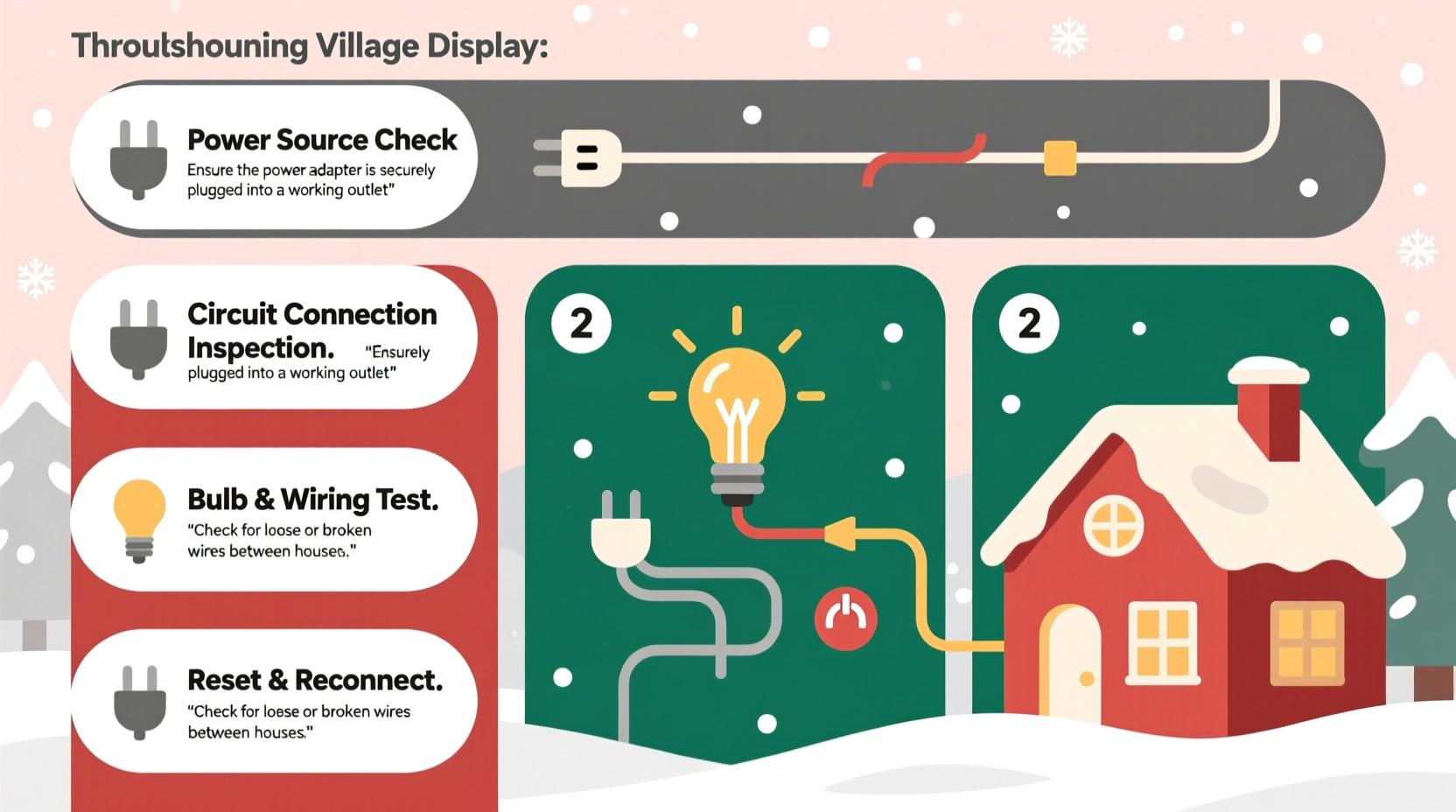
Before inspecting tiny bulb filaments or transformer labels, rule out foundational electrical issues. Over 40% of reported “no power” cases trace back to something as simple as a tripped GFCI outlet or an overloaded circuit—especially in older homes where holiday loads strain outdated wiring. Start here, methodically:
- Test the outlet with a known-working device (e.g., phone charger or lamp). If it doesn’t power on, check your home’s breaker panel for a tripped switch—or locate the GFCI reset button (often in kitchens, bathrooms, or garages) and press it firmly.
- Inspect the village’s main power cord for visible damage: kinks, fraying near the plug or transformer, or chew marks (a real risk if stored in basements or garages).
- Unplug all other devices on the same circuit—space heaters, refrigerators, or entertainment systems—and try powering the village alone. Holiday lighting draws significant continuous load; many modern villages require 30–60 watts per section, and multi-tier displays easily exceed 150W.
- Confirm the wall outlet is grounded. Ungrounded (two-prong) outlets lack surge protection and can cause inconsistent voltage delivery—particularly harmful to sensitive LED drivers in newer villages.
2. Diagnose the Transformer: The Village’s Heartbeat
Most Christmas villages operate on low-voltage DC or AC (typically 3.5V, 4.5V, 6V, or 12V), delivered via a step-down transformer. These units are the most common point of failure—not because they’re poorly made, but because they endure thermal cycling (heating/cooling), moisture exposure during storage, and voltage spikes during seasonal power-up. A failed transformer may show no external signs: no burn marks, no humming, no warmth.
Here’s how to test it accurately:
- Voltage Check: Use a multimeter set to DC or AC voltage (match the transformer label). Place probes on the output terminals (not the input side). A healthy unit should read within ±5% of its labeled output (e.g., 6.0V ± 0.3V). Zero or erratic readings indicate internal failure.
- Load Test: Transformers can show correct voltage with no load but collapse under actual draw. Plug in *one* house first—if it powers, add a second. If the first works but the second kills all power, the transformer is undersized or failing under load.
- Heat & Smell: After 5 minutes of operation, gently touch the transformer casing. It should be warm—not hot enough to burn skin. A burning plastic or ozone smell means immediate replacement is required.
Manufacturers like Department 56, Lemax, and Bachmann specify compatible transformers in their instruction manuals—and warn against substituting generic units. Even slight voltage mismatches (e.g., using a 9V transformer for a 6V system) can fry LED modules or cause flickering that mimics total failure.
3. Trace the Wiring Harness: From Transformer to First House
Village power flows through a daisy-chained wiring harness—a series of thin, color-coded wires connecting houses in sequence. Each connection point (usually a plug-and-socket or screw-terminal block) is a potential failure zone. Corrosion, bent pins, or loose crimps interrupt continuity silently. Here’s what to examine:
| Connection Type | Common Failure Mode | Diagnostic Action |
|---|---|---|
| Male/female plug (e.g., 2.1mm barrel or proprietary snap-fit) | Oxidation on metal contacts; worn socket springs losing grip | Clean contacts with isopropyl alcohol and a soft toothbrush. Gently bend socket prongs inward with needle-nose pliers for tighter fit. |
| Screw-terminal block (common in older or custom setups) | Loose wire strands; insulation pinched under terminal | Power off. Loosen screw, trim 1/8\" of wire, re-strip cleanly, and retighten firmly. Ensure no stray copper strands touch adjacent terminals. |
| Inline splice connectors (wire nuts or heat-shrink butt connectors) | Misaligned wires; cold solder joints; moisture ingress | Inspect for discoloration or brittleness. Reflow solder if accessible; replace damaged connectors with marine-grade heat-shrink variants. |
Pro tip: Label each house’s input/output ports with masking tape and a fine-tip marker before disassembly. Many village owners unknowingly reverse the chain—plugging “out” into “out”—which breaks the circuit entirely. The correct flow is always: Transformer → House 1 IN → House 1 OUT → House 2 IN → House 2 OUT → etc.
4. Inspect Individual Houses: Bulbs, Sockets, and Internal Boards
Once power reaches the first house, failure can still occur internally. Modern villages use either incandescent mini-bulbs (with fragile filaments) or surface-mount LEDs (with integrated current-limiting resistors). Both have distinct failure patterns.
For incandescent-based villages: Filaments break from vibration during storage or thermal stress. Replace bulbs only with exact voltage/wattage matches—using a 3.5V bulb in a 4.5V circuit shortens lifespan dramatically. Always test bulbs in a known-good socket first.
For LED-based villages: The issue is rarely the LED itself. More often, it’s a failed current-limiting resistor (looks like a tiny beige cylinder marked with colored bands) or a cracked solder joint on the circuit board. These require magnification and a multimeter in continuity mode—but you can often spot damage visually: brown scorch marks, lifted pads, or cloudy epoxy over the LED chip.
“Over 70% of ‘dead house’ reports we see at our repair lab stem from a single cold solder joint near the input socket—not the bulb or transformer. It takes 90 seconds to reflow with a fine-tip iron.” — Marcus R. Chen, Lead Technician, Holiday Light Solutions LLC
A quick diagnostic sequence for any unlit house:
- Verify power arrives at the house’s input port using a multimeter.
- Check continuity between input and output ports—if broken, the internal wiring or board is faulty.
- If power enters but doesn’t exit, open the base (most houses have removable bottom plates secured by screws or clips) and inspect the board for damage.
- For plug-in bulb systems, remove and test each bulb individually—even one dead bulb in a series string can kill the entire house.
5. Seasonal Storage and Environmental Damage: The Hidden Culprits
This is where most long-term village owners stumble—not during setup, but during the 11 months between displays. Improper storage degrades components invisibly:
- Moisture & Humidity: Cardboard boxes in damp basements or garages encourage condensation. When powered up in December, this moisture causes micro-corrosion on contacts and shorts across circuit boards. Result: intermittent power or complete failure after 2–3 seasons.
- Temperature Extremes: Storing villages in attics (>95°F) or unheated sheds (<20°F) stresses plastic housings (causing warping or brittleness) and degrades transformer electrolytic capacitors—leading to voltage sag or noise.
- Physical Compression: Stacking heavy items on top of village boxes crushes delicate wiring harnesses and bends connector pins. One bent pin can prevent full contact, causing high resistance and voltage drop.
Real-World Case Study: The “Half-Lit” Village Dilemma
Sarah K., a collector of Department 56 Alpine Village since 2012, contacted us after her display powered only the first three houses—everything beyond went dark. She’d replaced the transformer twice and checked every bulb. Our technician discovered the issue wasn’t hardware, but history: Sarah stored her harness coiled tightly in a cardboard box inside her garage. Winter humidity caused oxidation on the brass contacts of the fourth-house input plug. The corrosion increased resistance just enough to drop voltage below the 4.2V minimum required by the LED modules in houses 4–12. Cleaning the contacts with DeoxIT® D5 and applying dielectric grease restored full functionality. Total fix time: 14 minutes. Lesson: Voltage drop accumulates across connections—and corrosion is rarely visible to the naked eye until tested.
Step-by-Step Troubleshooting Flowchart
Follow this sequence without skipping steps. Each “Yes” answer moves you closer to resolution; each “No” confirms the component is functional and directs you downstream.
- Is the outlet live? → No: Reset breaker/GFCI. Yes: Proceed.
- Does the transformer output correct voltage (under no load)? → No: Replace transformer. Yes: Proceed.
- Does the transformer hold voltage when one house is connected? → No: Transformer is weak/undersized. Yes: Proceed.
- Is power present at House 1’s input port? → No: Check harness from transformer to House 1. Yes: Proceed.
- Is power present at House 1’s output port? → No: House 1 internal fault. Yes: Proceed to House 2 input.
- Repeat step 5 for each subsequent house until power stops. → The last house showing input power but no output is the failure point.
FAQ
Can I use a higher-wattage transformer to power more houses?
No—unless explicitly approved by the village manufacturer. Exceeding the transformer’s rated load causes overheating, voltage instability, and premature LED driver failure. Instead, split large displays across multiple correctly rated transformers, each feeding a separate daisy-chain branch.
Why do some houses flicker only when others are added?
Flickering under load signals voltage drop—usually due to undersized wiring, corroded connections, or a failing transformer. It’s not random; it’s physics. As current demand rises, resistance at weak points converts electricity into heat instead of light, starving downstream components.
My village worked last year but not this year—what changed?
Seasonal storage conditions almost always degrade connections over time. Even minor corrosion or capacitor aging in the transformer can cross a failure threshold after one more thermal cycle. Don’t assume “it worked before” means components are healthy—test them.
Conclusion
Your Christmas village isn’t just decoration—it’s a curated expression of memory, tradition, and craftsmanship. When it fails to light, it’s more than an electrical problem; it’s a small rupture in the ritual. But power failure is rarely mysterious. It’s predictable, traceable, and almost always solvable with systematic attention—not replacement. You now have a field-tested methodology: verify infrastructure, validate the transformer, map the harness, inspect internals, and audit storage habits. No special tools beyond a $15 multimeter and patience are required. Most fixes take under 30 minutes. And once resolved, document your solution: note transformer model, voltage readings, and connection types. That log becomes your village’s maintenance history—valuable for future seasons and resale integrity. Don’t let one dark corner dim your whole display. Power up with purpose. Restore the glow—not just for this year, but for the decades of holidays ahead.




 浙公网安备
33010002000092号
浙公网安备
33010002000092号 浙B2-20120091-4
Comments
No comments yet. Why don't you start the discussion?