
Every holiday season, families across the country set up their cherished Christmas villages—miniature towns aglow with twinkling lights, rotating carousels, and festive music. But as enchanting as these displays are, they can quietly become a strain on household electrical systems. If you’ve noticed your circuit breaker tripping when the village is powered on, or if outlets buzz or dim under load, your display may be drawing more power than your circuit can safely handle.
The issue isn’t uncommon. Many vintage and modern village pieces use incandescent bulbs, motors, and sound modules that, when combined, can exceed 1,500 watts—the maximum safe capacity of a standard 15-amp household circuit. Left unchecked, this overloading risks fire hazards, damaged electronics, and frequent disruptions during what should be a joyful time.
This guide breaks down exactly why Christmas village setups overload circuits, how to diagnose the problem, and—most importantly—how to fix it safely and effectively.
Understanding Household Circuit Limits
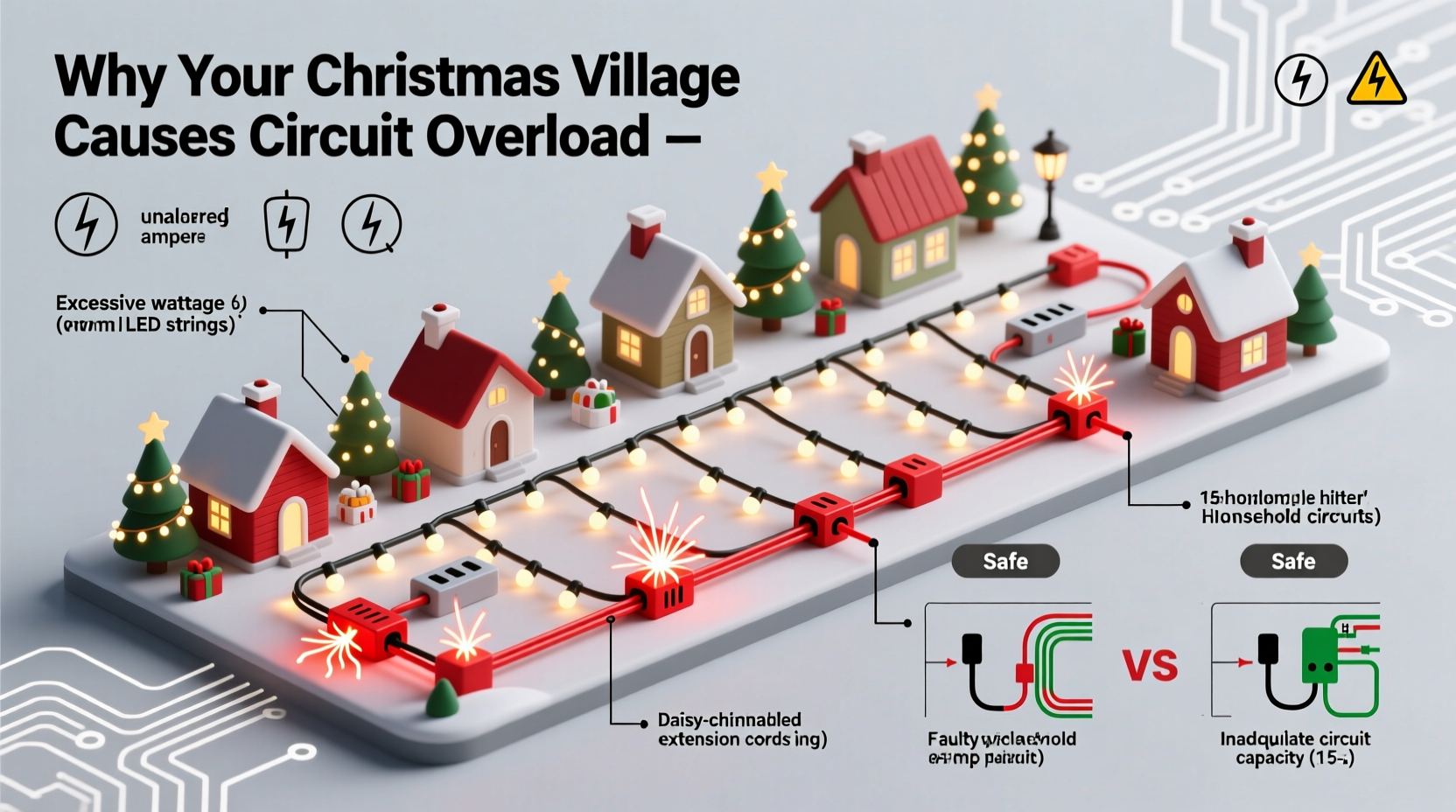
A typical U.S. residential circuit operates at 120 volts and is protected by either a 15-amp or 20-amp breaker. The maximum wattage a circuit can handle is calculated using a simple formula:
Wattage = Voltage × Amperage
For a 15-amp circuit: 120V × 15A = 1,800 watts
For a 20-amp circuit: 120V × 20A = 2,400 watts
However, electrical codes require circuits to be loaded no more than 80% of their capacity for continuous use (over three hours). This means:
- 15-amp circuit max safe load: 1,440 watts
- 20-amp circuit max safe load: 1,920 watts
Most Christmas villages run for several hours each evening, classifying them as continuous loads. Therefore, even if your total draw is below 1,800 watts, exceeding 1,440 watts on a 15-amp circuit violates safety standards and increases the risk of overheating.
Why Christmas Villages Overload Circuits
While individual village buildings may seem low-power, their cumulative draw adds up quickly. Consider the following factors:
Incandescent Lighting
Many traditional village pieces use incandescent bulbs, which consume significantly more power than LEDs. A single building with five 5-watt bulbs draws 25 watts. Ten such buildings equal 250 watts—before adding trains, trees, or animated figures.
Motorized Elements
Rotating Ferris wheels, moving trains, and spinning snowmen include small motors that spike energy use during startup. These surges, though brief, can trigger sensitive breakers—especially arc-fault or GFCI types common in modern homes.
Daisy-Chained Power Supplies
Villagers often connect multiple transformers or plug sets into one outlet via power strips or extension cords. While convenient, this concentrates demand on a single circuit, increasing the chance of overload.
Shared Outlet Usage
It’s easy to forget that other devices—lamps, TVs, space heaters—on the same circuit contribute to the total load. A village might push an already busy circuit past its limit.
“Holiday lighting and decorative displays are among the top seasonal causes of residential circuit overloads. The risk multiplies when users combine older, high-draw decorations with modern power strips not rated for sustained use.” — National Fire Protection Association (NFPA) Electrical Safety Report, 2023
Step-by-Step Guide to Diagnose and Fix the Problem
Follow this structured approach to identify and resolve your circuit overload safely.
- Map Your Circuit
Turn off the breaker controlling the room where your village is located. Test outlets and lights to confirm which ones go dead. Note everything on the same circuit—this is your total load zone. - Unplug Everything Non-Essential
Disconnect all non-village devices from outlets on the circuit. This isolates the village’s impact. - Power On One Section at a Time
Begin with just a few buildings. Turn on the village incrementally while monitoring the breaker. If it trips after adding a specific piece, that item may have a short or excessive draw. - Use a Plug-In Power Meter
Devices like the Kill-A-Watt meter measure real-time wattage. Plug your village’s main power strip into it to see total consumption. Compare the reading to the 1,440-watt safe limit for 15-amp circuits. - Inspect Transformers and Cords
Look for warm transformers, frayed wires, or discolored plugs—signs of overheating. Replace any damaged components immediately. - Test on a Different Circuit
Move the entire setup to a kitchen or garage circuit (often 20-amp) to see if the problem persists. If it doesn’t trip, your original circuit was overloaded.
Solutions to Prevent Circuit Overload
Once you’ve diagnosed the issue, implement one or more of these proven fixes.
1. Upgrade to LED Lighting
Replace incandescent bulbs in your village with LED equivalents. LEDs typically use 80–90% less power. For example:
| Bulb Type | Wattage per Bulb | Estimated Annual Cost (5 hrs/day) |
|---|---|---|
| Incandescent (5W) | 5 watts | $1.10 |
| LED Equivalent | 0.5 watts | $0.11 |
Converting ten buildings from incandescent to LED saves about 45 watts per building, totaling 450 watts—well over a third of a 15-amp circuit’s safe capacity.
2. Distribute Load Across Multiple Circuits
Split your village into zones powered by different circuits. For instance:
- Zone 1 (Main Street): Plugged into living room circuit
- Zone 2 (Train & Station): Connected to dining room circuit
- Zone 3 (Mountain Area): Runs off hallway circuit
Use smart power strips or remote-controlled outlets to turn all zones on/off simultaneously without physical access to multiple outlets.
3. Use High-Quality, Rated Power Strips
Avoid daisy-chaining cheap power strips. Instead, use heavy-duty strips rated for at least 1,500 watts (125V/15A) with surge protection and individual switches.
4. Install a Dedicated Circuit
For large or permanent displays, consider having an electrician install a dedicated 20-amp circuit. This eliminates competition with other devices and supports future expansion.
5. Automate with Timers or Smart Plugs
Reduce runtime by scheduling your village to operate only during peak viewing hours (e.g., 4 PM to 10 PM). Smart plugs also allow remote shutdown if you notice signs of overload.
Mini Case Study: The Johnson Family Village Rescue
The Johnsons in Columbus, Ohio, had enjoyed their 35-piece Lionel village for over a decade. Last year, their living room circuit began tripping every evening around 7 PM. Initially blaming the breaker, they called an electrician who discovered the root cause: a combination of 18 incandescent-lit buildings, a motorized train loop, and a fiber-optic tree—all running on a shared 15-amp circuit that also powered a TV and floor lamp.
Their total measured draw was 1,620 watts—180 watts over the safe limit. The solution?
- Replaced all interior bulbs with micro-LEDs (cutting lighting load by 400 watts)
- Moved the train transformer to a kitchen outlet (different circuit)
- Installed a smart timer to limit operation to 5 PM–9 PM
Result: No more tripped breakers, a cooler-running system, and a 30% reduction in holiday electricity costs.
Checklist: Prevent Christmas Village Circuit Overload
- ✅ Calculate total wattage of all village components
- ✅ Use a plug-in power meter to verify actual draw
- ✅ Replace incandescent bulbs with LEDs
- ✅ Avoid daisy-chaining power strips
- ✅ Distribute load across multiple circuits
- ✅ Inspect cords and transformers for damage
- ✅ Limit runtime with timers or smart plugs
- ✅ Consult an electrician for dedicated circuits if needed
Frequently Asked Questions
Can I use an extension cord for my Christmas village?
Only if it’s heavy-duty (14-gauge or lower), UL-listed, and used temporarily. Permanent setups should rely on wall outlets or properly installed power strips. Avoid coiling cords, as this traps heat.
How do I know if my breaker is tripping due to overload or a fault?
An overload typically occurs after several minutes of operation and resets cleanly. A short circuit or ground fault trips instantly and may feel warm or emit a burning smell. In the latter case, unplug everything and inspect wiring before proceeding.
Are battery-powered village pieces safer?
They eliminate circuit load but introduce other concerns: cost, environmental waste, and inconsistent brightness as batteries drain. Best used selectively—for hard-to-reach areas or temporary additions—not as a full-scale replacement.
Final Thoughts and Call to Action
Your Christmas village is more than a decoration—it’s a tradition, a centerpiece of family memories, and a symbol of the season’s warmth. Protecting that experience means respecting the electrical systems that bring it to life. Circuit overload isn’t just an inconvenience; it’s a warning sign that, if ignored, could lead to equipment damage or worse.
Take action now. Audit your setup, make the switch to efficient LEDs, and distribute your load wisely. Share your journey in the comments—what changes did you make? How much power did you save? Your story could help another villager avoid a holiday mishap.




 浙公网安备
33010002000092号
浙公网安备
33010002000092号 浙B2-20120091-4
Comments
No comments yet. Why don't you start the discussion?