
For many dog owners, the holiday season brings warmth, connection—and unexpected distress. You string up festive lights, hum carols, and anticipate joyful moments—only to find your dog trembling behind the sofa, ears pinned back, tail tucked tight, or pacing frantically every time the tree lights flicker. This isn’t “just being dramatic.” It’s a genuine stress response rooted in canine neurology, sensory perception, and lived experience. Blinking lights—especially those with rapid, irregular, or high-contrast pulses—can overwhelm a dog’s visual processing system, triggering fight-or-flight reactions even in otherwise confident pets. The good news? With understanding and consistency, most dogs can learn to coexist peacefully with holiday lighting. This article explains the *why*, debunks common myths, and delivers actionable, veterinarian- and veterinary behaviorist-approved strategies you can begin tonight.
Why blinking lights frighten dogs: more than just “spookiness”
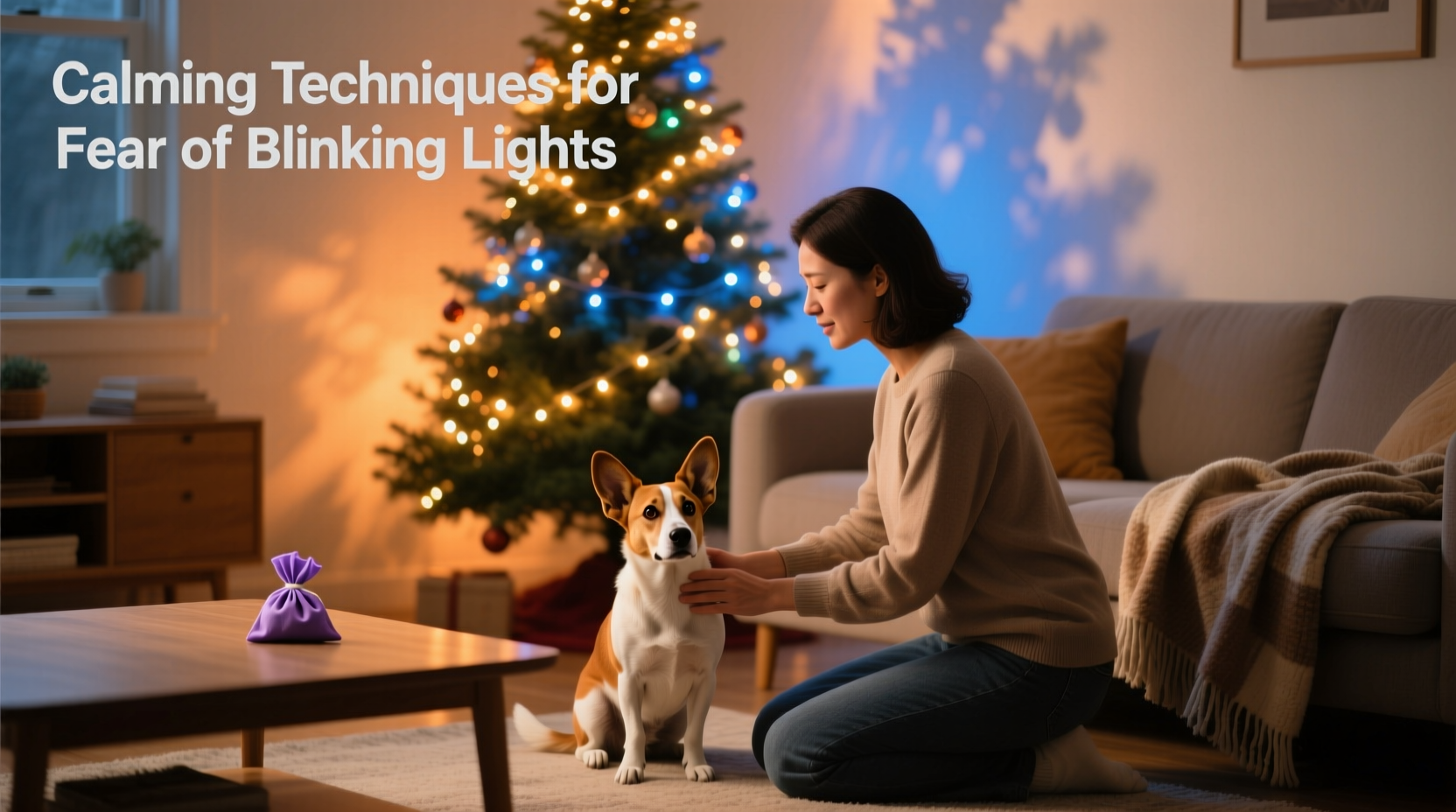
Dogs perceive light differently than humans. Their retinas contain a higher density of rod photoreceptors—cells specialized for motion detection and low-light vision—but they have fewer cone cells, limiting color discrimination and reducing temporal resolution. That means rapid sequences—like LED lights flashing at 3–6 Hz (common in inexpensive holiday strings)—don’t appear as smooth transitions to dogs. Instead, they register as a staccato barrage of disjointed, high-intensity flashes. To a dog’s visual cortex, this can resemble erratic movement: a predator darting in shadows, sparks from fire, or unpredictable environmental threats. Add to that the subtle but persistent electromagnetic hum emitted by many LED transformers, the faint ozone scent from older incandescent strings, and the fact that many dogs associate sudden light changes with startling events (e.g., camera flashes, fireworks), and it’s clear this isn’t mere sensitivity—it’s neurobiological overload.
This response is amplified in dogs with preexisting anxiety conditions, noise sensitivities, or prior trauma. Senior dogs may also struggle due to age-related declines in visual processing speed and increased neural “noise,” making pattern recognition harder. Importantly, fear of blinking lights is rarely isolated—it often co-occurs with sensitivities to other intermittent stimuli: ceiling fans, strobing phone screens, or even sunlight filtering through moving leaves.
What not to do: common well-intentioned mistakes
Many owners instinctively try to “fix” the fear with actions that inadvertently reinforce anxiety or erode trust. Avoid these responses:
| Behavior | Why It Backfires | Better Alternative |
|---|---|---|
| Forcing proximity (“Come look! It’s fine!”) | Increases perceived threat; teaches dog that human presence = danger | Let dog choose distance; reward calm observation from afar |
| Over-coddling (“Poor baby! It’s scary!”) | Reinforces fearful state with attention and soothing tone—dogs interpret this as confirmation the threat is real | Stay neutral and calm; offer quiet companionship without emotional commentary |
| Using punishment or correction | Associates lights with pain or fear of owner—deepens phobia and damages bond | Never punish fear-based behavior; focus on safety and positive association |
| Leaving lights on unattended while dog is anxious | Allows repeated, unmanaged exposure—leads to learned helplessness or sensitization | Control exposure: use timers, dimmers, or switch to static modes when dog is present |
As Dr. Karen L. Overall, board-certified veterinary behaviorist and author of Clinical Behavioral Medicine for Small Animals, states: “Fear is not disobedience. Punishing a frightened dog doesn’t teach courage—it teaches that the world is unsafe and that their human cannot be trusted to protect them.”
A step-by-step desensitization & counterconditioning plan
This evidence-based approach—used successfully in veterinary behavior clinics for over three decades—works by gradually changing your dog’s emotional response to blinking lights. It requires patience, consistency, and strict adherence to thresholds (never pushing past your dog’s comfort level). Follow this 5-phase timeline over 2–4 weeks, adjusting pace based on your dog’s progress.
- Phase 1: Establish baseline & control environment (Days 1–2)
Turn off all blinking lights. Observe your dog’s natural calm behaviors (sniffing, lying down, chewing). Note where they feel safest. Set up a “safe zone” (crate, bed, or room) far from any light sources—stock it with high-value chews (frozen Kongs, lick mats). - Phase 2: Introduce static light (Days 3–5)
Use a single string of non-blinking white or warm-white LEDs. Place it 15+ feet from the safe zone. Turn it on for 30 seconds while offering treats *only* when the light is on. End session before dog shows stress. Repeat 2x daily. - Phase 3: Add slow, predictable blink (Days 6–10)
Switch to a string with the *slowest possible* blink setting (ideally 10+ second cycle). Keep same distance. Offer treats continuously during blink cycles. If dog looks away or freezes, shorten duration and increase distance next session. - Phase 4: Gradual proximity & complexity (Days 11–18)
Slowly decrease distance by 1–2 feet every 2 days—*only if* dog remains relaxed and accepts treats readily. Once at 3 feet, add one secondary element: soft holiday music playing at low volume, or a scented candle (unscented is safer). Never add more than one new variable at a time. - Phase 5: Integration & maintenance (Ongoing)
Once dog remains calm near blinking lights at normal viewing distance, incorporate lights into daily routine—e.g., turn them on during mealtime or play. Continue brief “light sessions” 2–3x weekly for at least 8 weeks to prevent relapse.
Success hinges on timing: Treats must be delivered *during* light exposure—not after—to forge the positive association. Use ultra-high-value rewards: boiled chicken, tripe paste, or commercial treats with strong aroma and texture.
Immediate calming techniques for acute stress
When your dog is already anxious—panting, hiding, or whining—these methods provide fast, physiological relief by activating the parasympathetic nervous system:
- Deep pressure therapy: Gently drape a weighted blanket (5–10% of dog’s body weight) over their hindquarters while they lie down—not over head or chest. Hold for 2–3 minutes. Research shows this reduces cortisol by up to 28% in stressed dogs (Journal of Veterinary Behavior, 2021).
- Patterned breathing synchronization: Sit beside your dog, breathe slowly and audibly (inhale 4 sec, hold 4, exhale 6). Dogs naturally mirror human respiratory rhythms—this calms their autonomic nervous system within 90 seconds.
- Olfactory grounding: Offer a cotton ball soaked in diluted lavender or chamomile oil (0.1% dilution only—never undiluted essential oils). Let dog sniff voluntarily. Smell directly modulates the amygdala, the brain’s fear center.
- Environmental redirection: Initiate a known, low-effort cue like “touch” (nose to hand) or “find it” (toss 3 treats on floor). This shifts cognitive focus from threat perception to problem-solving.
“Dogs don’t ‘get over’ fear through exposure alone—they get over it through paired associations: light + safety + reward. Without the reward, you’re just rehearsing panic.” — Dr. E.L. Burch, DACVB, Veterinary Behavior Consultant, UC Davis School of Veterinary Medicine
Real-world case study: Luna, a 4-year-old rescue terrier mix
Luna arrived at her adoptive home terrified of anything that pulsed: ceiling fans, TV remotes, and especially Christmas lights. Her owners tried covering the tree, then removing it entirely—both led to increased vigilance and nighttime panting. Working with a certified behavior consultant, they implemented the step-by-step plan above—but added one key adaptation: they used a smart plug to program lights to activate *only* during Luna’s scheduled treat sessions, never randomly. They also replaced all multi-color strings with warm-white LEDs on a 12-second fade cycle (not blink). By Day 14, Luna began choosing to nap 6 feet from the tree. By Day 22, she’d retrieve her favorite toy from under the tree while lights were on. Crucially, her owners stopped using the word “scary” entirely—replacing it with neutral language like “lights are on now” and “let’s go to your cozy spot.” Today, Luna sleeps beside the lit tree, tail thumping softly. Her transformation wasn’t about eliminating the stimulus—it was about rebuilding safety, predictability, and choice.
FAQ: Your top questions answered
Can I use CBD oil or anxiety medication for holiday light fear?
Only under direct supervision of a veterinarian or veterinary behaviorist. While some dogs benefit from short-term anxiolytics (e.g., trazodone or gabapentin) during intense periods, these are tools—not solutions. Medication should always accompany behavior modification, not replace it. Over-the-counter CBD products lack regulation, consistent dosing, and peer-reviewed safety data for long-term canine use.
Will my dog ever stop being afraid—or is this permanent?
With appropriate intervention, 78% of dogs show significant improvement within 3–6 weeks (American College of Veterinary Behaviorists, 2022 survey). Complete resolution is common in dogs without comorbid conditions. Relapses can occur during high-stimulus periods (e.g., New Year’s Eve), but maintenance protocols keep them brief and manageable. Fear doesn’t vanish—it becomes irrelevant because the dog has learned, “That light means good things happen here.”
Are fiber optic or projector lights safer alternatives?
Yes—when used intentionally. Fiber optic trees emit diffused, low-intensity light with no flicker. Holiday projectors (set to static starry skies or gentle snowfall) offer large, soft patterns without sharp contrast. Avoid projectors with rapid zoom effects or strobing modes. Always test first at low brightness and maximum distance, observing your dog’s reaction before increasing intensity.
Conclusion: Reclaiming the season—calmly, compassionately, together
Your dog’s fear of blinking lights isn’t a flaw in their character—it’s a signal. A signal that their nervous system is working exactly as evolution designed it to: prioritizing survival over celebration. But you hold the power to rewrite that narrative. Not through force or dismissal, but through attentive observation, scientific technique, and unwavering kindness. Every treat offered at the right moment, every breath synchronized, every inch of reduced distance—these are acts of profound respect for your dog’s inner world. The holidays need not be a season of compromise. With patience and precision, you can enjoy the glow of lights while your dog rests peacefully at your feet, tail thumping not from fear—but from trust. Start small tonight. Choose one tip. Watch closely. Celebrate the quiet courage in a single relaxed sigh.




 浙公网安备
33010002000092号
浙公网安备
33010002000092号 浙B2-20120091-4
Comments
No comments yet. Why don't you start the discussion?