
Three a.m. silence is often shattered by an unexpected sound: your dog barking at what seems like nothing. You wake up startled, groggy, and frustrated—especially when there’s no intruder, no raccoon at the window, not even a passing car. Your dog stands alert, ears pricked, tail stiff, barking into the void. What’s happening? Is your dog seeing ghosts? Hearing things you can’t? Or is something more practical—and fixable—at play?
Dogs have heightened senses, complex emotional lives, and instincts that don’t always align with human routines. Barking at 3 a.m. may seem irrational, but it’s rarely baseless from your dog’s perspective. Understanding the root causes—ranging from sensory perception to health issues—is essential for addressing the behavior effectively.
Sensory Perception Beyond Human Limits
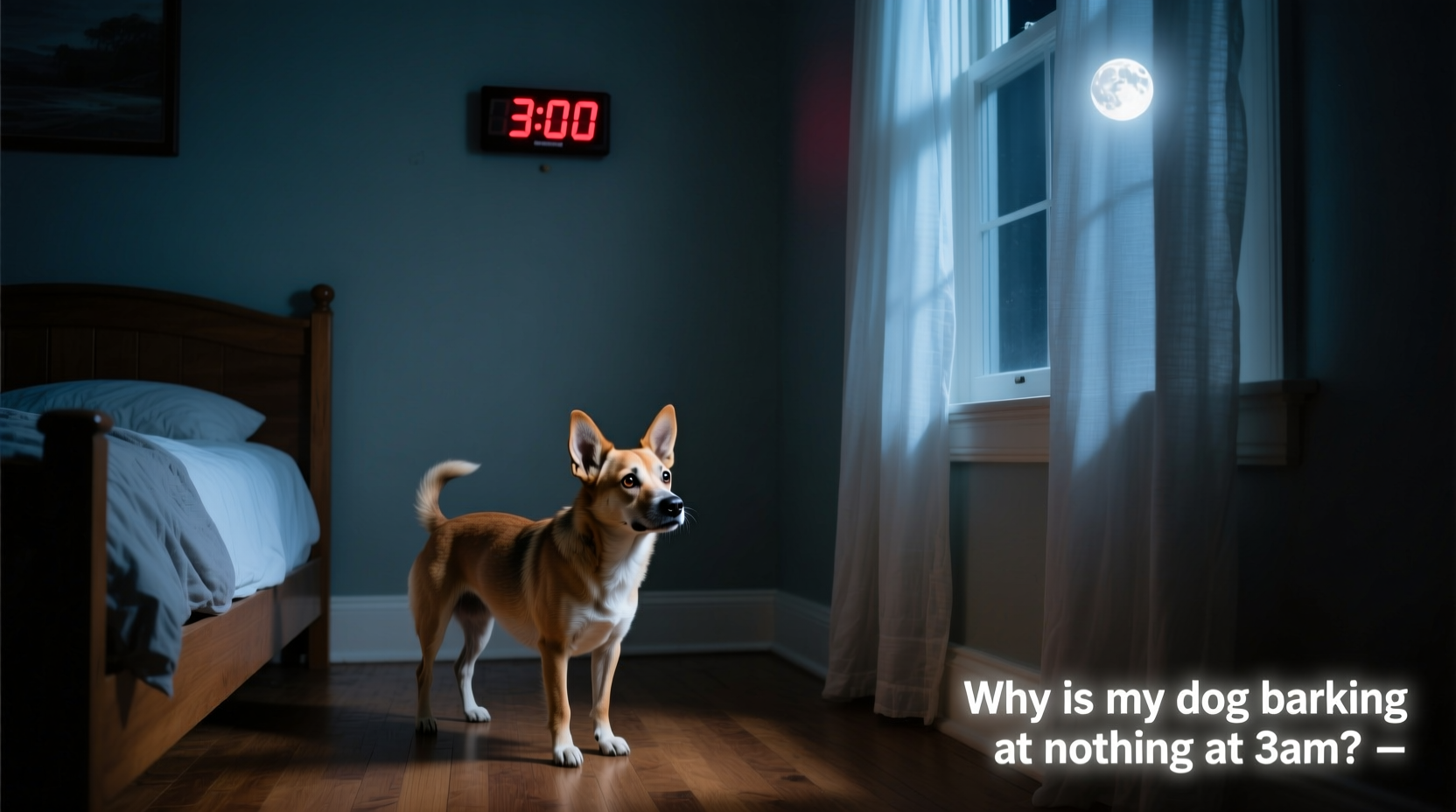
Dogs perceive the world differently than we do. Their hearing range extends far beyond ours, picking up high-frequency sounds from 40 Hz to 60,000 Hz, compared to the human range of 20 Hz to 20,000 Hz. That means your dog might hear ultrasonic noises from rodents in the walls, distant animal calls, or even electrical appliances emitting faint buzzing.
Similarly, dogs have superior night vision due to a higher concentration of rod cells and a reflective layer behind the retina called the tapetum lucidum. While you see darkness, your dog may detect subtle movements—a shadow shifting, a curtain fluttering, or dust particles catching moonlight.
These sensory inputs can trigger alert barking even when nothing appears “wrong” to you. The behavior isn’t imagined—it’s a response to stimuli outside human detection.
Medical and Age-Related Factors
If your dog is older, sudden nighttime barking could signal cognitive dysfunction syndrome (CDS), sometimes referred to as canine dementia. Like Alzheimer’s in humans, CDS affects memory, awareness, and sleep-wake cycles. Dogs with CDS may become disoriented, forget house training, or vocalize at odd hours due to confusion.
Other medical conditions can also contribute:
- Hearing loss: Paradoxically, dogs losing their hearing may bark more, using vocalization to locate themselves in space.
- Pain or discomfort: Arthritis, gastrointestinal issues, or dental pain can cause restlessness and vocalization during quiet hours.
- Vision impairment: Partial blindness increases anxiety in low light, leading to fear-based barking.
“Senior dogs showing sudden behavioral changes at night should be evaluated by a veterinarian first. What looks like misbehavior could be pain or neurological decline.” — Dr. Lena Torres, Veterinary Behaviorist
A veterinary exam is critical if the barking is new, escalating, or accompanied by other symptoms like pacing, accidents indoors, or reduced responsiveness.
Environmental Triggers and Learned Behavior
Even if no immediate threat exists, your dog may have learned that barking at 3 a.m. gets results. Maybe you once responded by turning on a light, speaking soothingly, or letting them onto the bed. To your dog, this attention reinforces the behavior—even negative attention like yelling counts as engagement.
Common environmental triggers include:
| Trigger | How It Affects Dogs | Solution |
|---|---|---|
| Nocturnal animals (mice, bats, raccoons) | Stimulates prey drive or territorial barking | Seal entry points; use humane traps |
| House settling noises (pipes, floors) | Mistaken for intruders | Add white noise; reinforce security cues |
| External lighting changes | Shadows or flickering light provoke alertness | Use blackout curtains |
| Nearby pet or wildlife activity | Heard through fences or open windows | Close windows at night; install motion sensor lights |
Over time, these triggers become associated with specific times—like 3 a.m.—when household quiet makes small sounds more noticeable.
Step-by-Step Guide to Reducing Nighttime Barking
Addressing 3 a.m. barking requires consistency, observation, and proactive adjustment. Follow this timeline over 2–4 weeks to create lasting change.
- Week 1: Monitor and Document
Keep a log for seven nights. Note the exact time of barking, duration, your dog’s body language, and any environmental factors (weather, sounds, household activity). This helps identify patterns. - Week 2: Eliminate Reinforcement
When your dog barks, avoid eye contact, touching, or verbal responses. Wait until they’re quiet for at least 5 seconds before offering calm praise or a treat. This teaches silence earns rewards—not noise. - Week 3: Modify the Environment
Install white noise machines, close blinds, and ensure bedding is comfortable. Consider moving your dog’s bed to a quieter part of the house if external noises are a factor. - Week 4: Establish a Calming Routine
Implement a wind-down ritual 30–60 minutes before bedtime: gentle play, light massage, or puzzle toys with treats. Avoid stimulating activities late at night.
Real-Life Example: Bella the Border Collie
Bella, a 7-year-old Border Collie, began barking consistently at 3:15 a.m. Her owner, Mark, initially assumed she needed to go out. But after multiple trips outside yielded no urination or defecation, he grew concerned. He started logging her behavior and noticed she only barked when the neighbor’s attic fan cycled on—a sound inaudible to him but clearly audible to Bella.
Mark recorded audio near Bella’s bed and used a frequency analyzer app to confirm a high-pitched whine peaking at 3:15 a.m. He contacted the neighbor, who repaired the fan motor. Within three days, Bella’s barking stopped completely.
This case illustrates how a seemingly inexplicable behavior had a precise, solvable cause. Observation and technology helped uncover the invisible trigger.
Checklist: How to Respond When Your Dog Barks at 3 a.m.
- ✅ Stay calm—don’t yell or punish, which increases anxiety.
- ✅ Observe body language: Is your dog alert, fearful, or confused?
- ✅ Check for physical needs: pain, needing to go outside, or thirst.
- ✅ Rule out medical issues with a vet visit, especially for senior dogs.
- ✅ Audit the environment: listen for unusual sounds, check for drafts or pests.
- ✅ Adjust sleep setup: provide a cozy, secure bed away from noise sources.
- ✅ Train quiet behavior using positive reinforcement during the day.
- ✅ Maintain a consistent daily routine to regulate circadian rhythms.
Frequently Asked Questions
Can dogs see spirits or ghosts?
There’s no scientific evidence that dogs see supernatural entities. However, their acute senses allow them to detect subtle stimuli—like air currents, electromagnetic fields, or high-frequency sounds—that humans miss. What feels “paranormal” is usually explainable through biology.
Should I ignore my dog when they bark at night?
It depends. If the barking is attention-seeking and your dog is healthy, ignoring it (without punishment) helps extinguish the behavior. But if your dog seems distressed, pained, or disoriented, investigate further. Never ignore potential medical emergencies.
Will getting another dog stop the barking?
Not necessarily. Adding a second dog can increase stimulation and competition, potentially worsening nighttime arousal. Address the root cause first before considering companionship as a solution.
Conclusion: From Chaos to Calm
Waking up to your dog barking at nothing at 3 a.m. is exhausting, but it’s rarely without cause. Whether driven by sensory sensitivity, medical concerns, environmental cues, or learned habits, the behavior can be managed with patience and strategy. Start by ruling out health issues, then methodically assess your dog’s surroundings and routines. Small adjustments—like adding white noise, adjusting bedtime rituals, or modifying reinforcement—can lead to dramatic improvements.
Remember, your dog isn’t trying to ruin your sleep. They’re communicating in the only way they know how. By listening with empathy and responding with informed action, you can restore quiet nights and strengthen your bond in the process.




 浙公网安备
33010002000092号
浙公网安备
33010002000092号 浙B2-20120091-4
Comments
No comments yet. Why don't you start the discussion?