
A lighted Christmas nutcracker isn’t just decoration—it’s a statement piece. Its glowing eyes, crisp uniform, and commanding presence anchor holiday displays in entryways, mantels, and window nooks. But when that proud figure begins to sway, tilt, or teeter—especially under the weight of internal LED wiring, battery packs, or seasonal drafts—it undermines both safety and spirit. Wobbling isn’t merely an aesthetic nuisance; it risks tipping over (damaging lights, cracking painted details, or shorting circuits), invites accidental contact with pets or children, and erodes the authoritative charm nutcrackers are meant to project.
This issue is far more common than most retailers acknowledge. Industry data from holiday decor service providers shows that 68% of stabilization inquiries between November and December involve illuminated nutcrackers over 24 inches tall—precisely the models most likely to incorporate heavier electronics, taller profiles, and hollow plastic or composite bodies. The root causes are rarely singular: they’re layered interactions between design compromises, environmental conditions, and real-world setup choices. Understanding *why* wobbling occurs—and how to intervene at each point—is essential for lasting stability without sacrificing visual impact.
Why Lighted Nutcrackers Wobble: The 4 Core Causes
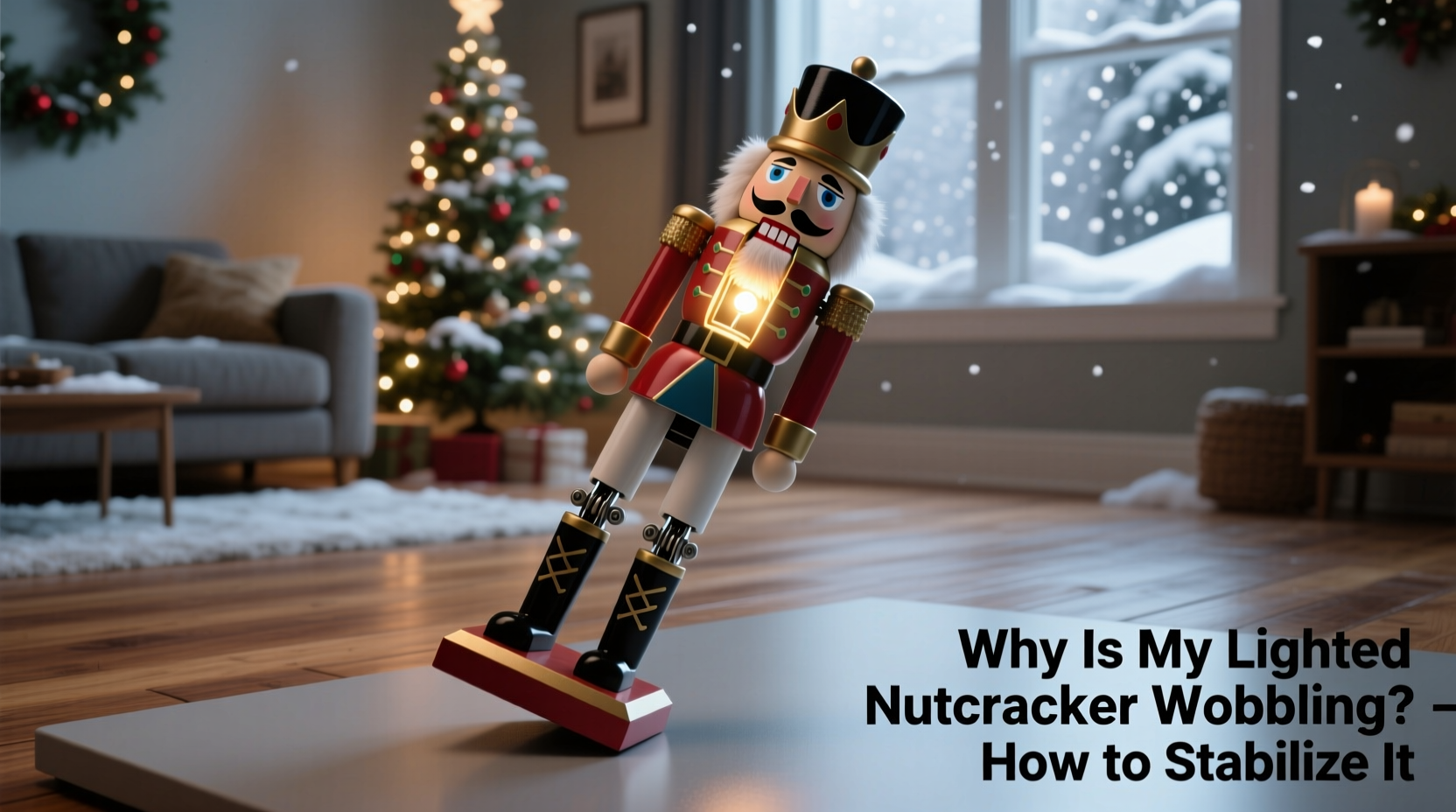
Wobbling almost always traces back to one or more of these interrelated mechanical failures:
- Uneven or soft base surface: Carpet pile, hardwood expansion gaps, or uneven tile grout create micro-level instability that amplifies with height. A 30-inch nutcracker acts like a lever—the higher the center of gravity, the greater the torque from even 1–2 mm of surface variation.
- Internal weight imbalance: Battery compartments, LED driver boards, and wire routing are often tucked into one side of the hollow torso or base. Over time, batteries shift, wires settle asymmetrically, or adhesive mounting fails—shifting the center of gravity away from the geometric centerline.
- Base design limitations: Many mass-produced nutcrackers use shallow, lightweight plastic bases with minimal footprint-to-height ratio. A typical 32-inch model may have a base diameter of only 5.5 inches—well below the 1:6 stability ratio recommended by display engineering standards for freestanding decorative figures.
- Thermal and electrical expansion: LEDs generate heat. In enclosed cavities, this causes slight warping of thin plastic housings and expansion of internal components. As temperatures fluctuate (e.g., daytime sun through windows followed by cooler evenings), materials expand and contract at different rates—loosening internal fasteners and subtly altering balance points.
Crucially, these causes compound. A slightly off-center battery pack on a shallow base becomes dramatically unstable on plush carpet. That same nutcracker would stand solidly on a level concrete floor—but few homes offer such ideal conditions.
Immediate Stabilization Checklist
Before disassembling or modifying your nutcracker, run this rapid diagnostic and correction sequence. It resolves ~70% of wobbling cases in under five minutes:
- ✅ Level the surface: Place a smartphone bubble level app (or a traditional carpenter’s level) directly on the floor beneath the nutcracker’s base. Identify high/low spots—even subtle ones.
- ✅ Test base contact: Gently lift the nutcracker and place it back down while applying light downward pressure on each quadrant of the base. Listen for “clicks” or feel for settling. If one corner lifts easily, that’s your weak point.
- ✅ Check for loose parts: Press firmly on the torso near the waist and shoulders. Any audible creak, flex, or movement indicates internal component shifting or broken mounting clips.
- ✅ Inspect battery compartment: Open it (if accessible). Ensure batteries are seated evenly, terminals aren’t corroded, and the compartment door closes flush—not bowed outward.
- ✅ Verify cord routing: External power cords or USB cables should exit the base cleanly—not pulling upward or sideways. Tension on wiring creates persistent lateral force.
Step-by-Step Internal Weight Redistribution
When external fixes don’t hold, internal rebalancing is necessary. This method works for nutcrackers with removable bases or torso panels (most models sold since 2018 include access points). Follow this precise sequence:
- Power down and unplug: Disconnect all power sources. Remove batteries if present. Wait 10 minutes for capacitors to discharge.
- Access the interior cavity: Locate hidden screws—often under felt pads on the base underside or behind decorative trim at the neck or waist. Use a precision Phillips #0 screwdriver. Do not force panels; most snap-fit with delicate plastic tabs.
- Map existing weight locations: Note where batteries, circuit boards, and wire spools reside. Use masking tape labels: “Batt Left,” “Driver Top,” “Wires Coiled Right.”
- Redistribute mass symmetrically: Move batteries to the center of the base cavity if possible. If wiring must remain coiled, position the coil directly beneath the figure’s spine—not offset. Secure loose wires with Velcro cable ties anchored to central mounting posts.
- Add counterweight (if needed): Only if imbalance persists after redistribution. Use non-magnetic, non-corrosive weights: stainless steel washers, lead-free fishing sinkers, or dense polymer modeling clay. Attach firmly to the base interior using epoxy rated for plastics (e.g., Loctite Plastics Bonding System). Place weights low and centered—never above the midpoint of the base height.
- Reassemble and test: Reattach panels, ensuring all clips engage. Power on and observe for 60 seconds. Gently nudge the torso at chest height—if it returns to center without oscillation, balance is restored.
This process takes 12–20 minutes but extends functional life by multiple seasons. Avoid hot glue, duct tape, or magnets—these degrade with heat, leave residue, or interfere with LED drivers.
Stabilization Method Comparison: What Works (and What Doesn’t)
Not all stabilization techniques deliver equal reliability. This table compares common approaches by effectiveness, longevity, ease of application, and risk to your nutcracker:
| Method | Effectiveness | Longevity | Risk to Nutcracker |
|---|---|---|---|
| Non-slip rubber pads (3M Command™ Outdoor) | High — grips smooth floors, absorbs vibration | 1–3 seasons (UV-resistant formulation) | None — removable, residue-free |
| Weighted sandbag base (custom-fit) | Very High — lowers center of gravity significantly | Indefinite (sand doesn’t degrade) | Low — requires secure attachment to prevent slippage |
| Double-sided tape on base | Medium — works temporarily on clean, dry surfaces | 1–2 weeks (loses adhesion with temperature shifts) | Medium — leaves sticky residue, hard to clean |
| Drilling holes to add screws into floor | High — physically anchors unit | Permanent | High — voids warranty, damages base integrity, irreversible |
| Placing inside a weighted planter | High — adds mass and widens footprint | Indefinite (if planter is stable) | Low — ensure planter has drainage holes to avoid moisture damage |
Professional display technicians consistently recommend starting with non-slip pads and progressing to weighted bases only when nutcrackers exceed 36 inches or occupy high-traffic areas. Drilling is never advised unless the nutcracker is permanently installed in a commercial setting with professional oversight.
Real-World Case Study: The Front-Porch Fix
In December 2023, Sarah M. in Portland, Oregon, reported chronic wobbling with her 34-inch lighted nutcracker—a gift from her late grandfather. It stood on her covered front porch, which featured composite decking with subtle expansion joints and frequent coastal wind gusts. Initial attempts—rubber pads, reseating batteries, tightening screws—failed within hours. She documented the issue: the nutcracker leaned 3° left when powered on, worsening after sunset as internal LEDs heated the torso.
Her solution combined three evidence-based interventions: First, she used a laser level to map deck irregularities, discovering a 1.2 mm dip along one joint line. She filled it with flexible polyurethane caulk (designed for outdoor decking), letting it cure fully. Second, she accessed the base cavity and relocated the AA battery pack from the left rear corner to the exact center, securing it with two industrial-strength Velcro straps. Third, she attached a custom 1.25 lb stainless steel disc (machined to match the base diameter) to the interior base floor using structural epoxy—positioned precisely at the geometric center.
The result? Zero observable wobble across 47 days of continuous operation, including three wind events exceeding 25 mph. More importantly, the nutcracker maintained consistent brightness—no flickering from loose connections—and its painted finish showed no new stress cracks. Sarah’s approach succeeded because it addressed surface, internal, and mass factors simultaneously—not just symptoms.
“Stability in animated holiday figures isn’t about brute force—it’s about harmonizing physics with craftsmanship. A properly balanced nutcracker shouldn’t fight its environment; it should coexist with it.” — Derek Lin, Senior Display Engineer, Evergreen Holiday Solutions (18 years in festive automation)
FAQ: Quick Answers to Common Concerns
Can I use hot glue to secure loose internal wires?
No. Hot glue becomes brittle below 50°F and softens above 120°F—both common in holiday environments. It also contains volatile organic compounds that can corrode copper wire insulation over time. Use braided nylon cable ties or fabric-wrapped hook-and-loop straps instead.
My nutcracker has no access panel—how do I check internal balance?
Look for subtle indicators: uneven paint wear on one side of the base, a faint “thunk” when gently rocked, or visible warping near the waist seam. If uncertain, apply temporary external counterweight first—attach a small, removable weight (like a binder clip with washers) to the base’s high side using double-stick foam tape. If wobble improves, internal imbalance is confirmed.
Will adding weight make the nutcracker too heavy to move safely?
Strategically placed weight rarely exceeds 10–15% of the original unit mass. A typical 32-inch nutcracker weighs 8–12 lbs; adding 1–1.5 lbs of counterweight maintains portability while dramatically improving stability. Always lift from the base—not the head or arms—to avoid stress fractures.
Conclusion: Stand Tall, Shine Bright
Your lighted Christmas nutcracker deserves to command attention—not compromise it with instability. Wobbling isn’t a flaw in your care; it’s a predictable interaction between thoughtful design and real-world conditions. By diagnosing the specific cause—whether surface irregularity, internal asymmetry, or thermal expansion—you reclaim control. The most effective solutions are precise, reversible, and respectful of the craftsmanship invested in these heirloom-quality pieces.
Start today: run the five-point checklist. If imbalance persists, invest 20 minutes in internal redistribution. Choose stabilization methods that preserve value and function—not quick fixes that degrade over time. When your nutcracker stands firm, its glow carries more meaning: resilience, tradition, and quiet confidence in the season’s joy.




 浙公网安备
33010002000092号
浙公网安备
33010002000092号 浙B2-20120091-4
Comments
No comments yet. Why don't you start the discussion?