
Blown fuses in outdoor Christmas light strings aren’t just inconvenient—they’re a red flag. Each time the fuse trips, it’s your lighting system’s way of shouting that something is wrong: too much current, compromised insulation, moisture intrusion, or an underlying fault. Ignoring repeated fuse failures invites fire hazards, equipment damage, and potentially dangerous voltage leaks—especially in wet, cold, or high-traffic outdoor environments. This guide cuts through seasonal guesswork. It’s built on NEC (National Electrical Code) fundamentals, field-tested diagnostics used by professional holiday installers, and real-world failure patterns observed across thousands of residential installations. No assumptions. No shortcuts. Just actionable, safety-first troubleshooting you can apply tonight.
Understanding Why Fuses Blow — Beyond “It’s Just Old”
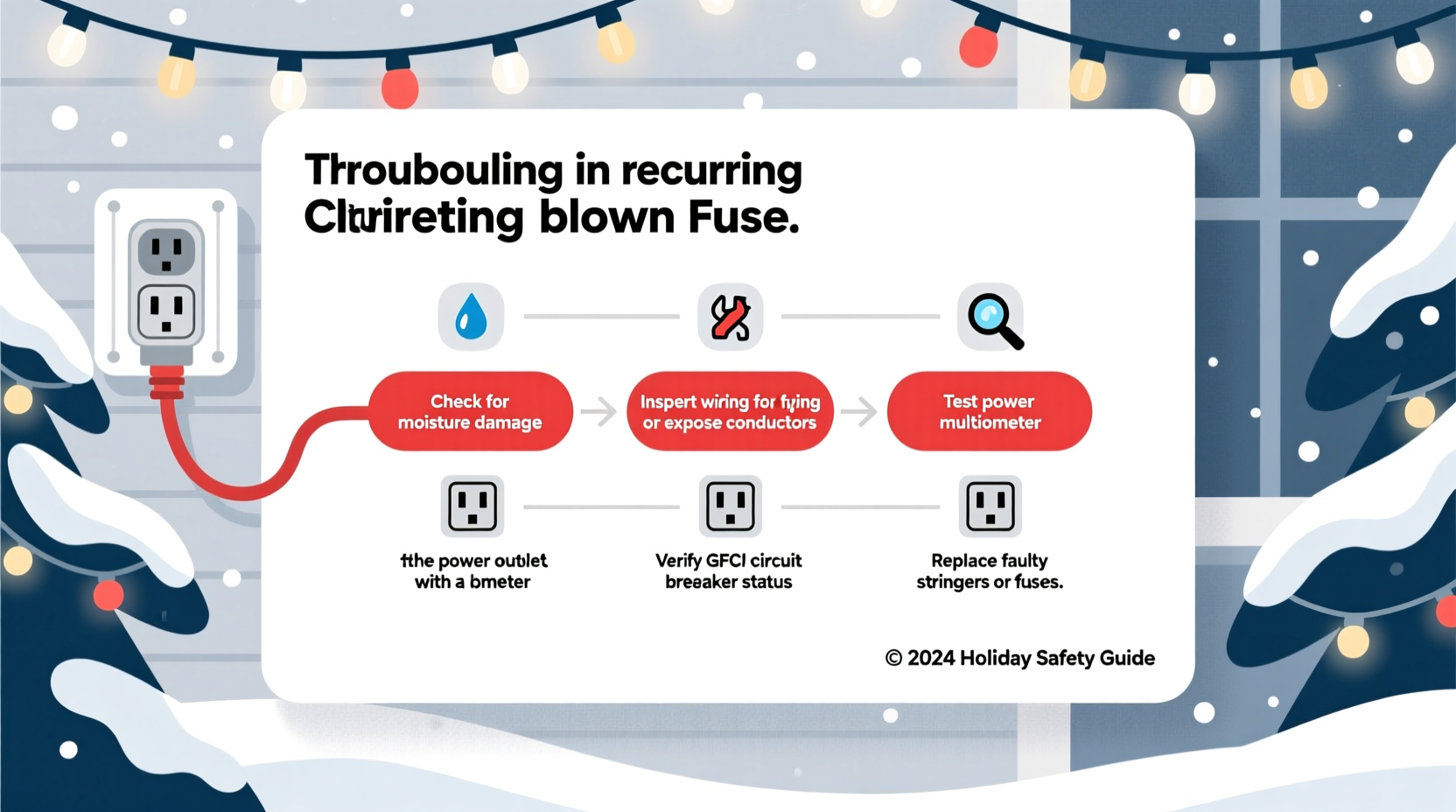
A fuse is a deliberate weak link—a calibrated safety device designed to melt and interrupt current when amperage exceeds its rated capacity. For most C7/C9 and mini-light strings, that’s 3–5 amps. When it blows repeatedly, the cause is rarely random. It’s either:
- Overload: Too many lights (or incompatible types) drawing more current than the circuit or fuse can handle;
- Short Circuit: A direct path between hot and neutral wires—often caused by damaged sockets, pinched cords, or water ingress;
- Ground Fault: Current leaking from hot wire to ground (e.g., via wet soil, metal gutters, or faulty insulation);
- Fuse Degradation: Corrosion, thermal cycling fatigue, or physical damage compromising the fuse’s integrity—even if it hasn’t blown yet;
- Power Supply Issues: Voltage spikes, unstable transformers, or shared circuits with high-draw appliances (like refrigerators or sump pumps).
Crucially, a fuse doesn’t “decide” to blow—it responds precisely to physics. If yours blows within seconds of plugging in, suspect a hard short. If it lasts 10–30 minutes before failing, overheating or intermittent grounding is more likely. Timing matters—and tells you where to look first.
Step-by-Step Diagnostic Sequence (Start Here)
Follow this sequence *in order*. Skipping steps leads to misdiagnosis and wasted time. Each test isolates variables using only a multimeter (set to continuity or resistance mode) and visual inspection.
- Unplug everything. Disconnect all light strings, extension cords, timers, and smart controllers. Turn off the outlet at the breaker.
- Inspect the fuse itself. Remove the fuse from the plug housing. Hold it up to light: look for visible discoloration, blackening, or a broken internal wire. Replace with an identical-rated fuse (e.g., 3A AGC glass) — never higher.
- Test for continuity at the plug. With multimeter in continuity mode, touch one probe to the brass (hot) prong and the other to the silver (neutral) prong *at the plug end only*. A loud beep means a dead short *in the cord or plug*—stop here and replace the entire string.
- Isolate the first string. Plug in *only one* light string directly into a known-good outdoor GFCI outlet. Wait 2 minutes. If the fuse blows, that string is faulty. If not, proceed.
- Add strings incrementally. Connect one additional string per test cycle. After each addition, wait 2 minutes. The moment the fuse blows, the *last added string* is the culprit—or the cumulative load has exceeded capacity.
- Check the outlet and circuit. Plug in a different high-wattage device (e.g., space heater on low) to verify the outlet holds steady. If it trips immediately, the issue is upstream: overloaded circuit, failing GFCI, or wiring fault.
Common Culprits & How to Identify Them
Most recurring fuse failures trace back to these five root causes. Each includes telltale signs and verification methods:
| Cause | Key Indicators | Verification Method |
|---|---|---|
| Water Intrusion | Blowing only after rain/snow; corrosion around sockets; milky plastic housings; fuse fails faster overnight | Use multimeter in resistance mode: place probes across socket contacts while gently squeezing bulb base. Readings below 10kΩ indicate moisture bridging. |
| Socket Damage | Loose, cracked, or discolored sockets; bulbs that wobble; strings that flicker near specific sections | Visually inspect every socket. Insert a bulb, then gently twist it 90° while observing for arcing or sparking inside the socket (do this with power OFF first, then test live only if safe). |
| Wire Insulation Failure | Visible nicks, abrasions, or UV-cracking on cord; strings mounted on metal gutters or sharp edges; fuse blows when wind moves lights | Run hands along entire cord length feeling for stiff, brittle, or tacky spots. Use a flashlight to check for exposed copper beneath cracked insulation. |
| Overloaded Daisy Chain | Fuse blows only when >3 strings connected; warm plug housing; dimming at far end of chain | Calculate total wattage: (Watts per string) × (number of strings). Compare to outlet rating (typically 1,800W max on 15A circuit). Subtract 20% for safety margin. |
| Faulty Controller/Timer | Fuse blows only when timer activates; works fine on manual override; erratic behavior during “fade” or “twinkle” modes | Bypass timer entirely. Plug strings directly into outlet. If fuse holds, timer’s internal relay or capacitor is failing. |
Real-World Case Study: The Gutters-That-Grounded
In December 2023, a homeowner in Portland, Oregon reported consistent fuse blowing across three different light sets—each working fine indoors but failing within 90 seconds outdoors. Initial assumption was “bad strings.” But a licensed electrician noticed all strings ran along aluminum gutters fastened to wooden fascia. Using a clamp meter, he measured 0.8A leakage current flowing from the light cord’s hot wire to the gutter—a classic ground fault. Investigation revealed that decades-old gutter screws had pierced the insulation of a buried section of cord where it passed behind the downspout. Rain had turned the aluminum gutter into an unintended conductor. The fix? Relocating the cord away from metal surfaces, sealing the puncture site with marine-grade heat-shrink tubing, and installing a dedicated GFCI-protected outlet (not shared with the garage door opener). No new strings were needed—just precise diagnosis.
“Repeated fuse failure is never ‘just lights.’ It’s electricity telling you there’s a breach in its intended path. Treat every blown fuse like a diagnostic data point—not a consumable.” — Carlos Mendez, NFPA-Certified Holiday Lighting Inspector and Lead Trainer at LightSafe Academy
Do’s and Don’ts: Critical Safety Practices
Outdoor lighting operates in harsh conditions. These practices prevent fuse failures *and* protect people and property:
- DO use only UL-listed, wet-location-rated light strings (look for “UL 588” and “For Outdoor Use Only” markings);
- DO calculate total load before connecting: Add watts of all strings, then ensure total ≤ 80% of circuit capacity (e.g., 1,440W max on 15A circuit);
- DO inspect every socket, cord, and plug for damage *before* installation—not just at the start of the season, but mid-season after wind or snow events;
- DO store strings coiled loosely—not wrapped tightly on spools—to prevent insulation stress fractures;
- DON’T connect LED and incandescent strings on the same circuit (voltage regulation mismatches cause surges);
- DON’T run cords under carpets, rugs, or snow piles (heat buildup + moisture = insulation breakdown);
- DON’T use indoor-rated extension cords outdoors—even “heavy-duty” ones lack UV-resistant jackets and moisture seals;
- DON’T ignore GFCI tripping. If your outdoor outlet trips *without* lights plugged in, call an electrician immediately—this indicates a ground fault in the wiring itself.
FAQ: Quick Answers to Urgent Questions
Can I replace a blown fuse with a higher-amp one to stop it from blowing?
No. Fuses are engineered to match the cord’s ampacity—the maximum current its wires can safely carry without overheating. A 5A fuse on a 3A-rated string allows 67% more current than the wires are designed for. This creates resistive heating, melting insulation, and dramatically increasing fire risk—especially in dry pine boughs or near vinyl siding. Always replace with the exact amperage and physical type (e.g., AGC 3A glass).
Why do LED lights still blow fuses if they use less power?
LED strings have lower *wattage*, but their electronics introduce complexity. Cheap LED drivers can fail catastrophically—shorting internally or generating voltage spikes during power-on. Also, mixing old and new LED strings on one circuit can cause incompatibility in rectification, leading to current surges. Always use LEDs from the same manufacturer and generation for daisy-chaining, and verify driver certifications (UL 1310 or UL 8750).
My fuse blows only at night—what’s causing that?
This points strongly to temperature-related failure. As ambient temperatures drop, brittle insulation contracts and cracks widen. Moisture trapped in sockets freezes, expands, and bridges contacts. Or, a failing component (like a capacitor in a controller) becomes unstable when cold. Test by running the string in a garage at 50°F vs. outside at 25°F—if it only fails cold, replace the string or controller. Do not rely on “it works during the day” as proof of safety.
Conclusion: Your Lights Should Shine—Not Spark
A blown fuse isn’t a minor holiday hiccup. It’s your electrical system’s emergency alert—indicating stress, degradation, or danger. By methodically diagnosing overload, shorts, moisture, and compatibility issues—not guessing—you transform frustration into control. You protect your home, your family, and your investment in quality lighting. Start tonight: unplug, inspect, measure, and isolate. Replace damaged sockets, recalculate your loads, and verify every connection against NEC guidelines. Don’t wait for the next storm or the next fuse to blow. Proactive care means brighter, safer, and longer-lasting displays—year after year.




 浙公网安备
33010002000092号
浙公网安备
33010002000092号 浙B2-20120091-4
Comments
No comments yet. Why don't you start the discussion?