
Since the release of iOS 17, many iPhone users have reported faster-than-usual battery drain. While the update brings new features like StandBy mode, improved autocorrect, and enhanced privacy tools, it has also introduced background inefficiencies that can sap battery life—especially on older devices. If your iPhone seems to lose charge within hours of a full charge, you're not alone. The good news is that most of these issues are fixable with targeted adjustments to settings, habits, and app behavior.
Battery degradation isn't always hardware-related. In fact, software updates often trigger increased background activity, location tracking, and push notifications that silently consume power. This article breaks down the most common causes of rapid battery drain in iOS 17 and provides actionable, real-world solutions to help you reclaim battery longevity.
Understanding iOS 17’s Impact on Battery Performance
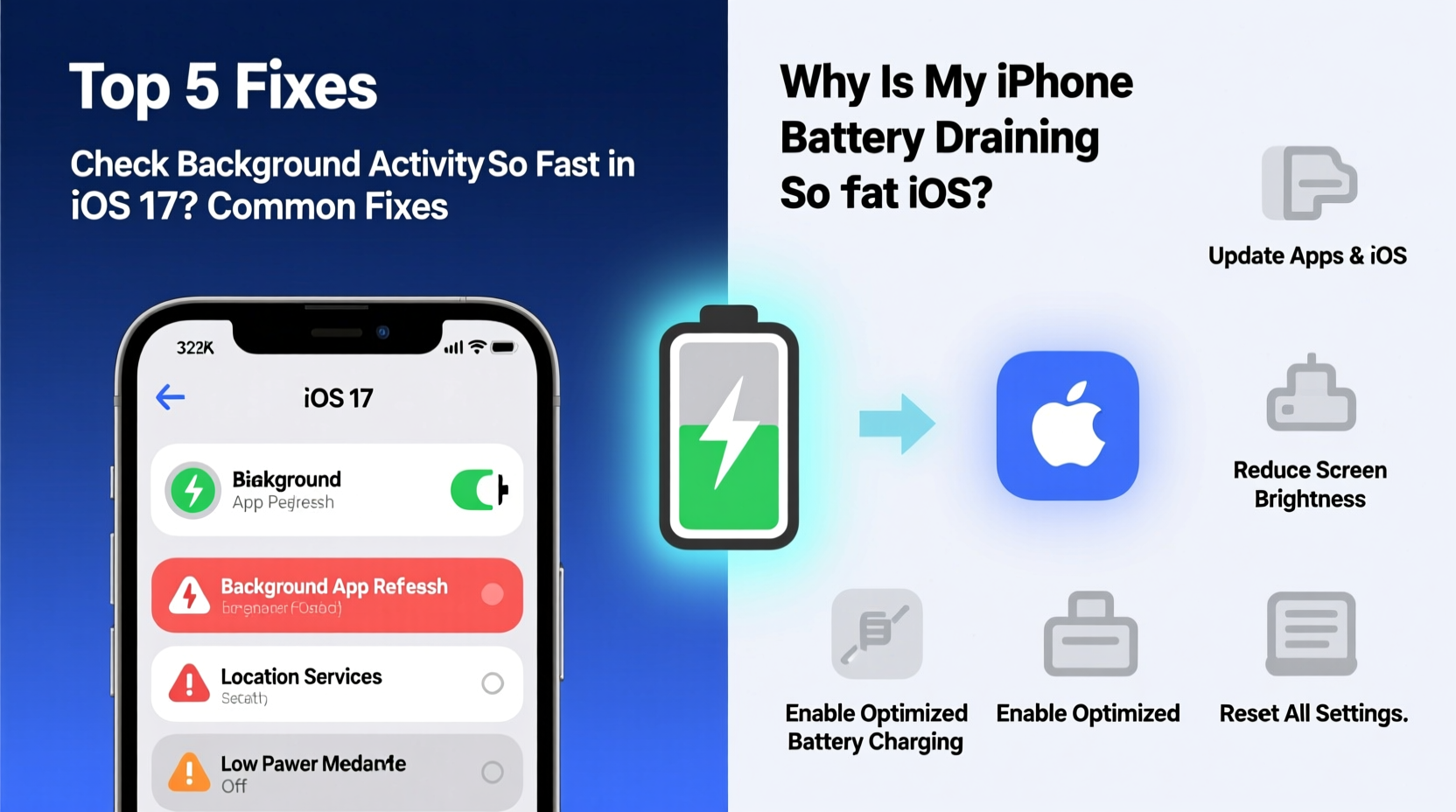
iOS 17 introduces several system-level changes that affect how your iPhone manages energy. Features like Live Voicemail, redesigned keyboard interactions, and enhanced background app refresh routines increase CPU usage. Additionally, Apple’s focus on real-time communication and cloud syncing means more processes run continuously—even when the screen is off.
One key factor is StandBy mode, which activates when your iPhone is charging and lying horizontally. While convenient for checking time or notifications, this feature keeps the display active intermittently, drawing power even during idle periods. Similarly, widgets on the Lock Screen and dynamic wallpapers contribute to higher screen-on time and GPU load.
According to telemetry data from Battery University, post-update battery complaints spike by an average of 30% across major iOS releases. As Joshua Kline, Senior Mobile Analyst at TechInsight Group explains:
“Every major iOS update recalibrates background task scheduling. It takes a few weeks for the system to optimize itself based on user patterns. During this adaptation phase, battery drain is common—but not permanent.” — Joshua Kline, Senior Mobile Analyst, TechInsight Group
Common Causes of Rapid Battery Drain in iOS 17
Before jumping into fixes, it's important to identify what's actually consuming your battery. iOS 17 includes detailed battery usage analytics, but interpreting them correctly matters. Below are the top culprits behind excessive drain:
- Background App Refresh: Apps like social media, email, and navigation tools constantly sync data in the background.
- Location Services: Over-permissioned apps (e.g., weather, fitness trackers) frequently access GPS, draining power quickly.
- Push Notifications: High-frequency alerts keep radios active, increasing cellular and Wi-Fi usage.
- Screen Brightness & Timeout: Auto-brightness may overcompensate, and longer auto-lock times keep the display lit unnecessarily.
- StandBy Mode: Enabled by default when charging, it uses OLED pixels and sensors even overnight.
- Software Bugs: Early versions of iOS 17 had known bugs affecting Bluetooth connectivity and background fetch cycles.
Step-by-Step Guide to Fix Battery Drain in iOS 17
Follow this structured approach to systematically reduce unnecessary power consumption. These steps apply to all iPhone models running iOS 17, though results vary depending on device age and usage patterns.
- Review Battery Usage by App
Go to Settings > Battery and examine which apps are consuming the most power. Focus on two metrics: “Battery Usage” and “Background Activity.” If an app uses significant power while you weren’t actively using it (e.g., Facebook running in the background for 3 hours), restrict its permissions. - Disable Background App Refresh for Non-Essential Apps
Navigate to Settings > General > Background App Refresh. Turn it off globally or selectively disable it for apps like TikTok, Instagram, or games. This prevents apps from downloading content when not in use. - Limit Location Access
Open Settings > Privacy & Security > Location Services. For each app, choose “While Using” instead of “Always.” Disable location access entirely for apps that don’t require it (e.g., calculators, note-taking tools). - Turn Off Push Email and Reduce Fetch Frequency
Go to Settings > Mail > Accounts > Fetch New Data. Switch from “Push” to “Fetch” and set intervals to “Hourly” or “Manually.” This reduces constant server polling. - Disable StandBy Mode
Settings > StandBy > toggle off. This stops your iPhone from waking up when charging face-up, saving considerable power overnight. - Reduce Motion and Visual Effects
Enable Reduce Motion (Settings > Accessibility > Motion) and turn on Reduce Transparency (Settings > Accessibility > Display & Text Size). These decrease GPU workload, especially on iPhone 12 and earlier models. - Update All Apps
Developers released compatibility patches shortly after iOS 17 launched. Outdated apps may run inefficient code, causing crashes and high CPU usage. Update via the App Store. - Restart Your iPhone Weekly
A simple reboot clears cached processes and resets network connections. Long-running sessions can lead to memory leaks, particularly in messaging apps.
Tips and Best Practices for Long-Term Battery Health
Maintaining battery efficiency requires ongoing attention. Here are essential habits to adopt:
| Do | Avoid |
|---|---|
| Charge between 20% and 80% regularly | Letting battery drop to 0% frequently |
| Use optimized charging (Settings > Battery) | Leaving phone plugged in overnight without optimization |
| Keep iOS updated to latest patch (e.g., 17.5+) | Staying on early versions with known bugs |
| Enable Low Power Mode during heavy usage days | Disabling Low Power Mode permanently due to minor slowdowns |
| Store iPhone in cool environments (below 32°C/90°F) | Leaving phone in hot cars or direct sunlight |
Mini Case Study: Sarah’s iPhone 13 Battery Recovery
Sarah, a freelance photographer in Portland, noticed her iPhone 13 would die by mid-afternoon after updating to iOS 17. She relied heavily on Maps, Lightroom, and WhatsApp for client coordination. Initially, she assumed the battery was failing and considered a $99 replacement.
Instead, she followed the step-by-step guide above. She discovered that Adobe Lightroom was using 40% of her battery in the background due to automatic cloud syncs. She changed its background refresh setting to “Wi-Fi Only” and disabled location access. She also turned off StandBy mode, which she didn’t use, and reduced email fetch frequency.
Within two days, her battery lasted nearly 30% longer. After a month, she extended daily usage from 5 hours to over 7 hours of screen time without needing a recharge. No hardware repair was necessary.
Checklist: Quick Battery Optimization Routine
Perform this checklist monthly—or immediately if you notice sudden battery drops:
- ✅ Check battery usage stats for rogue apps
- ✅ Disable Background App Refresh for non-critical apps
- ✅ Set location access to “While Using” or “Never” where appropriate
- ✅ Turn off StandBy mode
- ✅ Enable Optimized Battery Charging
- ✅ Update all apps and install latest iOS patches
- ✅ Restart your iPhone
- ✅ Lower screen brightness and set auto-lock to 30 seconds
- ✅ Disable Raise to Wake (Settings > Display & Brightness) if not needed
- ✅ Use Dark Mode with black backgrounds (especially on OLED models)
Frequently Asked Questions
Does iOS 17 slow down older iPhones?
Not intentionally. However, newer operating systems demand more from hardware. iPhones older than the iPhone XR may experience reduced performance and faster battery drain due to processor limitations and aging batteries. Apple does not throttle performance unless the battery is significantly degraded, which can be checked in Settings > Battery > Battery Health.
Is it safe to use third-party battery-saving apps?
No. Apple restricts access to core power management systems, meaning third-party \"battery saver\" apps cannot actually improve battery life. Many such apps are misleading and may collect personal data. Rely only on built-in iOS settings for optimization.
Why does my battery drain overnight even when I’m not using it?
This usually indicates background activity from apps syncing data, location tracking, or push notifications. Common offenders include messaging apps, cloud backup services, and fitness trackers. To test, enable Airplane Mode before sleeping. If battery remains stable, the issue is network-related. Gradually re-enable services to isolate the culprit.
Conclusion: Take Control of Your iPhone’s Battery Life
Rapid battery drain in iOS 17 is a widespread but solvable issue. While software updates inevitably introduce temporary inefficiencies, the tools to correct them are already on your device. By auditing app behavior, adjusting system settings, and adopting smarter charging habits, you can restore—and often exceed—your previous battery performance.
The key is consistency. Just as you wouldn’t expect a car to run efficiently without maintenance, your iPhone needs regular tuning. Don’t rush to replace the battery unless diagnostics confirm hardware failure. In most cases, a few strategic tweaks make a dramatic difference.




 浙公网安备
33010002000092号
浙公网安备
33010002000092号 浙B2-20120091-4
Comments
No comments yet. Why don't you start the discussion?