
Many people notice something unsettling when they look at themselves in photos: their face appears lopsided, uneven, or simply \"off.\" Features seem misaligned—eyes at different heights, one side of the mouth higher than the other, or a nose that looks crooked. Yet, when you glance in the mirror, everything seems balanced. This discrepancy isn’t a flaw in your appearance; it’s a product of how light, perspective, and human perception interact. The truth is, no one has a perfectly symmetrical face—and cameras reveal this more clearly than mirrors do. Understanding why this happens involves diving into optics, psychology, and even neuroscience.
The Myth of Facial Symmetry
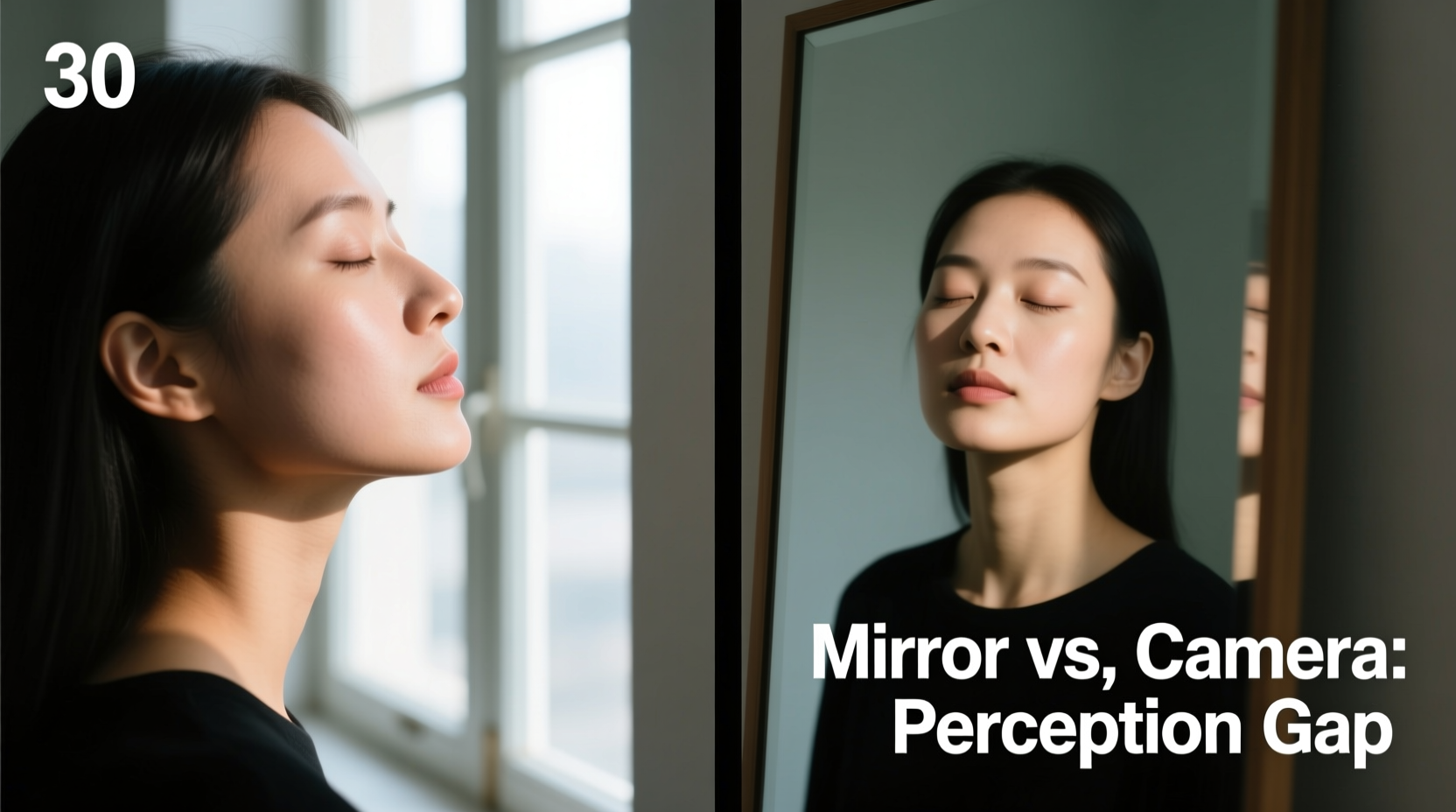
Symmetry is often associated with beauty and health. Studies have shown that people tend to find symmetrical faces more attractive, possibly because symmetry suggests genetic fitness and developmental stability. However, true facial symmetry is virtually nonexistent. Everyone’s face is slightly asymmetrical—some more than others. These differences are usually subtle and go unnoticed in daily interactions due to the brain’s ability to normalize what we see.
What changes in photographs is not your face, but the way it's captured and interpreted. A camera records a static, two-dimensional image from a single angle, freezing every nuance without the dynamic context our brains use to make sense of movement and depth. In contrast, when you look in the mirror, you're seeing a live, reversed version of yourself, which feels familiar—even if it’s not accurate.
Camera Angles and Perspective Distortion
One of the most powerful factors influencing how your face appears in photos is the shooting angle. Even small shifts in camera position can dramatically alter facial proportions due to perspective distortion—a phenomenon where closer objects appear larger relative to those farther away.
For example, holding a phone too close to your face (as in selfies) exaggerates features nearest to the lens: the nose may appear disproportionately large, while ears seem smaller and set further back. This effect also accentuates any natural asymmetries. If one cheekbone sits slightly higher, tilting your head even five degrees can make that side dominate the frame.
Professional photographers often shoot from eye level or slightly above using longer focal lengths to minimize distortion. Phone cameras, on the other hand, typically use wide-angle lenses that magnify imperfections when used up close. The result? A photo that looks nothing like the balanced reflection you're used to.
How Distance Affects Perception
A key study conducted by researchers at the University of California demonstrated that self-perceived attractiveness drops significantly when viewing close-up photos versus images taken from a distance. Participants rated themselves as less attractive in selfies taken at arm’s length compared to portraits shot from five feet away—even though the subject was the same. The reason? Proximity amplifies asymmetry through lens distortion.
“People don’t realize how much camera distance affects their appearance. A 12-inch gap can distort facial geometry just like a funhouse mirror.” — Dr. Sarah Kim, Visual Perception Researcher, Stanford University
Mirror vs. Camera: The Reversal Effect
Another critical factor is the reversal of image. When you look in a mirror, you see a flipped version of your face—one that you’ve grown accustomed to over decades. But most photos (unless edited) show your true orientation, not the mirrored one. This means your parting, smile tilt, or dominant eye might appear on the “wrong” side, creating a sense of unfamiliarity.
This phenomenon is known as the mere-exposure effect: we prefer images we see more frequently. Since you see your mirrored reflection daily, that version feels right. When confronted with the non-mirrored photo, your brain registers it as strange—even if it’s objectively more accurate.
To test this, try flipping a selfie horizontally. Many people report that the flipped version suddenly looks more “like me,” confirming that familiarity, not accuracy, drives comfort.
Do Mirrors Lie?
In a way, yes—but only by omission. Mirrors provide real-time feedback, but they don’t show the world how you look. Friends and family see the non-reversed version of your face all the time. So while the photo may feel jarring to you, it’s actually closer to how others perceive you.
| Mirror View | Photo View |
|---|---|
| Reversed (flipped left-right) | True orientation (as seen by others) |
| Familiar due to daily exposure | Unfamiliar but accurate |
| No lens distortion (if full-length) | Distortion possible based on lens and distance |
| Dynamic, contextual view | Static, flat representation |
Lighting and Shadow: Amplifying Asymmetry
Light plays a crucial role in shaping how facial structure is perceived. Uneven lighting can cast shadows that emphasize one side of the face while minimizing the other, making natural asymmetries more pronounced. For instance, soft frontal lighting tends to flatten features and reduce contrast, creating a balanced look. In contrast, side lighting highlights contours—great for drama, but potentially unflattering if one side of your face protrudes slightly more.
Consider this scenario: You take two photos in the same location—one in the morning with sunlight coming from the left, another in the afternoon with light from the right. Despite identical expressions, the photos may look like different versions of you. One side appears fuller, the jawline sharper, or the eyes deeper set—all due to directional light enhancing structural differences.
Real Example: The Social Media Influencer’s Dilemma
Jessica, a lifestyle content creator with over 100k followers, began receiving comments about her “crooked smile” in recent posts. Confused, she checked old videos and mirror selfies—her smile looked even. After consulting a media photographer, she discovered the issue wasn’t her face, but her setup. She had recently switched to a new smartphone with an ultra-wide front camera and was taking selfies from just 8 inches away. The combination of proximity and lens type exaggerated the natural 3-degree tilt in her smile, making one side appear delayed. By stepping back to 18 inches and using portrait mode, the asymmetry became imperceptible.
Neurological Factors: How Your Brain Skews Reality
Human vision isn’t passive recording—it’s active interpretation. The brain constantly fills in gaps, smooths edges, and adjusts for motion. When you interact with someone face-to-face, your visual system processes multiple angles, micro-expressions, and lighting changes over time. This dynamic input allows your brain to construct a stable, averaged perception of a person’s face.
Photos disrupt this process. They present a single moment, devoid of context. Without motion or depth cues, minor irregularities become focal points. Moreover, we tend to scrutinize photos far more critically than real-life reflections. Where a mirror glance lasts seconds, a photo can be studied for minutes, inviting comparison and self-critique.
Functional MRI studies have shown that the fusiform face area—the part of the brain responsible for facial recognition—responds differently to mirrored versus non-mirrored images. Familiar configurations trigger stronger positive responses, reinforcing discomfort with unaccustomed views.
Checklist: Minimizing Perceived Asymmetry in Photos
- Shoot from at least 12–18 inches away (avoid extreme close-ups)
- Use a rear camera instead of front-facing when possible (higher quality, less distortion)
- Position light source directly in front or slightly above
- Avoid strong side lighting unless aiming for artistic effect
- Hold the camera at eye level to prevent unflattering angles
- Take multiple shots from slightly varied positions to find the most balanced view
- Review photos on a larger screen, not just your phone’s small display
FAQ: Common Questions About Facial Asymmetry in Photos
Is my face really that asymmetrical, or is it just the camera?
All faces are asymmetrical to some degree—often more than we realize. Cameras don’t create asymmetry; they reveal it. Lens choice, distance, and lighting determine how noticeable it appears. What feels extreme in a photo is usually within the normal range of human variation.
Why do I look better in videos than in still photos?
Video captures motion, expression changes, and multiple angles, allowing your brain to form a holistic impression. Still photos freeze a single moment, often highlighting transient imbalances—like one eye blinking slower or a fleeting muscle twitch—that disappear in motion.
Can facial asymmetry indicate a medical problem?
Minor asymmetry is normal. However, sudden changes—such as drooping on one side, uneven pupil response, or difficulty moving facial muscles—should be evaluated by a healthcare provider. Conditions like Bell’s palsy, stroke, or TMJ disorders can cause noticeable shifts in symmetry.
Step-by-Step Guide to Capturing a Balanced Self-Portrait
- Choose the right environment: Find a space with soft, natural light—ideally near a window with indirect sunlight.
- Select your device: Use the rear camera of your phone or a dedicated camera for better optics.
- Set distance: Stand at least 1.5 feet away. Use a tripod or rest your arms on a surface to stabilize.
- Align the angle: Position the camera at eye level. Tilt it down slightly if needed, but avoid extreme low or high angles.
- Frame your face: Center your face in the viewfinder, ensuring equal space on both sides.
- Adjust posture: Sit or stand straight. Relax your shoulders and jaw to avoid tension-induced asymmetry.
- Take multiple shots: Capture several images with slight head turns (neutral, 15° left, 15° right) to compare results.
- Review objectively: Wait a few hours before reviewing. Compare under neutral lighting to avoid bias from screen color temperature.
Conclusion: Embracing Realistic Self-Perception
The gap between how you look in photos and how you see yourself in the mirror isn’t a flaw—it’s a lesson in perception. Cameras capture reality with mechanical precision, while mirrors offer a familiar illusion shaped by habit. Recognizing that asymmetry is universal helps shift focus from self-criticism to self-acceptance. Instead of chasing impossible symmetry, aim for authenticity. The most compelling images aren’t those that hide imperfections, but those that reflect genuine presence.




 浙公网安备
33010002000092号
浙公网安备
33010002000092号 浙B2-20120091-4
Comments
No comments yet. Why don't you start the discussion?